
Removing coatings from concrete is not a one-method job. Epoxy, paint, sealers, adhesives, thinset, and weathered overlays all behave differently, and the best removal method depends on coating thickness, bond strength, substrate condition, dust control requirements, and the finish profile needed after removal.
This guide compares five advanced methods commonly used by contractors and facility crews: diamond grinding, bush hammer texturing, shot blasting, abrasive blasting, and chemical stripping. The goal is not to claim one method is always best. It is to help choose the safest and most realistic method for the surface in front of you.
1. Diamond grinding and milling
Diamond grinding or milling is one of the most controlled ways to remove coatings from concrete. It is often used for epoxy, paint, glue residue, traffic coating, and thin surface buildup where the contractor needs both removal and leveling.
Diamond tools are useful when:
- The coating is bonded tightly but not extremely thick.
- The floor must remain relatively flat after removal.
- Dust can be controlled with a shroud and HEPA extraction.
- The next step requires a predictable concrete surface profile.
The main advantage is control. A trained operator can adjust speed, tooling, pass depth, and overlap to avoid gouging the slab. The limitation is that soft or gummy coatings can load the tool, so cleaning passes and correct bond selection matter.
2. Bush hammer texturing
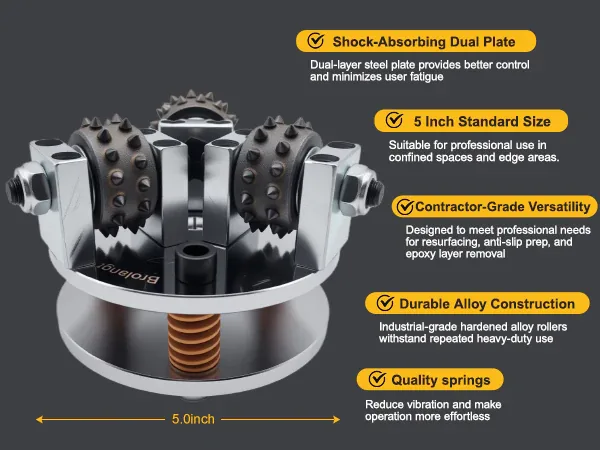
Bush hammer tools do not simply scrape a coating away. They impact the surface and create a textured concrete profile. This can be useful when the project needs aggressive mechanical keying for a new coating, overlay, anti-slip finish, or repair mortar.
Bush hammering is useful when:
- The surface needs more texture than ordinary grinding provides.
- Old coating removal and surface profiling are part of the same job.
- A CSP 3 to CSP 5 style texture is desired.
- The area includes ramps, walkways, steps, or other surfaces where grip matters.
The tradeoff is that bush hammering changes the surface texture. That is good when a rough profile is wanted, but it is not the right choice if the final surface must remain smooth without follow-up grinding.
3. Shot blasting
Shot blasting uses steel shot thrown at high speed to clean and profile concrete. It is a common commercial method for larger open floors, especially where consistent profiling is more important than fine detail work.
Shot blasting is useful when:
- The area is large and open.
- A consistent profile is required before industrial coating.
- The contractor has proper containment and dust collection.
- Edges and tight corners can be handled separately.
Shot blasting is productive, but it requires specialized equipment and operator experience. It also may not be ideal for small repair areas, irregular edges, or spaces where noise and containment are major constraints.
4. Abrasive blasting
Abrasive blasting includes sand, garnet, or other blasting media. It can remove softer coatings and feather edges, and it is sometimes used on vertical or irregular surfaces where floor grinding equipment is not practical.
It is useful when:
- The surface shape makes grinding difficult.
- A coating needs to be abraded rather than deeply milled.
- Proper containment, PPE, and cleanup are available.
The caution is dust and substrate damage. Excessive pressure or the wrong media can scar weak concrete, expose aggregate unevenly, or create a cleanup burden that is larger than the removal job itself.
5. Chemical stripping
Chemical strippers can soften certain paints, sealers, adhesives, and thin coatings. They may be practical in detail areas or when mechanical dust must be minimized.
Chemical stripping is useful when:
- The coating type is compatible with the stripper.
- Ventilation and PPE can be controlled.
- Waste collection is planned before work starts.
- Mechanical follow-up is available to remove residue.
Chemical stripping is rarely a complete surface preparation solution by itself. Residue, moisture, and softened coating material must be removed before a new coating system can bond reliably.
How to choose the right method
Start with the final requirement, not the tool. If the next coating needs a rough mechanical profile, grinding alone may be too smooth and bush hammering or blasting may be better. If the goal is flatness and controlled removal, diamond grinding or milling often makes more sense. If the surface is large and open, shot blasting may be efficient. If the coating is thin but difficult to access mechanically, chemical stripping can support the workflow.
A practical decision path:
- For flat floors with epoxy or paint: consider diamond grinding or milling first.
- For anti-slip texture or strong mechanical keying: consider bush hammering.
- For large industrial slabs: compare shot blasting with diamond grinding.
- For edges, details, or sensitive dust conditions: evaluate chemical stripping plus mechanical cleanup.
- For weak concrete: test a small area before committing to aggressive impact methods.
Safety and surface preparation notes
Coating removal can create silica dust, coating debris, chemical waste, and noise. Use appropriate respiratory protection, eye protection, hearing protection, and dust extraction. If the coating may contain lead, asbestos, or other hazardous material, stop and use a qualified testing and remediation process before grinding or blasting.
For most coating projects, the removal step should end with inspection. Check that the old coating is removed, the concrete is sound, dust is controlled, and the surface profile matches the coating manufacturer's requirement.
Conclusion
Diamond tools, bush hammer plates, shot blasting, abrasive blasting, and chemical stripping each have a place in concrete coating removal. The best method is the one that removes the old material, leaves the right surface profile, and fits the site's safety and cleanup limits.
For Brolangt users working on concrete texture, coating removal, or anti-slip preparation, the 5-inch bush hammer plate is most relevant when the goal includes mechanical profile and surface grip rather than a smooth polished finish.