
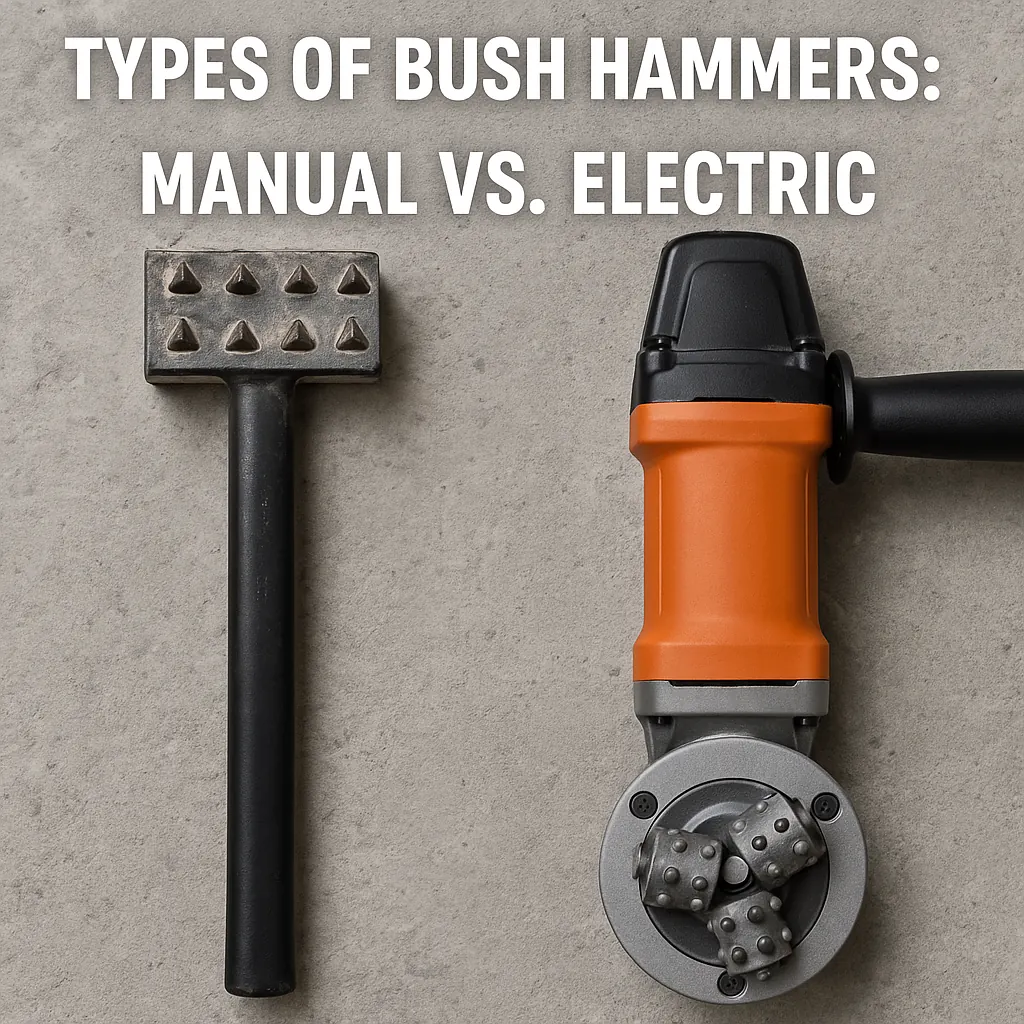
Bush hammers are essential tools for texturizing and prepping concrete, stone, and other hard surfaces. But not all bush hammers are created equal. In this article, we explore the two main categories of bush hammers—manual and electric—and help you determine which tool best suits your application.
What Is a Bush Hammer?
A bush hammer is a surface treatment tool equipped with a series of pointed or pyramid-shaped carbide tips that impact the material to create a rough, anti-slip texture. If you're new to bush hammers, start with our overview article: What Is a Bush Hammer and What Is It Used For?
Manual Bush Hammers
Manual bush hammers are hand-held tools typically constructed from hardened steel with replaceable or integrated carbide tips. These tools are widely used in:
- Stone carving and artistic applications
- Smaller-scale concrete patching or surface prep
- On-site texture adjustments without power tools
Advantages
- Low cost and no power source required
- High precision for localized work
- Ideal for small-scale or detail-intensive projects
Limitations
- Low productivity – not suitable for large areas
- Requires significant manual labor
- Inconsistent depth if not used skillfully
Electric (or Machine-Mounted) Bush Hammers
Electric bush hammers are mounted on floor grinders, angle grinders, or CNC machines. They use rotating bush hammer plates or rollers to uniformly texture concrete surfaces. Applications include:
- Coating removal (paint, epoxy, glue, etc.)
- Surface preparation before polishing or overlays
- Anti-slip treatment for public spaces and roadways
For a deeper look into coating removal, check out: 5 Advanced Methods for Removing Coatings from Concrete
Advantages
- High efficiency – can cover hundreds of square meters per day
- Uniform texture and depth
- Compatible with various machines: floor grinders, bridge saws, CNC
Limitations
- Requires compatible machinery and power supply
- Higher upfront cost
- Less precise for tight spots or corners
How to Choose the Right Bush Hammer Type
The choice depends on your surface area, texture needs, mobility, and budget. Here’s a quick guideline:
| Factor | Manual Bush Hammer | Electric Bush Hammer |
|---|---|---|
| Surface Area | Small/medium | Large-scale |
| Precision Work | Excellent | Moderate |
| Efficiency | Low | High |
| Initial Cost | Low | High |
Want to learn how to use bush hammers effectively? Read: How to Use a Bush Hammer on Concrete Floors
Conclusion
Both manual and electric bush hammers have unique advantages depending on the scope and type of your work. For occasional, detailed texturing, a manual tool may suffice. But for professionals handling large projects, electric bush hammers offer unmatched productivity.