
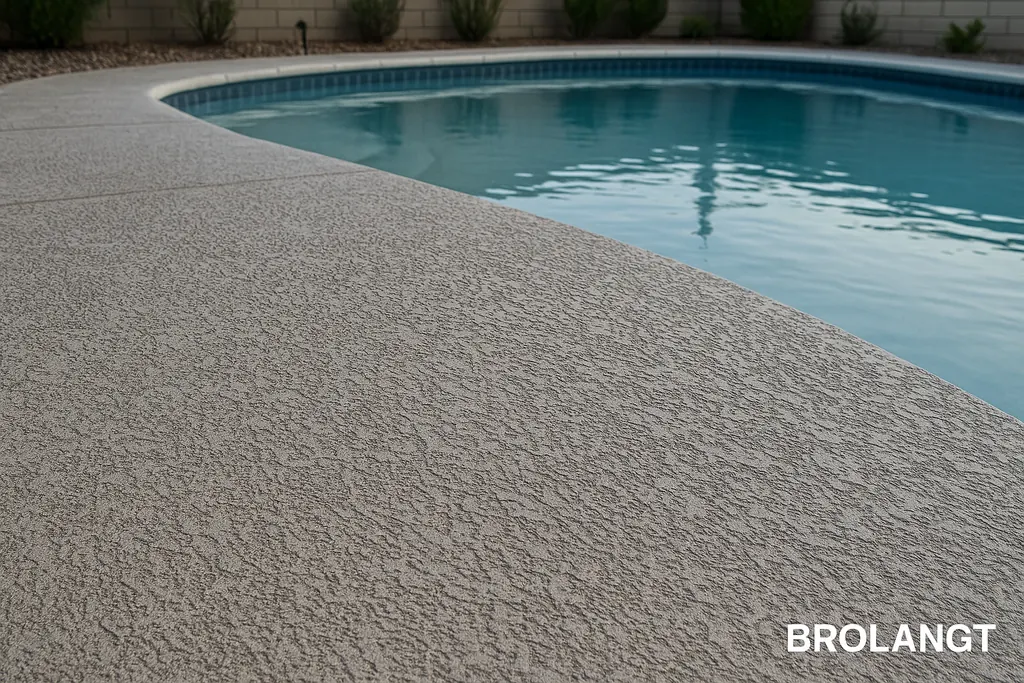
Pool decks are one of the most enjoyable areas of a home or recreational space, but they also present safety challenges. Slippery surfaces caused by water, algae, or worn finishes can lead to dangerous accidents. While premium solutions like resurfacing with high-grade stone or installing specialty tiles exist, many homeowners and facility managers ask: What are the most cost-effective ways to add traction to a pool deck without compromising safety? This article explores professional yet budget-friendly methods, backed by industry standards and real-world examples, to make pool decks safer for everyone.
Background: Why Pool Decks Become Slippery
Concrete and stone pool decks naturally lose their friction over time due to wear, chemical exposure, and water saturation. According to ASTM slip-resistance guidelines, surfaces around wet areas should maintain a coefficient of friction (COF) above 0.6 for pedestrian safety. Unfortunately, many untreated decks fall below 0.4 after a few years of use. This highlights the need for low-cost, practical anti-slip interventions.
Key Factors Contributing to Slipperiness
- Water accumulation – Standing water drastically reduces traction.
- Surface wear – Smooth concrete loses its microtexture after years of use.
- Algae and biofilm – Organic growth creates invisible hazards.
- Chemical erosion – Pool chlorine and salts break down surface roughness.
Professional Methods That Are Still Budget-Friendly
1. Anti-Slip Coatings and Sealers
Textured coatings or non-slip sealers are among the cheapest ways to improve traction. These products, which cost $0.80–$1.50 per square foot, can be rolled onto existing surfaces. Adding silica sand or polymer grit enhances performance. However, coatings typically last 1–3 years before reapplication is required.
2. Rubber Mats and Traction Strips
In high-risk zones (e.g., diving boards, entry steps), rubberized mats or adhesive traction strips provide localized slip resistance. While not a full-deck solution, they reduce accidents at specific points for as little as $50–$100 per area.
3. Mechanical Surface Texturing with Bush Hammer Tools
Mechanical treatment is a cost-effective, long-term solution. Brolangt 6-inch Bush Hammer Tool or the 5-inch Bush Hammer Plate can be attached to grinders to roughen surfaces. This process creates a CSP 4–5 profile, restoring grip and meeting slip-resistance standards. Initial tool cost is higher, but one tool can treat hundreds of square feet, making it budget-friendly long term.
For larger jobs, rotary hammer attachments like the SDS Max Bush Hammer and SDS Plus Bush Hammer are suitable for concrete prep and restoration at scale.
Correct Practices vs Common Mistakes
| Correct Practice | Common Mistake |
|---|---|
| Applying anti-slip coating with silica grit evenly across the deck | Using a smooth sealer that increases slipperiness when wet |
| Using bush hammer tools to create a CSP 4–5 profile | Pressure washing only, which removes dirt but not surface smoothness |
| Targeting high-risk areas with mats | Covering entire decks with loose rugs that trap water |
Case Study: North American Stone Facility
At a stone fabrication plant in Illinois, managers faced frequent worker slips around the wet saw area. Instead of resurfacing the entire 1,500 sq. ft. floor, they opted for a bush hammer texturing process. Using a Brolangt SDS Max tool, they achieved a CSP 5 profile in two days at less than $0.60 per square foot. Worker slip incidents dropped by 70% over the next six months, validating the cost-effectiveness of mechanical traction enhancement.
Misconceptions and Pitfalls
- Myth: Chlorine-resistant sealers add traction. In reality, many are smooth finishes meant for chemical resistance, not slip safety.
- Myth: Pressure washing restores grip. It only removes dirt; it does not recreate surface texture.
- Myth: All bush hammers are the same. Quality tools like Brolangt’s carbide-tipped hammers ensure durability and consistent results, unlike cheap imitations.
Industry Data and Standards
According to Statista, pool-related injuries in the U.S. exceed 155,000 cases annually, with over 70% linked to slips and falls. The ISO 13036 standard for slip-resistance testing emphasizes measurable surface profiling (CSP levels), reinforcing the need for technical solutions rather than cosmetic ones.
Practical Recommendations
- Start with a slip-resistance test (COF measurement) to establish a baseline.
- For immediate, low-cost fixes, use non-slip coatings in small batches.
- For long-term improvement, invest in bush hammer tools for mechanical profiling.
- Maintain surfaces regularly with cleaning and re-application to ensure lasting safety.