
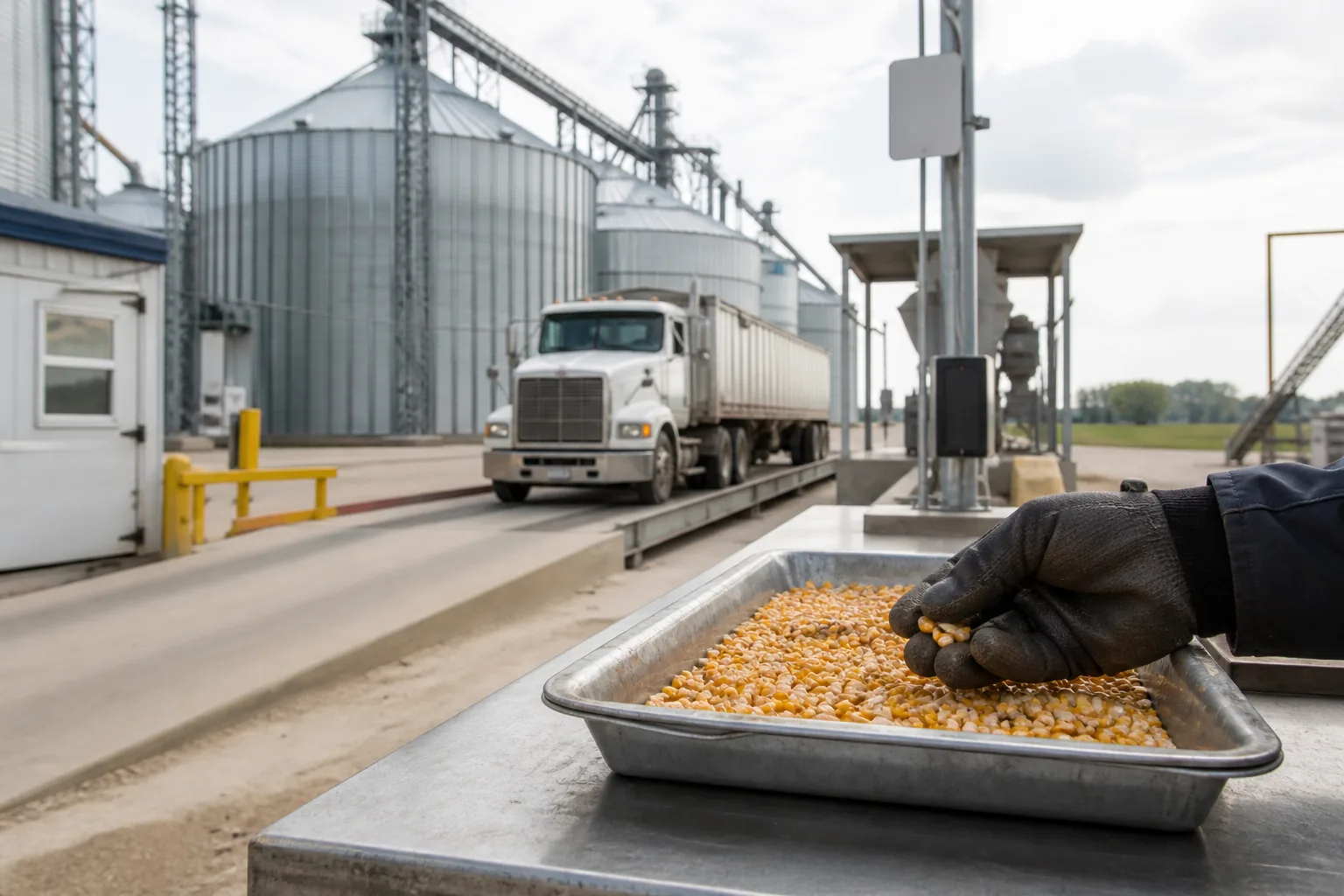
Many corn buyers begin moisture-related charges above 15.0% or 15.5%, but there is no single national elevator threshold. Your actual starting point is the base moisture stated in the buyer's current bid, discount schedule, delivery contract, or scale policy. One location may charge for every tenth above 15.0%, another may use half-point brackets above 15.5%, and a third may apply a different schedule under a forward contract.
Call the receiving location before the first load leaves the farm. Ask not only, “What moisture do you dock at?” but also how the buyer calculates drying charges, shrink, price discounts, rounding, averaging, and maximum acceptable moisture. A one-line answer such as “we start at 15” is not enough to predict the settlement.
The Quick Answer: Find These Eight Terms
| Item to confirm | What it controls | Exact question to ask |
|---|---|---|
| Base moisture | The point above which moisture treatment begins | “What is the moisture basis for this contract and delivery location?” |
| Drying charge | A cash fee, often based on wet bushels and points removed | “What is the drying fee, and is it charged per tenth, half point, or whole point?” |
| Moisture shrink | The reduction from delivered weight to credited dry weight | “What shrink factor and target moisture do you use?” |
| Price discount | A reduction in cents per bushel or a percentage of price | “Is there a moisture price discount in addition to drying and shrink?” |
| Maximum receiving moisture | The level the buyer will not accept, or will accept only by arrangement | “What is the maximum moisture you can receive today?” |
| Rounding rule | How a reading such as 17.2% becomes billable points | “Do you use the measured tenth, round normally, or round up to a bracket?” |
| Averaging rule | Whether loads stand alone or can be combined | “Is moisture settled load by load, by contract average, or by another method?” |
| Recheck policy | What happens when a result is close to a threshold or disputed | “Can a load be retested, and what sample or result controls settlement?” |
Get the answers in writing when possible. A posted schedule, contract attachment, email, or dated photograph of the receiving terms is much more useful than a remembered phone conversation after harvest.
“Dockage” Can Mean Several Different Deductions
Producers often use dockage as a general word for any reduction on a grain ticket. In grain inspection terminology, however, dockage can have a narrower technical meaning for certain grains. For corn delivered to a commercial buyer, the moisture-related lines are more accurately described as drying charge, moisture shrink, or moisture discount.
These are not interchangeable:
- A drying charge pays for removing water and operating the receiving facility's dryer.
- Moisture shrink reduces the weight or bushels credited because wet grain contains water that will not remain after drying.
- A moisture price discount reduces the price paid for each credited or delivered bushel, depending on the contract.
- A rejection limit determines whether the buyer will receive the load at all.
A buyer may use only one of these mechanisms or a combination. For example, the settlement may include both a drying fee and 1.4% shrink per moisture point. Another buyer may replace both with a percentage price discount. Never compare two bids until you know which deductions each one includes.
Why There Is No Universal USDA Moisture Dock
USDA's Federal Grain Inspection Service provides standardized inspection procedures, approved equipment, and official certificates. USDA states that moisture affects grain value and storability, and its official system reports moisture as an important quality characteristic. That does not create a nationwide commercial discount schedule for local elevator deliveries.
The distinction matters:
1. USDA procedures describe how an official result is produced and reported. 2. The buyer's contract describes how that result affects payment or acceptance.
A specific end user, processor, feed mill, export program, or government purchase contract may impose its own moisture maximum. That contractual number should not be presented as the standard for every elevator. Even two locations owned by the same company can have different receiving limits when dryer capacity, storage space, or end-use requirements differ.
This is also why “No. 2 corn means 15.5% moisture” is an unsafe shortcut. Moisture is important information, but the commercial moisture basis and the U.S. numerical grade are not the same decision. Read the actual discount schedule rather than inferring payment terms from the grade name.
How a Typical Moisture Schedule Works
Assume a buyer uses a 15.0% base. A load tests 17.2%. Before rounding, it is 2.2 moisture points above the basis:
17.2% − 15.0% = 2.2 points
What happens next depends on the written schedule:
- A tenth-point schedule could charge for 2.2 points.
- A schedule that rounds to the nearest half point could treat the load differently.
- A bracket schedule might place the load in a published 17.1%–17.5% tier.
- A round-up rule could move any fraction into the next billable increment.
Do not assume “two points over” simply because the displayed values begin with 17 and 15. On a large delivery, two tenths or one extra billing increment can change the result materially.
The same caution applies at the threshold. A farm reading of 15.4% does not guarantee that the buyer will read 15.4%, that 15.4% is charge-free, or that the schedule starts at 15.5%. The buyer may use a different sample, a different instrument class, and a specific rounding rule. If a load is near a price boundary, plan a margin rather than treating the boundary as an exact target.
Worked Example: 1,000 Wet Bushels at 20% Moisture
Iowa State University Extension published a useful comparison using 1,000 bushels of corn at 20% moisture and a $6.50 cash price. The example is illustrative, not a quote from a particular elevator.
Method A: Moisture Price Discount
Assume the buyer discounts price by 2.0% for each point above 15%.
- Moisture points above the basis: 20% − 15% = 5 points
- Total percentage discount: 5 × 2.0% = 10%
- Discount per bushel: $6.50 × 10% = $0.65
- Net price: $6.50 − $0.65 = $5.85 per bushel
- Net revenue: 1,000 × $5.85 = $5,850
Method B: Drying Charge Plus Commercial Shrink
Now assume the buyer charges $0.05 per wet bushel per moisture point and applies 1.4% shrink per point above 15%.
- Drying charge: 1,000 × 5 × $0.05 = $250
- Shrink percentage: 5 × 1.4% = 7.0%
- Shrink quantity: 1,000 × 7.0% = 70 bushels
- Credited quantity: 1,000 − 70 = 930 bushels
- Gross value after shrink: 930 × $6.50 = $6,045
- Net after drying charge: $6,045 − $250 = $5,795
The same wet corn and cash bid produce two different settlements: $5,850 under the example price discount and $5,795 under the example drying-charge-plus-shrink method. Neither method is automatically better. The answer changes with the corn price, starting moisture, fee, shrink factor, and contract language.
This example also shows why comparing only the posted cash bid is misleading. A buyer offering a few cents more may still produce a lower net return after its wet-corn schedule is applied.
Water Shrink and Commercial Shrink Are Not the Same
Wet corn loses saleable weight when water is removed. The theoretical water-only shrink from an initial moisture to a final moisture can be calculated as:
Water shrink (%) = (initial moisture − final moisture) ÷ (100 − final moisture) × 100
For 20% corn dried to 15%:
(20 − 15) ÷ (100 − 15) × 100 = 5.88%
Therefore, 1,000 wet bushels become about 941 dry-equivalent bushels at 15% if dry matter is perfectly conserved. The water-only loss is approximately 59 bushels.
In the Iowa State commercial example, the buyer uses 1.4% shrink per point, resulting in 7.0% total shrink, or 70 bushels. The difference between theoretical water shrink and the commercial factor can account for handling loss and the buyer's shrink policy. Iowa State notes that commercial shrink factors are often in the 1.35%–1.4% range per point, but the actual number must come from the buyer.
Ask two separate questions:
1. What moisture basis is the grain being shrunk to? 2. What percentage per point is used?
Without both answers, the word shrink is incomplete. A factor applied to a 15.0% basis is not directly comparable with a factor applied to 15.5%, and a commercial factor is not the same as water-only shrink.
Use Net Settlement, Not a Single Fee, to Compare Buyers
A practical comparison starts with this structure:
Net settlement = credited bushels × applicable price − drying fees − price discounts − other quality deductions
For each potential buyer, create one row with:
| Input | Buyer A | Buyer B |
|---|---|---|
| Delivered wet bushels | ||
| Measured moisture | ||
| Base moisture | ||
| Billable moisture points | ||
| Shrink factor | ||
| Credited bushels | ||
| Cash or contract price | ||
| Drying charge | ||
| Moisture price discount | ||
| Other known deductions | ||
| Estimated net settlement |
Then include freight, queue time, extra handling, and delivery risk outside the ticket calculation. A distant bid can look stronger on paper but lose its advantage after trucking and harvest delay.
If the alternative is drying on the farm, compare the same net result. On-farm drying has fuel, electricity, labor, repairs, equipment ownership, handling, and shrink. The step-by-step model in How Much Will It Cost to Dry Corn from 22% to 15%? can be used beside the elevator calculation.
The Maximum Receiving Moisture Is a Separate Number
The point where charges begin is not the same as the point where the buyer stops receiving corn.
An elevator might begin charges just above its base moisture yet continue accepting substantially wetter grain. Another facility may temporarily lower its maximum because dryers are full, wet holding capacity is limited, or a specific end user cannot accept the grain. Some contracts require advance approval above a stated level.
Ask for the current operational limit on the day of delivery, especially when corn is in the low or mid-20s. A limit quoted before harvest may change during a wet week. Confirm whether the limit applies to every load, a daily average, or only deliveries made under a particular contract.
Also ask what happens to a load above the limit. Possible outcomes include rejection, diversion to another location, a special charge, or acceptance only after authorization. Knowing this before the truck reaches the probe protects harvest capacity and reduces unnecessary hauling.
Load-by-Load Settlement Versus Averaging
Suppose two equal loads test 14.8% and 16.2%. Their simple average is 15.5%, but that does not mean the settlement will be charge-free under a 15.5% basis.
If the elevator settles each load independently, the 16.2% load may receive a moisture deduction while the 14.8% load receives no premium for being dry. If the contract permits weighted averaging, the result may be different. Some buyers average only within a contract, day, bin, or delivery period; others do not average moisture at all.
The word weighted matters when load sizes differ. A 1,200-bushel load at 16.0% and a 600-bushel load at 14.0% do not average 15.0% by simply adding the percentages and dividing by two. The wet-bushel weighted average is:
[(1,200 × 16.0) + (600 × 14.0)] ÷ 1,800 = 15.33%
Even that calculation may not reproduce the buyer's contractual method. Use it for planning, then verify the official averaging rule.
Why Your Farm Reading May Differ from the Scale Ticket
Moisture is a property of the sample tested, not an invisible constant attached to the entire field. A truck can contain wetter kernels from low areas, drier kernels from field edges, different hybrids, or grain harvested at different times of day. If the test portion does not represent the whole load, two correct instruments can report different numbers because they received different corn.
Temperature, kernel condition, sample handling, and the instrument's measurement method can also affect comparisons. USDA FGIS uses designated official moisture meters for officially inspected grain. A commercial buyer may use equipment and procedures specified by its system or contract. The ticket result controlling a private sale is determined by the agreement with that buyer, not by a single farm check.
A portable grain moisture meter is most useful as a routine management tool:
- Check multiple representative samples before loading.
- Record the range as well as the average.
- Identify fields, hybrids, or truck compartments likely to cross a billing bracket.
- Avoid mixing a small amount of very wet corn into an otherwise dry load.
- Recheck as harvest conditions change.
Do not present a portable field meter as an official, legal-for-trade, or settlement instrument. Use it to anticipate the receiving result and make segregation decisions; use the buyer's stated procedure for final settlement.
When farm readings are close to the threshold, the safest planning assumption is that normal sampling and measurement variation could move the load across it. A margin of several tenths may be more valuable than trying to deliver exactly at the line.
Other Ticket Deductions Are Separate from Moisture
A grain ticket may show several adjustments at once. Test weight, broken corn and foreign material, damaged kernels, heat damage, odor, insects, or mycotoxin results can affect grade, acceptance, or price independently of moisture.
Do not attribute the entire difference between gross and net value to the moisture schedule. Ask the buyer to explain each line separately. This is particularly important when wet grain has also been held without adequate aeration, because condition can deteriorate while the moisture percentage appears unchanged.
If the plan is to keep the corn rather than deliver it promptly, the elevator's base moisture is not a storage recommendation. Review What Moisture Is Safe for Corn Storage Through Winter or Summer? and select the target from storage duration, temperature, aeration, grain condition, and management capability.
A Pre-Haul Decision Procedure
Use this sequence for each field or major moisture zone:
1. Get the current written schedule. Confirm that it applies to the correct location, date, commodity, and contract. 2. Measure representative corn. Take samples from multiple field areas or combine intervals, not one convenient handful. 3. Estimate the likely delivery range. Use a range such as 17.0%–17.6%, not false precision from one reading. 4. Apply the buyer's rounding rule. Convert the range into minimum and maximum billable points. 5. Calculate both cash charges and credited bushels. Include shrink and price discounts, not only drying fees. 6. Check the maximum receiving moisture. Confirm it again if facility conditions are changing. 7. Compare the net alternatives. Include on-farm drying, field loss risk, freight, and harvest capacity. 8. Save the records. Keep the schedule, contract, scale tickets, moisture notes, and calculation used for the decision.
Running the calculation at both ends of the expected moisture range provides a more honest forecast than using one optimistic value. It also reveals whether an extra day of field drying is likely to change the billing bracket enough to matter.
Common Mistakes to Avoid
Assuming every elevator starts at 15.5%
Fifteen or 15.5% may be common local reference points, but neither is universal. Contract grain, specialty markets, processors, and different locations can use other bases.
Comparing drying fees without shrink
A low cents-per-point charge can be offset by a higher commercial shrink factor. Calculate the credited quantity and the cash fee together.
Treating the rejection limit as the dock threshold
The buyer can begin charging at one moisture and continue receiving grain to a much higher level. Ask for both numbers.
Ignoring brackets and rounding
A 17.2% result may be billed as 2.2, 2.5, or another scheduled increment above a 15.0% basis. The written rule decides.
Assuming dry loads offset wet loads
They may not. Confirm whether averaging is allowed and whether it is weighted by delivered quantity.
Using market moisture as a bin-storage target
A charge-free delivery point does not prove that corn is safe for the planned storage duration, especially through warm weather.
Relying on one unrepresentative sample
Within-load variation can be larger than the distance to the next discount bracket. Sample across the grain stream and manage the range.
Questions to Ask the Elevator Before Harvest
Use this call script:
> “For corn delivered under my contract to this location today, what is the base moisture? What drying charge, moisture shrink factor, and price discount apply? How do you round the moisture reading? Is settlement load by load or averaged? What is the current maximum receiving moisture? Which test controls settlement, and what is the recheck procedure?”
If the answers are verbal, repeat them back and request the current schedule. Also confirm whether the posted fee applies to wet bushels delivered or dry bushels credited, whether the charge is per point or per tenth, and whether taxes or handling fees are added.
Bottom Line
Expect many conventional corn elevators to begin moisture treatment above 15.0% or 15.5%, but never use that range as a substitute for the buyer's current terms. The true financial threshold is the combination of base moisture, rounding rule, shrink factor, drying charge, price discount, and load-averaging method.
Before hauling, obtain the written schedule and calculate a low and high settlement using representative farm moisture readings. When the result is near a bracket, leave a practical margin. That approach turns “When will they dock me?” from a guess into a documented marketing decision.
Sources and Further Reading
1. Iowa State University Extension and Outreach, Options for Fall Grain Drying and Marketing. 2. Iowa State University Ag Decision Maker, Corn Drying and Shrink Comparison. 3. Iowa State University Ag Decision Maker, Cost of Storing Grain. 4. Penn State Extension, Understanding Grain Discount Schedules. 5. USDA Agricultural Marketing Service, Moisture Equipment. 6. USDA Agricultural Marketing Service, Official Grain Inspection & Weighing System. 7. University of Nebraska–Lincoln, Grain Moisture Weight Price Estimator.