
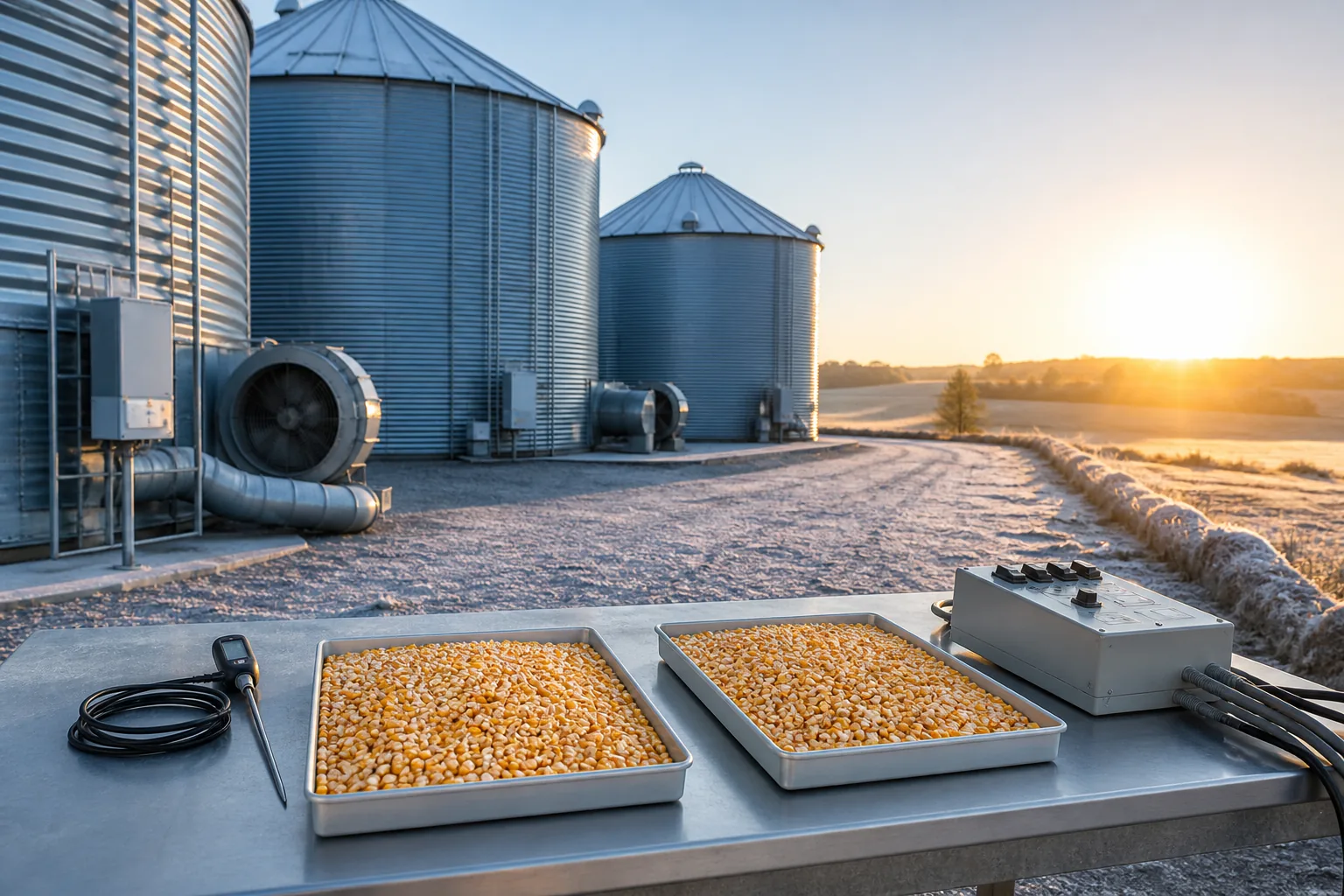
For clean, sound, aerated corn, a practical low-risk target is 15% moisture or lower for storage through winter and movement by spring, and 13%–14% for storage beyond six months or through warm summer weather. Use the drier end of the range for damaged corn, uneven moisture, poor airflow, warmer climates, or uncertain marketing dates.
Those numbers are management targets, not universal guarantees. Some regional extension guidance allows well-managed corn to be stored wetter for a defined period. Iowa State's 2025 guidance, for example, gives 15.5%–16.5% for corn sold by early to mid-spring and 14.5%–15.5% for storage into summer when aeration and management are adequate. University of Minnesota, NDSU, and Purdue publish more conservative long-duration targets in the 13%–14% range.
The difference is not simply disagreement. It reflects climate, storage duration, airflow, grain condition, acceptable risk, and the level of management assumed. If the farm does not have a proven higher-moisture program, use the conservative target rather than the highest published number.
Practical Moisture Targets by Storage Plan
| Storage plan | Conservative working target | Conditions that matter |
|---|---|---|
| Through winter, sold or fed by early spring | 15% or lower | Clean corn, prompt cooling, uniform aeration, routine monitoring |
| Managed Iowa system through early to mid-spring | 15.5%–16.5% | Iowa State 2025 guidance; at least 0.1 cfm/bu aeration and strong management |
| About one year | Around 14% | Clean, undamaged corn with effective temperature control |
| More than six months or through summer | 13%–14% | Use lower end in warm climates or when conditions are uncertain |
| Damaged, low-test-weight, mold-affected, or fines-heavy corn | At least 1 point below the normal target; sometimes 1–2 points | Shorter marketing window and more frequent monitoring may also be needed |
This table concerns conventional dry shelled corn in a bin. It does not apply to high-moisture corn intentionally ensiled for feed or to grain stored under a specialized preservation system.
Why “15.5% Is the Market Standard” Does Not Set the Storage Target
A buyer's moisture basis controls settlement, shrink, drying charges, or discounts. A storage target controls biological risk over time. They are related but not interchangeable.
Corn delivered promptly after harvest may be priced on a 15% or 15.5% basis. That does not mean every load at that moisture is suitable for storage through August. Grain intended for summer experiences months of warmer conditions, renewed insect activity, and greater exposure to moisture migration and localized heating.
Likewise, drying all corn to 13% when it will be sold in January may create unnecessary energy cost and weight loss. The correct target comes from the planned storage period plus the system's ability to control temperature and variation.
Use this sequence:
1. Set the latest realistic out-of-bin date. 2. Choose the regional moisture recommendation for that period. 3. Adjust downward for grain condition and uneven moisture. 4. Confirm that the bin can cool the entire mass uniformly. 5. Include a margin for a marketing delay or a warmer-than-normal season.
How to Reconcile the Published Recommendations
Several respected extension sources give different numbers because they assume different operating environments.
University of Minnesota
University of Minnesota recommends a maximum of 15% for clean, aerated corn stored up to six months and 13% for more than six months. A separate Minnesota storage table lists 15.5% for short-term storage until the following June, 14% for one year, and 13% for long-term storage under good management.
These two Minnesota tables use slightly different duration definitions, but they communicate the same trend: the longer the holding period, the lower the target should be.
NDSU
NDSU guidance commonly uses approximately 15.5% for winter storage and 13%–14% for storage into the following summer. It also emphasizes cooling corn to roughly 20°F–25°F for winter in northern conditions and monitoring moisture, temperature, insects, and grain condition.
Purdue
Purdue states that clean, undamaged shelled corn can be held for one year at about 14% when properly managed. It allows properly cooled corn at 15%–16% through winter if it will be sold, fed, or dried further before spring. Purdue recommends reducing moisture by roughly 1%–2% when corn is mechanically damaged, contains broken kernels and fines, or has reduced storability.
Iowa State
Iowa State's 2025 early-storage guidance is less conservative for well-managed Iowa systems: 15.5%–16.5% for sale by early to mid-spring and 14.5%–15.5% into summer, paired with at least 0.1 cfm/bu of aeration and good grain condition.
Do not take the top of the Iowa range and remove the operating assumptions. A farm in a warmer region, a bin with limited airflow, or corn with high damage does not have the same risk profile. When recommendations differ, choose the one that matches the local extension region and the actual bin—or use the lower value as the safer cross-regional default.
Storage Duration and Temperature Work Together
Moisture determines how biologically active grain can become; temperature strongly controls how quickly deterioration proceeds. Cooler grain lasts longer, but cold temperature does not permanently compensate for excess moisture.
At 15% moisture, University of Minnesota data illustrate that corn held at 50°F has substantially more storage life than corn held at 70°F. NDSU notes that allowable storage time is approximately cut in half for each 10°F increase in grain temperature. When spring and summer warm the bin, the same moisture becomes more difficult to manage.
Storage life is also cumulative. If corn used a large portion of its life while warm and wet before drying, the new lower moisture does not restore that consumed life. For the calculation method and temperature-moisture holding table, see How Long Can Wet Corn Sit Before Drying?.
The planning implication is simple: a summer target must be chosen for the warmest part of the intended storage period, not just the cold grain temperature achieved in January.
Cool the Entire Bin, Not Only the Grain Near the Fan
Aeration maintains a more uniform grain temperature and reduces moisture migration. It does not automatically dry the corn to a safe moisture.
In fall, begin an aeration cycle when average outdoor temperature is about 10°F–15°F below the grain temperature. Run the fan long enough for the cooling front to move completely through the mass. With upward airflow, the top-center area is commonly the last to cool; with downward airflow, the bottom-center area is harder to verify.
Stopping the fan because the first exhaust air feels cool is a common error. Part of the bin may remain warm, creating a temperature boundary where moisture can condense.
Regional winter temperature targets differ:
- Upper Midwest guidance commonly cools corn in stages to about 20°F–30°F.
- Indiana guidance commonly targets approximately 35°F–40°F for winter.
- Warmer regions may not be able to reach northern targets and should use their local extension schedule.
The operating goal is a uniformly cool grain mass appropriate for the region, not the lowest temperature achieved by one sensor.
Spring Management Is Regional, Not One-Size-Fits-All
Extension recommendations differ on whether cold, dry corn should be rewarmed in spring.
University of Minnesota says it is not necessary to rewarm dry grain during spring and summer when the system can maintain it appropriately. Purdue guidance recommends gradually warming corn to roughly 50°F–60°F by late spring when it will be held through hot summer conditions, helping avoid large temperature gradients and moisture migration.
These approaches reflect different climates, bin systems, and operating experience. The shared principles are more important than choosing a slogan:
- Avoid large, persistent temperature differences within the bin.
- Do not start a warming or cooling cycle that cannot be completed.
- Use local average conditions, not a brief afternoon temperature.
- Monitor the grain mass through the seasonal transition.
- Keep fan and duct openings managed when the fan is off to limit uncontrolled air movement.
Follow regional extension guidance for the specific location and bin. A strategy that works in northern Minnesota may not be appropriate in southern Indiana.
Grain Condition Can Require a Drier Target
Storage recommendations normally assume clean, sound corn. Several conditions shorten storage life:
- Broken or stress-cracked kernels
- Fines concentrated beneath the fill point
- Low test weight
- Field mold or ear rot
- Insect activity
- Foreign material such as cob or stalk pieces
- Grain that heated while waiting for drying
- Uneven final moisture after drying
Broken kernels and fines are more vulnerable to mold and create airflow resistance. A bin can therefore have acceptable average moisture while the center core remains warmer, wetter, and less aerated.
For poor-quality corn, reduce the moisture target by at least one point, consider a 1%–2% reduction when damage is substantial, and shorten the planned storage period. Drying lower is not a substitute for removing fines, completing the cooling front, and monitoring the grain.
Average Moisture Can Hide an Unsafe Wet Zone
A bin average of 14.5% does not prove that the entire bin is below 15%. Loads may differ by field, hybrid, harvest time, and dryer performance. A few wetter loads or a wet discharge interval can create zones that determine storage risk.
Use a repeatable process:
1. Sample representative loads entering storage. 2. Keep individual readings and the range, not only a blended average. 3. Separate materially wetter or damaged corn when practical. 4. Check cooled grain rather than relying only on readings from hot dryer discharge. 5. Sample different accessible areas during storage while following safe procedures. 6. Compare moisture trends with temperature, odor, condensation, and grain condition.
A portable Grain Moisture Meter is useful for routine comparisons across loads, drying runs, and storage checks. Its management value comes from multiple representative observations. One isolated reading should not be treated as the condition of the entire bin.
If the range is wide—for example, readings from 13.8% to 16.2%—do not make the summer-storage decision from the 15.0% average alone. Investigate why the variation exists and condition or segregate the higher-risk grain.
Choose the Target With a Five-Step Decision
Step 1: Define the exit date
“Through winter” should become a date such as March 15 or May 1. “Through summer” should become July, August, or the next harvest. Build in a delay margin.
Step 2: Classify the grain
Record moisture range, test weight, visible damage, fines, field disease, and any heating before drying. Use a lower target for corn that is not clean and sound.
Step 3: Verify the aeration system
Confirm airflow at the actual grain depth and static pressure, fan direction, perforated area, and expected hours per temperature cycle. An aeration specification without enough runtime does not cool the bin.
Step 4: Select the conservative applicable recommendation
Use local extension guidance when the farm meets its assumptions. If conditions or management capability are uncertain, default to approximately 15% for winter and 13%–14% for summer.
Step 5: Confirm the achieved condition
After drying and cooling, compare representative samples and temperatures. If the wettest meaningful zone is above the working target, the lot is not uniformly ready for the planned period even if the average is acceptable.
Four Practical Scenarios
Clean corn sold in February
The bin has full aeration, corn is uniform and sound, and winter temperatures permit prompt cooling. A target near 15% is a practical cross-regional starting point. A proven Iowa operation may follow the higher managed range in current Iowa guidance, but that is a deliberate program rather than a default.
Corn held until August
The marketing date crosses warm summer weather. Use 13%–14% as the conservative range. Move toward 13% if the climate is warm, the bin has known hot spots, the grain is damaged, or the exit date is uncertain.
Average 14.5%, range 13.7%–16.1%
The average alone is not enough for summer storage. Identify whether the high readings represent an isolated sample or a meaningful wet zone. Segregate, blend only as part of a controlled plan, or condition the wet portion before committing the bin to long storage.
Damaged corn at 15% for winter
Fines, cracks, low test weight, or field mold reduce storability. Drying at least one point lower, removing fines where practical, cooling promptly, monitoring more often, and marketing earlier may all be appropriate. Moisture reduction alone does not remove the added risk.
Monitor According to Risk
University of Minnesota recommends checking stored grain every 7–14 days when outdoor or grain temperature is above about 50°F. For sound grain uniformly cooled below 30°F, the interval may be extended to about three to four weeks during cold weather.
Higher-risk corn requires more frequent checks regardless of the calendar. Record:
- Grain temperature at multiple locations
- Moisture readings and their range
- Fan dates and hours
- Inlet and exhaust temperatures during aeration
- Condensation or frost under the roof
- Crusting, off-odors, insects, or visible mold
- Grain level and any change in fan static pressure or airflow
A rising temperature trend is more important than one absolute reading. If the grain warms without a matching weather or aeration explanation, investigate and act before visible spoilage spreads.
Never enter a bin while grain is flowing or to break a crust or bridge. Use lockout procedures and established grain-bin safety practices.
The Cost of Choosing a Lower Target
Drying one additional moisture point uses fuel and electricity and reduces saleable water weight. That cost is real, but it should be compared with the longer storage life and lower spoilage risk required by the actual marketing plan.
Avoid drying lower “just to be safe” without defining the reason. Instead, document which condition justifies the extra point: summer exposure, damaged grain, limited airflow, wide variation, or an uncertain sale date.
The formulas in How Much Will It Cost to Dry Corn from 22% to 15%? can be adapted to compare a 15%, 14%, or 13% target. Include both energy and the weight change from overdrying.
Common Mistakes
“The elevator uses 15.5%, so 15.5% is safe until August.”
The buyer's settlement basis is not a long-term storage recommendation. Summer requires a target matched to warm conditions and storage duration.
“Cold corn can be stored wet indefinitely.”
Cooling slows deterioration; it does not reset cumulative storage life or guarantee summer performance after the grain warms.
“The average is below 15%, so the bin is below 15%.”
Moisture variation can leave meaningful wet zones. Preserve the sample range and track where different loads entered the bin.
“Aeration will finish drying it.”
Storage aeration primarily controls temperature. Natural-air drying requires much higher airflow, suitable weather, and a system designed for drying.
“Every extension source should give the same number.”
Recommendations differ because duration, climate, grain condition, and management assumptions differ. Use the source that matches the operation or choose the more conservative number.
“Drier corn removes every storage problem.”
Fines, insects, temperature gradients, water leaks, and damaged kernels still require management. Moisture is one control, not the entire storage program.
Bottom Line
Use 15% moisture or lower as a practical low-risk target for clean, aerated corn stored through winter and moved by spring. Use approximately 13%–14% for corn held longer than six months or through summer, moving toward the lower end when grain is damaged, airflow is uncertain, the climate is warm, or the sale date may slip.
Higher regional limits can work under the conditions stated by the source. Iowa State's 15.5%–16.5% early-spring range and 14.5%–15.5% summer range assume strong aeration and management in Iowa. They should not be copied into a different bin or climate without the same controls.
The safest decision combines storage duration, actual grain temperature, aeration performance, corn condition, and the wettest meaningful moisture zone. Dry to the target the entire system can manage—not simply the highest number found in a table.
Sources and Further Reading
- University of Minnesota Extension: Managing Stored Grain to Minimize Storage Losses
- University of Minnesota Extension: Managing Stored Grain With Aeration
- NDSU Extension: Corn Harvest and Drying Guidance
- Iowa State University Extension: Corn Harvest, Handling, Drying, and Early Storage Considerations for 2025
- Purdue Extension: Managing Grain for Year-Round Storage
- Purdue Extension: Managing Grain in the Spring