
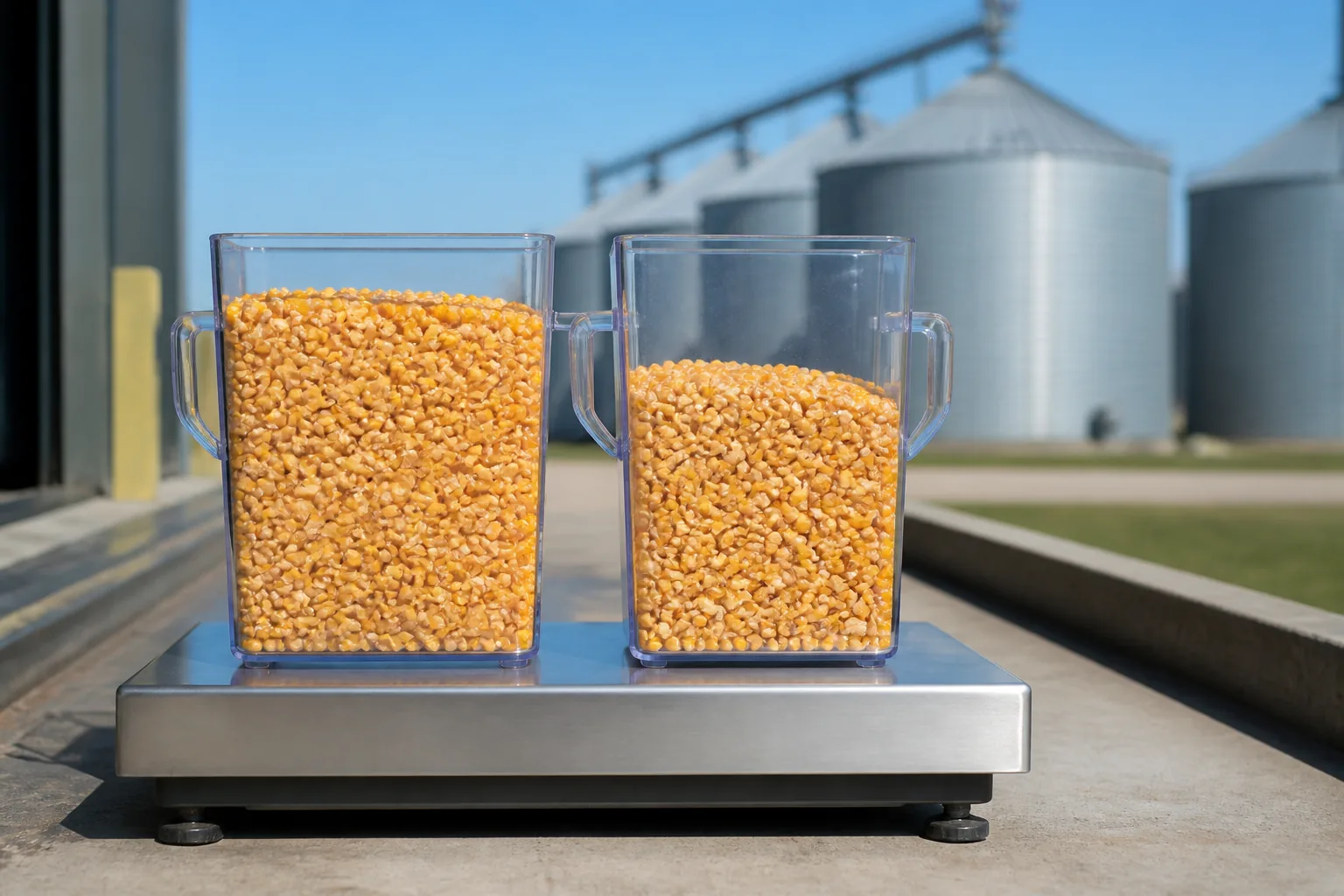
To find water-only grain shrink, use (initial moisture − final moisture) ÷ (100 − final moisture) × 100. Corn dried from 20% to 15% loses 5.88% of its incoming weight from water removal alone, so 1,000 incoming wet bushel-equivalents become about 941.2 bushels at 15%, assuming no dry matter is lost.
If a buyer instead applies 1.4% shrink for each point above 15%, the same 20% corn receives 7.0% pencil shrink and is credited as 930 bushels. The 11.2-bushel difference between 941.2 and 930 is not water; it is the additional allowance built into that commercial shrink method.
That distinction is the key to understanding shrink. Most physical weight loss during drying is unavoidable water removal. Handling loss, broken grain, fines, respiration, spoilage, and an elevator's accounting rule are separate parts of the result.
Grain Shrink Calculator: The Three Formulas You Need
Use moisture percentages as whole numbers in these formulas. Enter 20 for 20%, not 0.20.
1. Water-only shrink percentage
Water shrink (%) = (initial moisture − final moisture) ÷ (100 − final moisture) × 100
For 20% corn dried to 15%:
(20 − 15) ÷ (100 − 15) × 100 = 5.882%
2. Dry-equivalent bushels remaining
Dry-equivalent bushels = wet bushels × (100 − initial moisture) ÷ (100 − final moisture)
For 1,000 wet bushels at 20%, adjusted to 15%:
1,000 × 80 ÷ 85 = 941.2 bushels
3. Water-shrink bushels
Water-shrink bushels = wet bushels − dry-equivalent bushels
1,000 − 941.2 = 58.8 bushels
These formulas conserve dry matter. They assume water is removed while all kernel dry matter remains. That makes them the correct baseline for evaluating an actual dryer result or a commercial shrink schedule.
Quick Corn Shrink Table: Drying to 15%
The table shows water-only shrink. It does not include handling loss, drying charges, or an elevator's additional allowance.
| Initial corn moisture | Water-only shrink | Bushels removed per 1,000 wet bu | Bushels remaining at 15% |
|---|---|---|---|
| 16% | 1.176% | 11.8 | 988.2 |
| 18% | 3.529% | 35.3 | 964.7 |
| 20% | 5.882% | 58.8 | 941.2 |
| 22% | 8.235% | 82.4 | 917.6 |
| 25% | 11.765% | 117.6 | 882.4 |
| 30% | 17.647% | 176.5 | 823.5 |
The table also exposes a common mistake: drying 25% corn to 15% removes 10 moisture points, but it reduces incoming weight by 11.765%, not 10%. Moisture content is a percentage of total wet weight. As water leaves, the total weight that forms the percentage also changes.
Why the Final Moisture Target Changes the Shrink Factor
The water-shrink factor per moisture point is:
Water-shrink factor = 100 ÷ (100 − final moisture)
| Final moisture target | Water-shrink factor per point |
|---|---|
| 15.5% | 1.183% |
| 15.0% | 1.176% |
| 14.0% | 1.163% |
| 13.0% | 1.149% |
| 12.0% | 1.136% |
Purdue Extension publishes these same factors for shelled corn. Multiply the factor by the number of moisture points removed to calculate total water shrink.
The factor is slightly smaller at a lower final target, but do not conclude that drying farther causes less total shrink. More points are removed. Starting with 20% corn, the result changes as follows:
| Drying target | Points removed | Water-only shrink | Bushels removed per 1,000 wet bu |
|---|---|---|---|
| 15.5% | 4.5 | 5.325% | 53.3 |
| 15.0% | 5.0 | 5.882% | 58.8 |
| 14.0% | 6.0 | 6.977% | 69.8 |
| 13.0% | 7.0 | 8.046% | 80.5 |
The target therefore must be stated whenever shrink is discussed. “Five points of shrink” is incomplete if one person is shrinking to 15% and another to 15.5%.
Water Shrink Is Not the Same as Lost Grain
The 58.8 bushels removed when 1,000 wet bushels of 20% corn reach 15% are almost entirely the weight of water. The dry matter that determines the quantity of actual corn solids is still present under the water-only calculation.
This leads to an important economic distinction:
- Water shrink is physically unavoidable if grain moves from the initial moisture to the same final moisture.
- Dry-matter loss may be partly manageable because it can come from broken kernels, fines, spills, respiration, or spoilage.
- Commercial pencil shrink is an accounting estimate that may be greater than water-only shrink.
Calling every shrunk bushel “lost corn” exaggerates what the dryer destroyed. But ignoring shrink also overstates the quantity that will remain available for sale or storage. Use water shrink as the baseline, then investigate the amount above it.
The Four Kinds of Shrink That Get Mixed Together
1. Water shrink
This is the mass of water removed. For a fixed initial and final moisture, the mathematical result is the same whether the water leaves in the field, an on-farm dryer, or a commercial dryer.
2. Handling or dry-matter loss
Some kernel material can be lost through broken grain, fines, mechanical transfer, volatile compounds, respiration, and spills. Purdue reports Iowa State research in which on-farm handling losses ranged from 0.22% to 1.71% of incoming wet weight and commercial-system losses ranged from 0.64% to 1.33%. The three-year averages were 0.82% and 0.88%, respectively.
Those research ranges are context, not an automatic allowance for every system. Grain condition, dryer type, temperature, number of transfers, fines removal, and measurement quality affect the observed result.
3. Commercial or “pencil” shrink
A buyer may estimate the quantity remaining after drying by multiplying a constant factor by the points above its moisture basis. Purdue notes that common constant-factor methods have historically ranged from 1.2% to 1.5% per point. A factor above the water-only value implicitly includes a handling allowance.
The buyer is not necessarily measuring the actual dry matter lost from your specific load. It is applying the method stated in its schedule or contract. Read At What Moisture Will My Elevator Start Docking Me? for the other terms that can accompany shrink, including drying fees, price discounts, brackets, and rejection limits.
4. Spoilage loss
Grain that heats, molds, or deteriorates can lose dry matter through biological activity and can also suffer quality discounts. That is not normal water shrink and should not be hidden inside a routine drying calculation. If actual loss is much greater than water shrink plus reasonable handling loss, investigate grain condition and inventory records.
Worked Example: 10,000 Wet Bushels of 22% Corn
Assume the final target is 15%, the corn price is $5.00 per bushel, and there are no separate drying fees in this comparison.
Water-only result
Moisture points removed:
22 − 15 = 7 points
Water-only shrink:
7 ÷ 85 × 100 = 8.235%
Dry-equivalent bushels:
10,000 × 78 ÷ 85 = 9,176.5 bushels
Water-shrink quantity:
10,000 − 9,176.5 = 823.5 bushels
Bushel value represented by water shrink at $5.00:
823.5 × $5.00 = $4,117.65
This dollar figure shows how much gross bushel value is attached to the removed water-equivalent weight. It is not evidence that $4,117.65 of grain dry matter was destroyed.
Commercial result using 1.4% per point
Commercial shrink:
7 points × 1.4% = 9.8%
Credited bushels:
10,000 × (1 − 0.098) = 9,020 bushels
Total shrink quantity:
10,000 − 9,020 = 980 bushels
Difference from water-only dry equivalent:
9,176.5 − 9,020 = 156.5 bushels
Value of that additional pencil shrink at $5.00:
156.5 × $5.00 = $782.35
That $782.35 is the amount to examine when comparing shrink methods. Drying charges, freight, and other discounts must still be calculated separately.
Water-Only Versus 1.4% Commercial Shrink
The following corn examples use a 15% basis and a $5.00 price.
| Initial moisture | Water-only bushels removed per 1,000 | Bushels removed at 1.4% per point | Additional pencil shrink | Value of additional shrink |
|---|---|---|---|---|
| 20% | 58.8 | 70.0 | 11.2 | $55.88 |
| 22% | 82.4 | 98.0 | 15.6 | $78.24 |
| 25% | 117.6 | 140.0 | 22.4 | $111.76 |
The gap grows as initial moisture rises because the extra allowance is applied to more points. Scale the final column by delivery size: the 22% example represents about $782 for 10,000 wet bushels, not $78.
Do not use 1.4% as a universal elevator factor. It is an example common in extension comparisons. Obtain the actual basis and factor from each buyer.
Field Drying Does Not Eliminate Water Shrink
Suppose a field contains enough dry matter to produce 941.2 standard bushels of corn at 15%. If harvested at 20%, that same dry matter weighs the equivalent of 1,000 wet bushels. If the crop instead dries to 15% before harvest, the scale sees approximately 941.2 bushels because the water has already left in the field.
The location of water removal changes costs and risks, not the water-balance equation. Field drying can avoid dryer fuel and may avoid a commercial handling allowance, but waiting can increase stalk lodging, ear loss, wildlife damage, weather delay, and harvest loss. Mechanical drying adds energy and handling cost but may protect the crop from those field risks.
This is why the correct comparison is not “1,000 wet bushels versus 941 dry bushels.” The fair starting point is the same quantity of grain dry matter. Then compare field loss, drying cost, handling loss, commercial deductions, and timing.
For a full energy and ownership-cost model, use How Much Will It Cost to Dry Corn from 22% to 15%?.
Actual Shrink Versus Commercial Shrink
You can audit an on-farm drying system if reliable incoming and outgoing weights and representative moisture readings are available.
Step 1: Calculate expected water-only shrink
Use the incoming weight and the initial and final moisture values. This gives the expected outgoing weight with no dry-matter loss.
Expected final weight = incoming weight × (100 − initial moisture) ÷ (100 − final moisture)
Step 2: Measure actual outgoing conditioned weight
Use comparable scale records. Account for grain still in holding bins, conveyors, dryer columns, trucks, or storage before treating an inventory difference as loss.
Step 3: Calculate dry matter on both sides
Incoming dry matter = incoming weight × (100 − initial moisture) ÷ 100
Outgoing dry matter = outgoing weight × (100 − final moisture) ÷ 100
Step 4: Calculate dry-matter loss
Dry-matter loss (%) = (incoming dry matter − outgoing dry matter) ÷ incoming dry matter × 100
This dry-matter-loss percentage uses initial dry matter as its denominator. It is not numerically identical to a handling allowance expressed as a percentage of incoming wet weight. Label the basis clearly when comparing your result with a buyer's factor or an extension table.
Run the audit across a substantial, clearly defined lot rather than one small batch. Scale resolution, moisture variation, incomplete cleanout, and inventory carried between lots can overwhelm the signal in a small test.
Moisture Sampling Error Can Move Many Bushels
Shrink math is only as reliable as the moisture input. A single convenient sample may not represent corn from different field zones, truck compartments, dryer discharge intervals, or areas within a bin.
At a 15% target, a 0.5-point error changes water-only shrink by about:
0.5 × 1.176% = 0.588% of incoming weight
On 10,000 wet bushels, that is approximately 58.8 bushels. At $5.00 per bushel, the planning difference is about $294.
Use a portable grain moisture meter for routine pre-delivery and process checks, not as an official settlement instrument. Build a representative composite from multiple increments, mix it, divide it without selecting kernels by appearance, and record the range as well as the average. Recheck when the field, hybrid, weather, or dryer condition changes.
For multiple unequal loads, calculate a wet-weighted moisture average rather than averaging the displayed percentages. If every load uses the same final target and water-only formula, a correct wet-weighted average can support planning. If the buyer settles loads individually or uses brackets and rounding, calculate each ticket separately.
Do Not Confuse Shrink with Test Weight
Scale bushels and test weight answer different questions. Commercial corn quantity is normally converted from net pounds using the standard pounds per bushel, while test weight measures pounds that fit into a standardized volume and is also a quality factor.
Drying can increase corn test weight because kernels become denser relative to their volume, yet the total load still loses weight as water is removed. A rise in test weight does not cancel water shrink. Likewise, a 1,000-bushel bin volume is not automatically the same as 1,000 scale bushels.
Base shrink calculations on net scale weight or properly defined wet bushel-equivalents. Do not substitute a truck's test-weight reading into the water-balance formula.
Common Shrink Calculation Mistakes
Subtracting moisture points directly from bushels
Five moisture points removed do not equal 5% weight shrink. From 20% to 15%, water-only shrink is 5.882%.
Forgetting the final target
A load shrunk to 15.5% retains more weight than the same load shrunk to 15%. Every quote must state the basis.
Calling all water loss “handling loss”
Most drying shrink is water. Compare actual or commercial total shrink with the water-only baseline before judging system performance.
Comparing shrink factors without drying fees
A buyer with lower shrink can charge a higher drying fee or price discount. Compare net settlement, not one line of the schedule.
Treating commercial shrink as measured physical loss
Pencil shrink estimates credited quantity. It does not prove that the buyer physically lost that exact percentage from the load.
Adding handling loss on the wrong basis
A fixed handling allowance based on incoming wet weight and a dry-matter-loss percentage based on initial dry matter are different calculations. State the denominator.
Ignoring over-drying
Drying below the necessary marketing or storage target removes additional saleable weight and consumes energy. Use a target appropriate to the actual storage duration and buyer terms.
A Practical Shrink Worksheet
Record these inputs for each decision:
| Input | Your value |
|---|---|
| Incoming net weight or wet bushels | |
| Representative initial moisture | |
| Final moisture target or buyer basis | |
| Water-only shrink percentage | |
| Water-only dry-equivalent bushels | |
| Buyer's commercial shrink factor | |
| Commercial credited bushels | |
| Additional shrink above water-only | |
| Grain price | |
| Value of additional shrink | |
| Drying fee and other deductions |
Calculate the likely result at the low and high ends of the measured moisture range. Then compare the buyer's credited bushels with the water-only dry equivalent. That separates the part dictated by physics from the part determined by handling and contract policy.
Bottom Line
For corn adjusted to 15%, water-only shrink is 1.176% of incoming weight for each moisture point removed. Therefore, 20% corn loses 5.88%, 22% corn loses 8.24%, and 25% corn loses 11.76% of incoming weight before any handling allowance.
Do not treat all of that weight as destroyed grain—it is mainly water. The controllable or negotiable part is the dry-matter loss and any commercial shrink above the water-only calculation. Use representative moisture samples, state the final basis, convert every quote to credited bushels, and compare net dollars after drying fees and other deductions.
Sources and Further Reading
1. Purdue University Extension, Calculating Grain Weight Shrinkage in Corn Due to Mechanical Drying. 2. Iowa State University Extension and Outreach, Grain Drying Considerations This Fall. 3. Iowa State University Extension and Outreach, Options for Fall Grain Drying and Marketing. 4. Iowa State University Ag Decision Maker, Corn Drying and Shrink Comparison. 5. Iowa State University Extension and Outreach, A Tough Harvest—Frequently Asked Questions. 6. Penn State Extension, Understanding Grain Discount Schedules. 7. University of Nebraska–Lincoln, Grain Moisture Weight Price Estimator.