
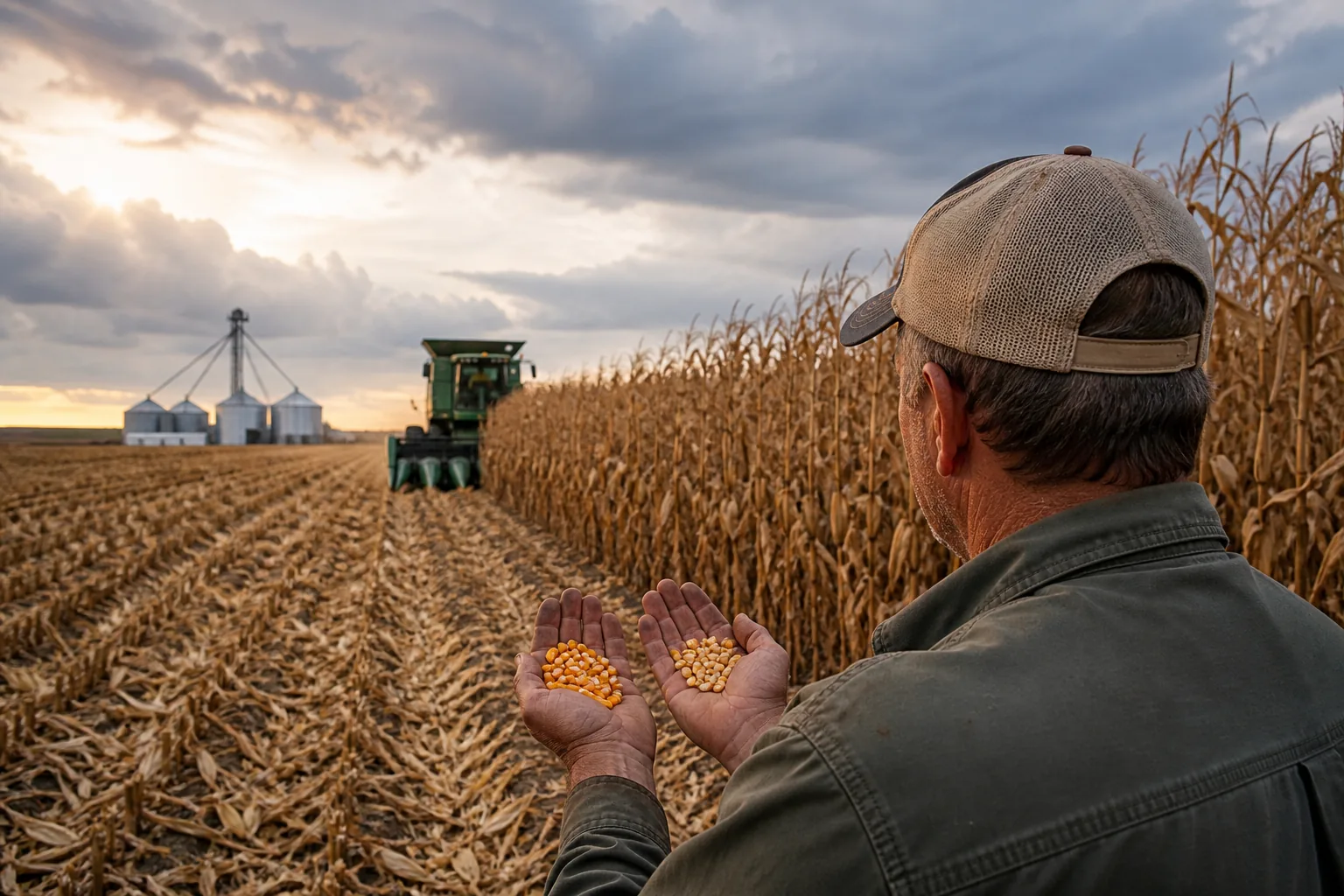
Harvest wet corn now when the crop has reached physiological maturity and the expected cost of waiting—lodging, dropped ears, ear rot, wildlife damage, weather delay, or slower late-season drydown—is greater than the drying cost you are likely to save. Wait when stalks and ears are sound, a meaningful drydown window is likely, and the dryer or wet-grain system cannot efficiently handle the current moisture.
Do not make the decision from moisture alone. Two fields at 24% moisture can require opposite actions: a healthy field ahead of warm, dry weather may justify several more days, while a field with failing stalks ahead of wind should move to the front of the harvest schedule.
For the broader question of target harvest moisture, see What Moisture Should I Harvest Corn At?. This article focuses on the narrower decision farmers face today: harvest this field now or accept more field exposure in exchange for fewer moisture points to remove later?
The Correct Comparison Is Not “Drying Cost Versus Free Drying”
Field drying does not require burner fuel, but it is not free. The crop continues to carry biological, mechanical, and weather risk until it is harvested. Artificial drying has a visible invoice; field exposure usually appears later as lost ears, lower recoverable yield, slower harvest, quality problems, or missed operating time.
Compare these two totals:
| Harvest now | Wait for field drydown |
|---|---|
| Fuel, electricity, and drying charges | Expected field loss during the waiting period |
| Dryer and wet-bin capacity used | Risk of lodging, ear drop, disease, and wildlife loss |
| More wet-grain hauling and handling | Risk that rain or cool weather slows or reverses progress |
| Possible throughput bottleneck | Value of harvest days that may be lost later |
| Earlier control over drying and cooling | Fewer moisture points to remove after harvest |
The cheaper-looking choice can become the expensive one when only one side of the comparison is priced.
Make the Decision in Five Steps
Use the same process for every field. A written comparison is more reliable than a farmwide rule such as “wait until 20%” or “start everything at 25%.”
Step 1: Confirm maturity and measure the moisture range
Use this framework only after the corn has reached physiological maturity, normally identified by black layer. Before black layer, waiting still affects grain fill and potential yield; after black layer, kernel dry matter has reached its maximum and further field change is primarily moisture loss and exposure.
Sample multiple representative areas rather than one headland or one convenient ear. Keep readings from unlike zones separate, including:
- Different hybrids or planting dates
- Replanted areas
- Low or poorly drained ground
- Drought-stressed or disease-stressed zones
- Areas with visibly different maturity
Record the individual readings, range, and average. A field that averages 24% but ranges from 18% to 29% can create overdrying, underdrying, and storage-uniformity problems that the average conceals.
A portable Grain Moisture Meter can support these routine comparisons when the operator collects representative samples and follows the same sampling procedure over time. One isolated reading should not be treated as the moisture of the entire field.
Step 2: Measure the field's failure risk
Walk representative areas rather than judging from the road. University of Minnesota Extension recommends testing at least 20 plants in each of five representative field locations. Use both:
- Push test: Push the plant about 45 degrees at ear level. Plants that break are at risk of lodging.
- Pinch test: Pinch the lower internode above the brace roots. A stalk that collapses easily has deteriorated tissue.
When 10% to 15% or more of tested plants fail, Minnesota Extension recommends prioritizing the field for harvest. Also inspect:
- Root lodging and plants already leaning
- Weak ear shanks and ears pointing downward or dropping
- Stalk rot and rapid canopy death
- Ear rot, insect feeding, and kernel sprouting
- Wildlife pressure
Do not average away a vulnerable part of the field. A weak zone may need to be harvested separately even when the rest can wait.
Step 3: Estimate realistic drydown—not an optimistic rate
Drydown varies with temperature, relative humidity, rainfall, dew, wind, solar radiation, hybrid characteristics, husk condition, and current kernel moisture. It also tends to slow as fall progresses.
Ohio State research reported field moisture loss of roughly 0.76 to 0.92 percentage point per day in warm, dry fall conditions, compared with about 0.32 to 0.35 point per day in cool, wet conditions. Those are research ranges, not promises. By late fall, drydown can become negligible.
Use an observed reading from the field with the Iowa State Corn DryDown Calculator to estimate 5- and 10-day moisture. The tool uses temperature, relative humidity, historical weather, and forecast data and is intended for corn that has reached physiological maturity.
Then make the estimate conservative:
1. Use the lower end of expected drydown when rain, fog, cool temperatures, or high humidity are likely. 2. Do not assume every part of a variable field will dry at the same rate. 3. Recheck actual moisture after two or three days instead of relying on the original forecast. 4. Stop extending an early-fall rate into late October or November.
The decision is about moisture points likely to be lost before the next meaningful risk event, not moisture points that might be lost eventually.
Step 4: Calculate the value of waiting
Use current farm records or the buyer's actual schedule. University of Minnesota Extension notes that the best basis for on-farm drying estimates is the farm's own record of bushels dried, moisture removed, fuel used, and electricity used. Dryer design, airflow, operating temperature, weather, management, and grain quality all affect cost.
For a first-pass comparison:
Drying cost avoided per acre
= expected harvested bushels per acre
× expected moisture points lost while waiting
× drying cost per bushel per point
Illustrative example—not a current market quote:
- Expected yield: 200 dry-equivalent bushels per acre
- Expected field drydown over the chosen wait: 3 points
- Drying cost: $0.04 per bushel per point
200 × 3 × $0.04 = $24 per acre of potential drying-cost savingsNow convert that saving into the field loss required to erase it:
Break-even field loss (%)
= drying cost avoided per acre
÷ crop value per acre
× 100
If corn is valued at $4.50 per bushel in this illustration:
Crop value = 200 × $4.50 = $900 per acre
Break-even field loss = $24 ÷ $900 × 100 = 2.7%
In that example, an expected field loss greater than about 2.7% would cost more than the drying expense saved. Insert your own price, yield, drying charge, and expected drydown. Also add any costs that change with the choice, including hauling wet grain, commercial drying, labor, dryer ownership, and lost harvest capacity.
Step 5: Test the result against system capacity
A field may be agronomically ready but operationally impossible to harvest efficiently. Identify the bottleneck:
- Combine capacity
- Grain carts and trucks
- Receiving pit
- Wet holding
- Dryer bushels per hour
- Cooling capacity
- Storage space
- Commercial receiving hours or moisture limits
Estimate how many wet bushels the entire system can process in 24 hours at the field's current moisture. Dryer throughput normally falls as more water must be removed. A plan based only on combine acres per day can strand warm, wet grain in carts, trucks, or wet holding.
If the dryer is the constraint, the answer is not always “wait everywhere.” Harvest the highest-risk acres first, slow the combine to match drying throughput, segregate wetter zones, or use another confirmed drying destination. Preserve sound fields for later.
Understand Shrink Before Comparing the Choices
Moisture shrink is often described as if it were entirely a fee. Most of it is the physical weight of water removed. That water leaves the corn whether it evaporates in the field, in an on-farm dryer, or at the elevator.
The key distinction is between:
- Water shrink: unavoidable weight reduction when corn is brought to a lower moisture basis
- Handling loss: dry matter lost as broken kernels, fines, dust, and material removed during drying and handling
- Pencil shrink: the buyer's calculation, which may combine water shrink with an assumed handling factor
Do not treat all wet pounds as saleable dry matter. When comparing buyers, examine the final moisture basis, shrink factor, drying charge, and any discount—not just the posted corn price. Purdue Extension shows that a smaller shrink factor can still produce more total shrink if the buyer shrinks to a lower final moisture.
For the harvest-now decision, compare net dry-equivalent value under both options. Field drying reduces wet weight before the truck reaches the scale; commercial drying shows the reduction on the settlement. The location of the water loss changes, but the dry matter should be the common basis of comparison.
When Harvesting Now Is Usually the Better Decision
Move a field forward when one or more of these risks are material:
Stalks or shanks are failing
A high push- or pinch-test failure rate means the field may not remain harvestable through the next wind event. The relevant loss is not just kernels on the ground; down corn also reduces combine speed, increases operator difficulty, and can raise header loss.
Ear rot or quality concerns are developing
Waiting does not repair infected ears. Where ear rot or suspected mycotoxin risk exists, harvest priority, segregation, prompt drying, appropriate testing, and professional guidance may be more important than saving drying fuel. Do not blend questionable grain with clean grain merely to improve an average result.
The forecast offers little useful drydown
Several cool, humid days may save little moisture while adding exposure. Ohio State Extension cautions that allowing corn to dry below about 20% in the field increases exposure to stalk lodging, ear drop, ear rot, insects, and wildlife.
A major weather event could close the harvest window
The cost of waiting includes the probability that rain, wind, snow, or freeze prevents timely field access. A forecast is uncertain, but the consequence of being wrong is field-specific. Weak corn deserves less tolerance for forecast error.
The drying system has room now
Unused dryer capacity today has value. If waiting moves the field into a period when multiple fields are ready at once, the farm may exchange a manageable drying cost for a later harvest bottleneck.
When Waiting Can Be Rational
Waiting can make sense when all important conditions support it:
- Corn is physiologically mature but too wet for efficient combining or the intended drying system.
- Stalks, roots, and ear shanks are sound across representative locations.
- Ear disease and wildlife pressure are low.
- Warm, dry weather offers a realistic multi-point drydown before the next risk event.
- Wet holding or dryer capacity is currently full.
- Another field has a higher failure risk and should be harvested first.
- The expected drying-cost saving is larger than the field-loss risk.
Waiting should have a deadline. Set a target date, expected moisture, and conditions that trigger immediate harvest. Recheck the field rather than letting “wait” become the default for another week.
Use a Split-Field or Split-Harvest Strategy When the Average Misleads
Uneven planting, replant areas, soil differences, drought stress, and hybrid changes can create a large moisture spread. Harvesting the whole field together can send both overdry and very wet kernels through the same dryer setting.
Better options may include:
1. Harvest the mature or weak area now and return for the wetter area. 2. Keep hybrids or planting dates identifiable through drying. 3. Test individual truckloads instead of relying on the preharvest field average. 4. Adjust dryer operation as the incoming moisture range changes.
The extra field move can be cheaper than forcing a highly variable crop through one harvest and drying plan.
A 15-Minute “Harvest or Wait” Worksheet
Complete this before changing the harvest order:
| Question | Field result | Decision effect |
|---|---|---|
| Has the field reached black layer? | Yes / No | Do not use normal post-maturity drydown logic before maturity |
| What are the moisture average and range? | ___ / ___ to ___% | Wide range favors segregation or separate harvest |
| What percentage fails push or pinch tests? | ___% | At 10%–15% or more, prioritize harvest |
| Are ear drop or ear rot increasing? | Yes / No | “Yes” favors earlier harvest |
| Expected 5-day drydown | ___ points | Use forecast-based, conservative estimate |
| Drying cost avoided by waiting | $___/acre | Benefit of waiting |
| Break-even field loss | ___% | Compare with actual field risk |
| Can the dryer process today's moisture? | Yes / No | “No” requires waiting, slower harvest, or another outlet |
| Next major weather risk | ___ | Sets the decision deadline |
Write the result and revisit it after any material change in weather, field condition, moisture, or dryer capacity.
Common Decision Errors
Counting water shrink as if it were all lost corn
Water must be removed for dry-grain storage or settlement. Compare dry matter and net value, then separately evaluate handling loss and buyer-assessed shrink.
Using one moisture reading for a variable field
A convenient sample can miss replanted or stressed zones. Multiple readings reveal whether the dryer will receive a narrow band or a damaging mixture of wet and overdry corn.
Assuming forecast drydown without checking the calendar
Drydown generally slows later in the fall. Three points may take a few favorable days early, then take far longer under cool, wet conditions.
Ignoring the value of dryer availability
A dryer that is open today but overloaded next week changes the economics. Harvest logistics have an opportunity cost even when no line item appears on the drying bill.
Waiting for the entire farm to reach one moisture target
Fields differ in maturity, standability, disease, and risk. Harvest order should be a portfolio decision: protect the acres most likely to lose value first.
Bottom Line
Harvest wet corn now if the field is mature and the probable value lost by waiting exceeds the drying cost you can realistically avoid. Wait only when the crop is standing well, the forecast offers meaningful drydown, and the farm's drying and handling system benefits from the delay.
The decision becomes clearer when you put four numbers on paper: current moisture range, forecast moisture change, drying cost avoided per acre, and break-even field loss. Then test those numbers against stalk failure, ear condition, weather risk, and dryer throughput. Moisture starts the calculation; field risk and system capacity finish it.
Sources and Further Reading
- University of Minnesota Extension: Pre-Harvest Considerations for Corn
- Ohio State University Extension: Precipitation, Cooler Weather, and Corn Dry Down
- Iowa State University Extension: The Corn DryDown Calculator—A Tool to Guide Harvest Timing
- University of Minnesota Extension: Energy Costs for Corn Drying and Cooling
- Purdue Extension: Calculating Grain Weight Shrinkage in Corn Due to Mechanical Drying
- Nebraska Extension: How to Estimate Harvest Losses in Soybean and Corn Fields