
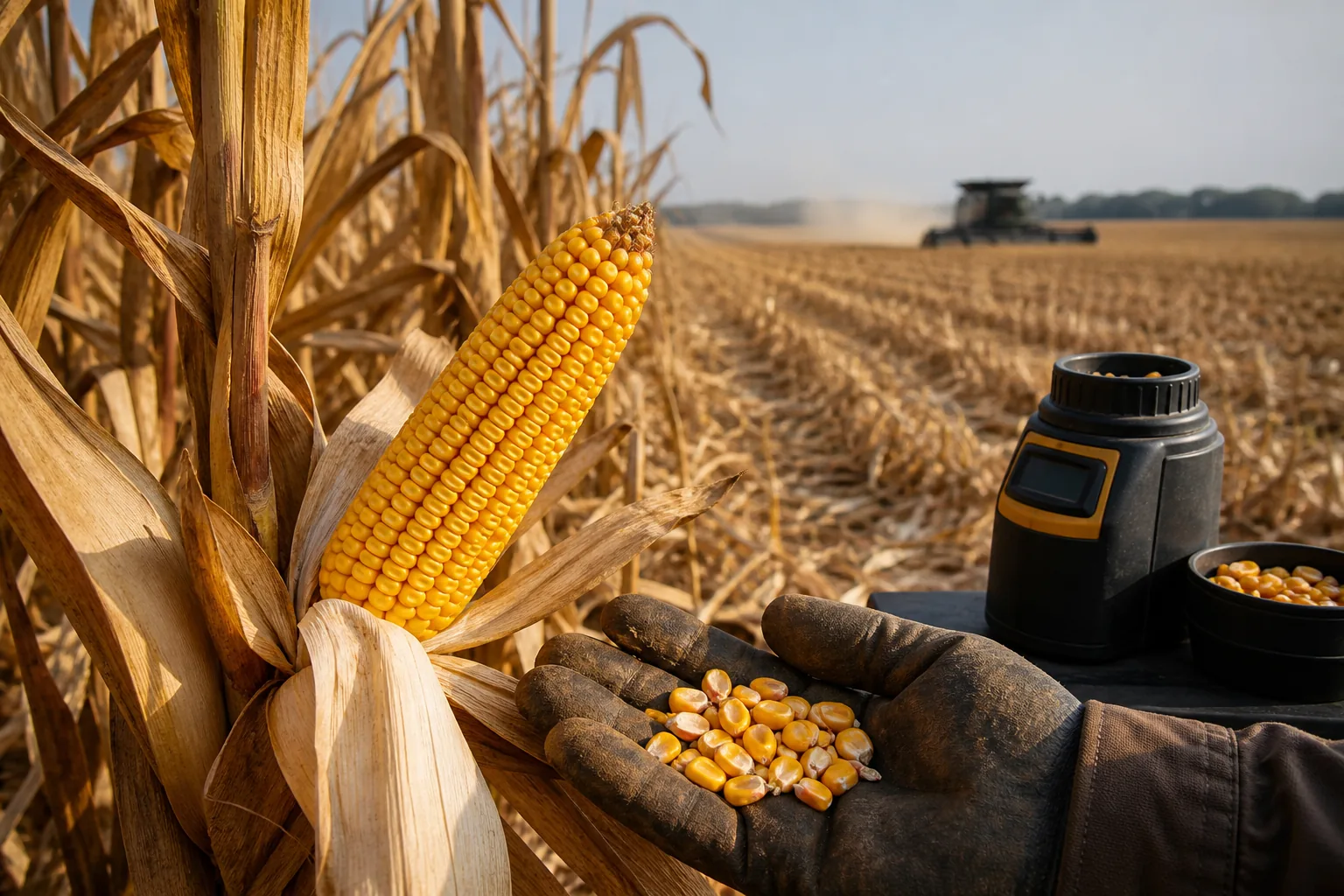
For corn that will be shelled, dried, and stored as dry grain, a practical starting point is to begin harvest at about 24% to 25% grain moisture, after the crop has reached physiological maturity. Many farms complete most of harvest in the 20% to 25% range. The right number for a particular field depends on stalk strength, ear retention, weather, combine performance, drying capacity, delivery terms, and how long the grain will be stored.
Waiting for corn to reach 15% in the field may reduce drying expense, but it is not automatically the most profitable choice. Below about 20%, additional field drying can be offset by greater exposure to lodging, dropped ears, ear rots, wildlife damage, and weather delays. On the other hand, harvesting much above 25% increases the amount of water the dryer must remove, slows harvest and handling, and may increase kernel damage if the combine or dryer is not suited to wetter grain.
This guide concerns dry-grain corn, not corn silage or high-moisture corn intentionally stored for livestock feed.
The Three Moisture Numbers Farmers Commonly Mix Up
Harvest moisture, delivery moisture, and storage moisture answer different questions. Treating them as one target leads to poor timing decisions.
| Moisture number | What it controls | Practical meaning |
|---|---|---|
| Harvest moisture | When to enter the field | Balances field risk against drying and handling cost |
| Buyer or contract basis | How delivered grain is priced | Determines drying charges, shrink, discounts, or rejection limits |
| Final storage moisture | How the grain must be conditioned | Depends on storage duration, grain temperature, aeration, and grain condition |
A buyer's moisture basis is not necessarily an agronomic recommendation for when to harvest. Likewise, corn harvested at 23% is not ready for ordinary dry-grain storage simply because harvest conditions were favorable. It still needs to be dried and cooled to a target appropriate for the storage plan.
University of Minnesota guidance lists 15% moisture for clean, aerated corn stored up to six months and 13% for storage longer than six months. Summer storage recommendations are commonly more conservative; University of Minnesota and NDSU guidance places summer storage near 13% to 14%, depending on conditions. These are storage-management references, not instructions to leave every field standing until it reaches those levels.
Do Not Start With Moisture Alone: Confirm Physiological Maturity
Corn reaches physiological maturity at the R6 stage, identified by the formation of a black layer at the base of the kernel. At that point, the kernel has reached its maximum dry-matter accumulation. Purdue Extension reports that grain moisture is commonly about 30% to 35% at black layer.
The black layer therefore signals maturity, not ideal combine timing. In most normal dry-grain systems, the crop is allowed to dry further before harvest. If frost kills an immature crop before black layer, moisture readings alone cannot describe its quality or storability; low test weight, uneven kernel development, and a wider moisture spread may require a separate harvest and drying plan.
Before deciding that a field is ready:
1. Confirm that representative ears have reached black layer. 2. Measure kernel moisture in more than one area of the field. 3. Inspect stalks, roots, shanks, ears, and disease pressure. 4. Check whether the dryer, wet bin, transport, and storage system can keep up.
Why 24% to 25% Is a Useful Starting Point
Ohio State University Extension recommends beginning dry-grain corn harvest at about 24% to 25% moisture. This range is useful because it often captures much of the benefit of field drydown while avoiding some of the increasing field risk associated with waiting below 20%.
It is not a universal optimum. Think of 24% to 25% as a point at which the farm should be ready to operate, then adjust field order using actual conditions.
| Field and system condition | Harvest tendency | Reason |
|---|---|---|
| Strong stalks, sound ears, stable forecast | May wait for more field drydown | Lower immediate field-loss risk |
| Stalk rot, weak shanks, lodging, ear drop | Harvest earlier | Standing loss can rise faster than drying savings |
| Wind, rain, snow, or freeze risk | Harvest earlier | A short delay may create a long or damaging delay |
| Limited dryer or wet-bin capacity | Stage harvest carefully | Wet corn can bottleneck the entire system |
| Adequate drying and receiving capacity | Can start wetter | More field risk can be removed sooner |
| Long delivery line or strict receiving limit | Verify before harvest | The field may be ready while the destination is not |
The best harvest sequence is often not “driest field first.” A wetter field with deteriorating stalks can deserve priority over a drier field that is standing well.
The Economic Trade-Off: Field Drying Is Not Free Drying
Field drying removes water without burner fuel, but the crop remains exposed. Artificial drying costs money and creates moisture shrink, yet it removes the crop from wind, stalk deterioration, ear drop, animals, and late-season weather.
The decision should compare marginal drying cost with marginal field risk, not compare drying cost with zero.
What you gain by waiting
- Fewer moisture points to remove with the dryer
- More dryer capacity per day
- Lower fuel use per harvested bushel
- Potentially lower drying charges at the elevator
- Less wet-grain weight to transport
What you risk by waiting
- Stalk lodging and ears that become difficult to gather
- Ear drop before or at the header
- Ear rots and declining grain quality in susceptible fields
- Wildlife and insect feeding
- A weather event that stops harvest
- Slower natural drydown as fall becomes cooler and wetter
- Overdry grain and lost sale weight if dry fields are harvested too late
Field drydown also slows with the season. Ohio State research summarized rates near 0.76 to 0.92 moisture point per day under warm, dry fall conditions, compared with about 0.32 to 0.35 point per day in cool, wet conditions. These are observed ranges, not a forecast for every field. Hybrid, maturity date, husk characteristics, temperature, rainfall, humidity, wind, and sunlight all influence the result.
The practical question is therefore not “Will the corn dry?” but “How many points is it likely to lose before the next meaningful field-risk event?”
Use a Field-by-Field Harvest Priority Score
A single farmwide moisture target ignores variation. Rank each field using five factors:
1. Current moisture and its spread
Record both the average and the range. A field averaging 23% with samples from 22% to 24% is operationally different from a field averaging 23% with samples from 18% to 28%.
NDSU has documented situations in which corn moisture varied from 15% to 25% within the same field because of soil and crop differences. Averages can hide wet pockets that overload the dryer and dry pockets that become overdried.
2. Stalk and root integrity
Walk beyond the headlands. Pinch lower internodes and use a push test on plants from several representative areas. Look for stalk rot, root lodging, broken plants, and increasing lean. A field that fails these checks should move forward in the harvest order even if it is wetter.
3. Ear retention and disease
Check shanks, dropped ears, insect feeding, husk condition, and visible ear rot. Where ear rot or suspected mycotoxin risk is present, segregated harvest, prompt drying, appropriate testing, and professional guidance may be more important than waiting for a lower moisture number.
4. Near-term weather exposure
Use the forecast as a risk window, not as a promise. Wind matters more in weak fields; rain and high humidity reduce drydown; cool late-season conditions can make each additional point take longer. Compare the likely moisture savings with the consequence if the field cannot be entered after the weather changes.
5. System throughput
Harvest capacity is determined by the slowest part of the chain: combine, carts, trucks, receiving pit, wet holding, dryer, cooling, or storage. Starting at 25% without enough wet holding or drying capacity may create long residence times for warm, wet grain. Determine the maximum moisture and daily acreage that the whole system can handle before entering the field.
How to Get a Moisture Reading That Represents the Field
One reading from the driest headland or one convenient ear is not a harvest decision. Grain moisture can vary by hybrid, planting date, soil type, elevation, drainage, plant population, disease pressure, drought stress, and replant area.
Use a repeatable field-checking routine:
1. Divide unlike areas. Treat different hybrids, planting dates, replanted patches, low ground, drought-stressed zones, and visibly immature areas separately. 2. Walk into the field. Do not rely on border rows, end rows, or a single roadside location. 3. Collect from several representative locations. Use a consistent pattern that includes the normal variation you expect to harvest. 4. Keep samples separate at first. Test each area so the range remains visible. Combining everything immediately can hide a wet zone. 5. Repeat the check. Retest as weather changes and as harvest moves between fields or hybrids. 6. Confirm with harvested grain. Once combining begins, check samples from the grain stream or loads and compare them with the preharvest estimate.
A portable Grain Moisture Meter is most useful here as a routine field reference across multiple representative samples. It supports trend and field-order decisions; it should not be treated as proof that one small sample represents an entire field or truckload.
Record the date, time, field, hybrid or zone, grain temperature, individual readings, range, and average. The range is often as important as the average because it shows what the dryer and storage system will actually receive.
What to Do at Different Moisture Levels
The following is a planning framework for physiologically mature dry-grain corn. Equipment limits and local conditions take priority.
| Field moisture | Practical interpretation | Before harvesting |
|---|---|---|
| Above 30% | Very wet for most conventional dry-grain harvest systems | Confirm maturity, combine capability, dryer limits, wet holding, and end use |
| 25%–30% | Earlier harvest window | Favor weak or high-risk fields if the drying system can manage them |
| 20%–25% | Common practical harvest range | Balance field priority with daily dryer and transport capacity |
| 18%–20% | Lower drying demand | Do not assume waiting remains economical; inspect stalks and ears closely |
| Below 18% | Low drying demand but greater exposure to field and overdrying losses | Harvest promptly where lodging, ear drop, quality loss, or overdry risk is increasing |
These ranges do not authorize temporary storage of wet grain without airflow or a drying plan. Warm, wet grain can lose quality quickly, and safe holding time shortens as moisture and temperature rise.
Combine Settings Must Follow Moisture Changes
A correct harvest date can still produce unnecessary loss if the combine remains set for yesterday's conditions. Wet kernels can be more difficult to shell cleanly and may be damaged by aggressive threshing. Drier ears can shell more easily at the header, while brittle kernels may crack under excessive rotor or cylinder speed.
At the start of each field—and again when conditions change—check:
- Dropped ears and loose kernels ahead of the combine
- Header loss behind the head
- Unthreshed kernels left on cobs
- Cracked kernels and fines in the tank
- Loss behind the separator
- Ground speed relative to crop intake
Separate preharvest loss from machine loss. Kernels already on the ground before the combine passes are not caused by the machine, but they are evidence that waiting has a cost. Adjust according to the combine manufacturer's procedure and the actual crop condition rather than relying on one setting for the season.
Plan Drying and Cooling Before the First Wet Load Arrives
If the field is ready at 24% but the dryer can process only half the expected daily harvest, moisture alone does not make the farm ready. Calculate the water-removal load, expected dryer throughput, wet-bin turnover, transport cycle, and final storage destination.
Ask these questions before starting:
- What incoming moisture range can the dryer handle at the required throughput?
- How many hours can the wet holding system safely bridge?
- Where will hot grain be cooled?
- What is the final moisture target for the planned storage period?
- Can wetter and drier fields or loads be kept identifiable?
- What happens if the dryer stops for several hours?
Do not use harvest moisture as the final dryer target. Clean, aerated corn intended for up to six months of storage may be managed near 15% under suitable cool conditions, while longer or warm-season storage generally calls for a lower target. Grain condition, fines, temperature, aeration performance, and moisture uniformity can require a more conservative plan.
More practical moisture-management articles are available in the Brolangt product knowledge library.
Common Mistakes That Lead to Poor Harvest Decisions
“I should wait until the field average reaches the elevator's number.”
The buyer's number controls commercial terms. It does not account for stalk failure, ear drop, incoming weather, or the spread of moisture within the field. Compare the actual drying and shrink schedule with field risk.
“The average is 20%, so the entire field is near 20%.”
An average hides variation. Separate late-planted, replanted, stressed, or low-lying areas and keep the observed range visible.
“Every day standing saves the same amount of drying.”
Drydown depends strongly on weather and usually slows later in the fall. Recheck the forecast and the crop instead of extending an early-season rate into late October or November.
“The driest field should always be harvested first.”
Harvest priority should include standability, ear retention, disease, and weather exposure. A wetter field with rapidly weakening stalks may have the larger expected loss.
“Corn harvested in the low 20s is ready for the bin.”
It is ready for a drying and cooling system, not ordinary long-term dry storage. Final storage targets are substantially lower and depend on duration and temperature.
A Practical Go/Wait Checklist
Harvest now—or move the field higher in the queue—when several of these are true:
- Grain has reached black layer and is within the farm's harvestable range.
- Stalks, roots, or shanks are weakening.
- Ear drop, lodging, ear rot, or wildlife damage is increasing.
- A damaging weather window is approaching.
- Field drydown has slowed.
- The dryer and wet-grain system have available capacity.
- The expected field loss from waiting is greater than the likely drying savings.
Wait and recheck when most of these are true:
- The crop is mature but still wetter than the equipment can handle efficiently.
- Stalks and ears are sound across representative areas.
- Favorable drying weather is likely before the next field-risk event.
- Drying or wet-holding capacity is the active bottleneck.
- A short delay materially improves throughput without exposing the field to disproportionate loss.
The decision should be updated, not made once. Moisture, weather, stalk condition, and dryer capacity can change enough in 24 to 48 hours to alter the correct field order.
Bottom Line
For physiologically mature corn intended for dry-grain storage, prepare to begin harvest around 24% to 25% moisture, with 20% to 25% serving as a practical operating range for many farms. Move earlier within that window when stalks, ears, disease, or weather increase field risk. Wait only when crop integrity, expected drydown, and system capacity justify the exposure.
Use representative samples, preserve the moisture range instead of relying only on an average, and match daily harvest volume to drying and cooling capacity. The best target is not the lowest field moisture; it is the point that minimizes the combined cost of drying, shrink, field loss, quality loss, and harvest delay.
Sources and Further Reading
- Ohio State University Extension: Precipitation, Cooler Weather, and Corn Dry Down
- Purdue Extension: Stalk Lodging in Corn—Guidelines for Preventive Management
- University of Minnesota Extension: Managing Stored Grain to Minimize Storage Losses
- University of Minnesota Extension: Natural-Air Corn Drying
- NDSU Extension: Varying In-Field Moisture Makes Corn Harvest, Drying and Storage a Challenge
- Nebraska Extension: How to Estimate Harvest Losses in Soybean and Corn Fields