
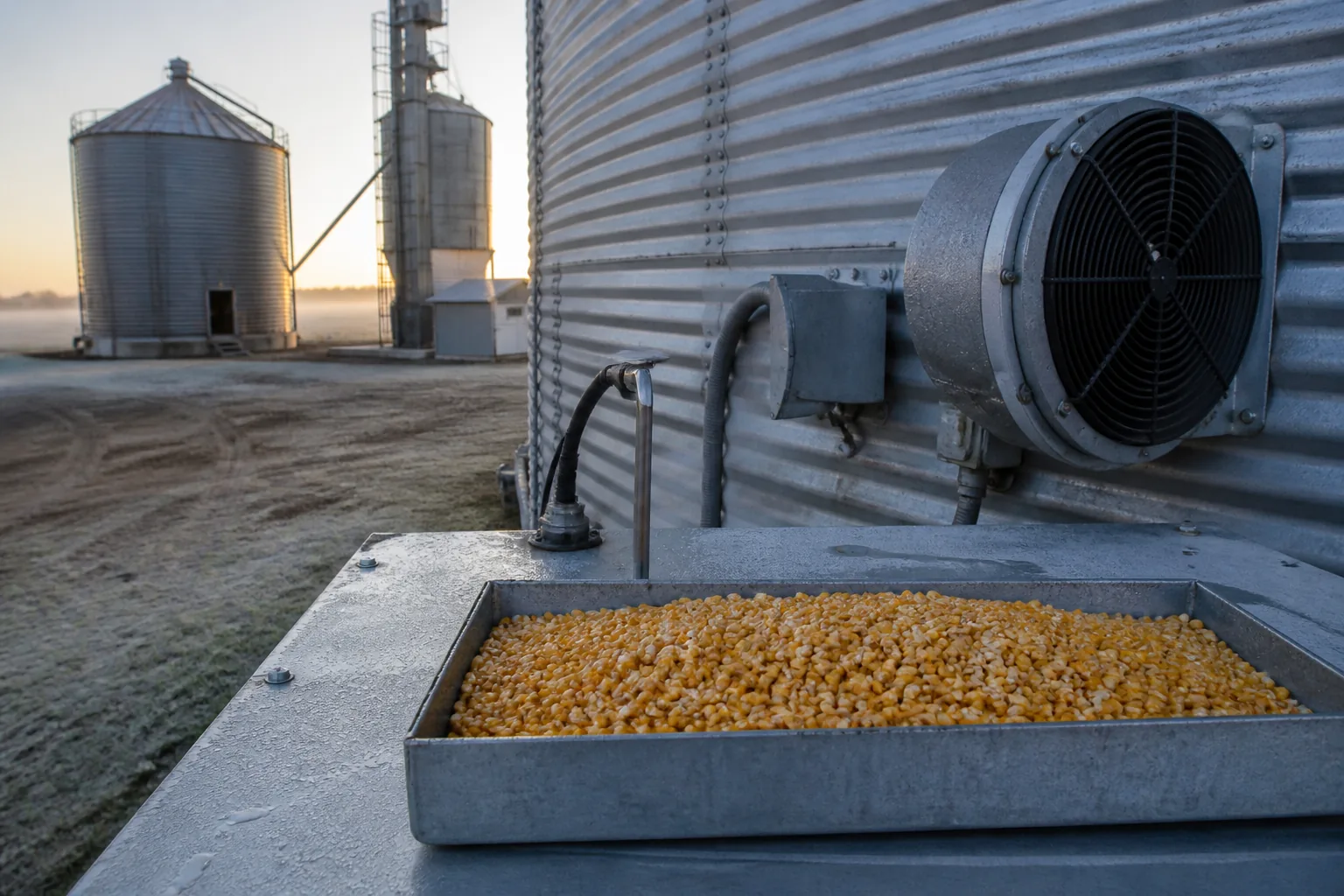
Wet corn should not be left in a truck, wagon, pit, or unaerated bin for a planned multi-day wait. Move it into an aerated wet-holding system and start cooling as soon as possible, then dry it according to the shortest safe limit created by its moisture, actual grain temperature, condition, and airflow.
There is no single safe number of days. At 22% moisture, extension tables place approximate maximum allowable storage time at only 3–5 days at 80°F, 8–9 days at 70°F, 15–17 days at 60°F, 30–35 days at 50°F, and 60–84 days at 40°F. These are estimates of total quality life under controlled conditions—not recommended waiting periods and not guarantees against heating or mold.
For operating decisions, use the conservative end of the range and plan to finish drying while at least half of the estimated storage life remains. Warm wet corn, damaged kernels, fines, uneven airflow, and moisture pockets justify a much shorter schedule.
Quick Reference: Approximate Maximum Time by Moisture and Temperature
The ranges below combine tables published by Iowa State University Extension and NDSU Extension. They show how strongly grain temperature changes the result.
| Corn moisture | At 80°F | At 70°F | At 60°F | At 50°F | At 40°F |
|---|---|---|---|---|---|
| 20% | 7–9 days | 14–16 days | 25–28 days | 50–63 days | 90–142 days |
| 22% | 3–5 days | 8–9 days | 15–17 days | 30–35 days | 60–84 days |
| 24% | 2–4 days | 6 days | 10–11 days | 15–25 days | 40–56 days |
| 26% | 2–3 days | 5 days | 8 days | 12–18 days | 35–41 days |
These numbers should not be treated as a countdown clock. They assume the grain is held near the listed temperature and do not fully represent every hybrid, damage level, fine-material concentration, field mold, wet pocket, or airflow pattern.
The two extension tables differ because allowable storage time is an estimate built from biological deterioration relationships and source assumptions. That difference is exactly why a manager should not schedule drying to the final day in a table. Use the lower value, subtract life already consumed, and keep a substantial reserve.
“Allowable Storage Time” Is a Quality Limit, Not Permission to Wait
Allowable storage time, often abbreviated AST, estimates how long grain can remain under a stated moisture and temperature condition before deterioration is expected to affect quality. It does not mean the grain will be unchanged until the last day and suddenly spoil the next morning.
Biological activity begins before obvious symptoms appear. Wet kernels, mold organisms, and insects respire, producing heat and moisture. If that heat is not removed, the grain warms, and the warmer grain deteriorates faster. An unaerated mass can therefore shorten its own remaining life.
Iowa State describes its table as maximum storage life for clean corn with about 30% mechanical damage and notes that corn with 40% mechanical damage may have only half that time. NDSU also describes its values as approximate. Actual corn with broken kernels, low test weight, disease, or concentrated fines may deteriorate substantially faster.
For temporary holding, a practical rule from Iowa State is to plan to market or manage grain with half of the allowable storage time still remaining. For corn that will later be stored into spring or summer, being even more conservative preserves life needed after drying.
Use Grain Temperature, Not the Weather App
The temperature in an AST table is the temperature of the grain mass. Afternoon air temperature, overnight low, or the weather forecast is not a substitute.
Freshly harvested corn can enter a wet bin warm from the field. A large grain mass is a good insulator, so the center may remain warm even after outdoor air cools. Temperature can also vary between the top, center, walls, and zones where fines restrict airflow.
Measure and record grain temperature at multiple practical locations. A temperature cable reports only the grain close to each sensor, so combine cable data with exhaust-air observations and physical samples where the system allows safe sampling.
The basic trend is powerful: increasing grain temperature by 10°F can cut holding time roughly in half. Iowa State's 2025 guidance similarly notes that, under otherwise comparable conditions, increasing moisture by about two points can approximately double the rate of deterioration from holding.
This means a load that appeared manageable after a cool 50°F harvest may become urgent if it remains at 60°F or begins to self-heat. Recalculate the plan from the higher observed grain temperature rather than the original assumption.
Storage Life Is Cumulative
Drying and cooling do not reset corn to a completely unused storage life. Time spent warm and wet consumes part of the grain's total quality life, and only the unused fraction remains under the next condition.
Calculate the fraction used during each holding period:
Storage-life fraction used
= days held under the condition
÷ allowable storage time for that moisture and temperature
Add the fractions from each period:
Total storage life used
= fraction from period 1
+ fraction from period 2
+ fraction from later periods
Example: 22% corn held under two temperatures
Use the conservative NDSU values for this example:
- 22% corn at 70°F: approximately 8 days AST
- 22% corn at 50°F: approximately 30 days AST
Suppose the corn remains at 70°F for two days, then is cooled to 50°F and waits five more days before drying.
Life used at 70°F = 2 ÷ 8 = 25.0%
Life used at 50°F = 5 ÷ 30 = 16.7%
Total life used = 41.7%
Estimated life remaining = 58.3%
The batch has already used nearly 42% of its estimated life before drying. If it will later be stored, that history matters. A plan that only looks at the new, lower moisture after drying will overstate the time available for future storage.
Use these percentages as management estimates, not precision predictions. When the grain condition is questionable, treat the remaining fraction as smaller.
Truck, Wet Bin, and Drying Bin Are Not Equivalent
Where the corn waits can matter as much as the stated moisture.
| Holding location | Main limitation | Practical response |
|---|---|---|
| Truck, wagon, or grain cart | Little or no controlled airflow through the load | Unload promptly; do not use as planned multi-day storage |
| Pit or unaerated bin | Biological heat and wet pockets can build unseen | Move to an aerated system or dryer as soon as possible |
| Aerated wet-holding bin | Can control temperature if airflow reaches the whole mass | Start fans promptly and confirm the cooling front completes |
| Full-floor natural-air drying bin | Can remove moisture only with sufficient airflow and suitable weather | Verify design limits, grain depth, initial moisture, and expected drying time |
| High-temperature dryer system | Removes moisture quickly but may be limited by wet-bin and dryer throughput | Match harvest rate to actual drying capacity |
Wet corn in a transport vehicle is not equivalent to corn held at a uniform table temperature in a properly aerated bin. Iowa State warns that holding wet corn in unaerated bins or transport vehicles can consume a significant portion of its storage-life potential.
Operationally, treat trucks and carts as part of the harvest flow, not as storage. If the dryer stops, reducing the combine inflow may be less costly than building an unaerated inventory that cannot be cooled or monitored well.
Aeration Buys Control, Not Unlimited Time
Aeration moves a cooling front through the grain and helps establish a cooler, more uniform temperature. It slows deterioration and reduces moisture migration. It does not erase storage life already used, and ordinary aeration should not be mistaken for grain drying.
Iowa State's 2025 guidance states that warm, wet corn needs at least 0.25 cubic foot per minute per bushel (cfm/bu) of aeration to remove biologically generated heat. In its example facility, wet-holding bins were designed for 0.629 cfm/bu and approximately 22-hour full-bin cooling—not because every farm needs that exact design, but because wet-holding airflow and dryer capacity must be engineered together.
Airflow stated on paper is not enough. Actual performance depends on:
- Grain depth and bin diameter
- Fan output at the system's static pressure
- Perforated-floor and duct area
- Fine material and broken kernels
- Grain distribution and coring
- Whether air can bypass part of the grain mass
- How quickly the bin is filled
Track inlet and exhaust temperatures to determine when the cooling front has passed. A fan that runs without moving air uniformly through the grain can create false confidence.
Aeration and Natural-Air Drying Are Different Jobs
Aeration primarily manages temperature. Natural-air drying uses much higher airflow over a much longer period to remove moisture.
NDSU limits natural-air or low-temperature corn drying to roughly 20%–21% initial moisture, with at least 1.0 cfm/bu and a corn depth of about 20–22 feet under its northern-region guidance. It reports that drying may take about 40 days in October and 70 days in November. Weather, airflow, grain depth, and region can change those results.
Corn above about 21% generally requires a high-temperature dryer under this guidance, especially when it is warm. Putting 24% corn in a bin with a small storage-aeration fan does not turn the bin into a natural-air dryer.
If wet corn is intentionally cooled for winter and dried in spring, that is a planned system requiring suitable airflow, unloadability, temperature management, and enough unused storage life. It should not be improvised after the dryer becomes overloaded.
Corn Above About 23% Creates an Unloading Risk
NDSU warns that corn above approximately 23% moisture may freeze together or deform and bind in a conventional grain bin. The mass may not flow for unloading. In cold regions, very wet corn should be placed where it can be mechanically dislodged rather than assumed to remain free-flowing.
This is separate from spoilage risk. A batch might be kept biologically cold yet still create a serious handling problem. Before filling a wet-holding structure, confirm:
- Maximum moisture the structure is designed to hold
- Expected grain temperature and freezing conditions
- Unloading method if the mass does not flow
- Fan, vent, and roof-pressure limitations
- Safe procedures for blockages
Never enter a grain bin to break a bridge or restore flow. Lock out unloading equipment and follow established grain-bin safety procedures.
Damage, Fines, and Moisture Variation Shorten the Schedule
The average moisture does not describe the highest-risk part of the batch. Corn harvested from different field zones or hybrids can enter the wet bin with a wide moisture range. Fines and broken kernels may concentrate beneath the fill point, where airflow resistance and biological activity are higher.
Iowa State's 2025 guidance identifies field molds, low test weight, broken kernels, stalk and cob pieces, and fines as factors that accelerate deterioration and reduce allowable storage time. Do not apply a table for sound, clean corn unchanged to a damaged lot.
Use representative checks across incoming loads. Record individual results and the range instead of keeping only one average. A portable Grain Moisture Meter is useful for routine comparisons across loads and for tracking moisture bands entering the wet-holding system.
If one group is several points wetter, keep it separate when possible and prioritize it for drying. Mixing wet and drier corn may produce an acceptable average while leaving local wet pockets that determine the real risk.
Build a Wet-Corn Holding Plan Before Harvest
A useful plan connects combine capacity, truck cycle time, wet-bin volume, airflow, and dryer throughput.
1. Measure actual dryer capacity at the expected removal
Nameplate capacity changes with moisture points removed. A dryer that handles corn quickly at 20% may process 25% corn much more slowly. Use actual bushels per hour at the expected incoming and discharge moisture.
2. Calculate how fast the wet bin fills
Net wet-bin fill rate
= combine delivery rate − dryer intake rate
Hours until wet bin is full
= available wet-bin bushels ÷ net fill rateIf the combine delivers 2,500 bu/h, the dryer accepts 1,500 bu/h, and the bin has 8,000 bushels of available space:
Net fill rate = 2,500 − 1,500 = 1,000 bu/h
Time to full = 8,000 ÷ 1,000 = 8 hours
Without another managed holding option, harvest must slow before the eight-hour limit.
3. Set a conservative maximum holding window
Use:
- The wettest meaningful moisture band, not only the average
- The warmest representative grain temperature
- The lower AST estimate
- A reduction for damage, fines, disease, or uneven airflow
- A goal of retaining at least half of the storage life
The resulting window should be shorter than the table maximum. It should also include time required to empty the last wet corn after harvest stops.
4. Define stop triggers
Stop adding wet corn and accelerate drying or movement if:
- Grain temperature rises unexpectedly
- Exhaust temperature or odor changes
- Condensation, crusting, or visible mold appears
- The fan cannot establish the expected cooling front
- Dryer downtime will exceed the planned reserve
- Incoming moisture is materially higher than expected
- Wet-bin level threatens safe airflow or unloading
Heating is not a reason to wait for the planned deadline. It is evidence that the original holding assumption is no longer valid.
A Daily Monitoring Routine While Corn Waits
Use a simple written record for every wet-holding bin:
1. Record representative incoming moisture average and range. 2. Record grain temperature at several locations. 3. Record fan start time and operating status. 4. Compare inlet and exhaust temperatures to follow the cooling front. 5. Check the grain surface, vents, roof area, and exhaust air from outside the bin. 6. Record wet-bin inventory and the oldest grain's arrival time. 7. Recalculate remaining AST after any temperature or moisture change. 8. Dry the oldest or highest-risk wet corn first where system design allows.
Do not rely on one center temperature cable. Grain is insulating, and a developing hot spot can be several feet from a sensor. Trends across readings and locations are more useful than one isolated number.
What to Do When the Dryer Stops
The correct response depends on whether the wet corn can be uniformly aerated and how much storage life remains.
Short interruption with adequate wet-bin aeration
Keep the wet-holding fan operating according to the system plan, monitor temperature and exhaust air, calculate the revised queue, and stop harvesting before unmanaged capacity is used.
Interruption with trucks or unaerated grain waiting
Prioritize moving this grain to controlled aeration or an available dryer. Do not assume cool nighttime air will penetrate a deep truckload without forced airflow.
Long interruption or uncertain restart
Consider commercial drying, delivery under the buyer's wet-corn schedule, transfer to another suitable facility, or reducing harvest. Compare those costs with the value at risk. The calculation in How Much Will It Cost to Dry Corn from 22% to 15%? can be used as the on-farm side of the comparison.
If the field is still standing, use Should I Harvest Wet Corn Now or Let It Dry in the Field? to compare field exposure with the drying-system bottleneck. The lowest-risk choice may be to change the harvest order rather than create more wet inventory.
Common Mistakes
“It is cool outside, so the corn is cool.”
Measure the grain. A warm center can persist inside a mass even when nights are cold.
“The table says 15 days, so drying on day 14 is safe.”
AST is an approximate maximum under assumed conditions. Use the conservative estimate, account for damage, and retain a large reserve.
“Running any fan means the corn is protected.”
Protection depends on actual airflow through the whole mass and completion of the cooling front. Fines, grain depth, and fan performance matter.
“Aeration will dry 24% corn while it waits.”
Storage aeration mainly controls temperature. Natural-air drying requires higher airflow, suitable weather, and moisture within the system's design limit.
“The average moisture represents the wet bin.”
An average can hide 26% pockets in a nominally 22% batch. Preserve the range and prioritize the highest-risk material.
“Drying later restores all the storage life.”
Storage life is cumulative. Corn that spent several days warm and wet carries that history into later storage.
Bottom Line
Wet corn should move out of trucks, wagons, pits, and unaerated storage promptly. Once it is in a properly designed wet-holding bin, the maximum theoretical wait depends mainly on actual grain temperature and moisture, then must be shortened for damage, fines, nonuniform airflow, and life already consumed.
At 22% moisture, extension tables estimate about 3–5 days at 80°F, 8–9 days at 70°F, 15–17 days at 60°F, 30–35 days at 50°F, and 60–84 days at 40°F. Do not schedule to those maximums. Use the lower figure, keep the grain uniformly cool with adequate aeration, monitor it daily, and plan to complete drying with at least half of the estimated storage life still available.
Sources and Further Reading
- Iowa State University Extension: Options for Fall Grain Drying and Marketing
- Iowa State University Extension: Corn Harvest, Handling, Drying, and Early Storage Considerations for 2025
- NDSU Extension: Allowable Storage Time for Cereal Grains, Malting Barley and Soybeans
- NDSU Extension: Corn Drying and Storage Tips When There Is Early Frost
- University of Minnesota Extension: Managing Stored Grain With Aeration
- NDSU Extension: Corn Harvest and Drying Guidance