
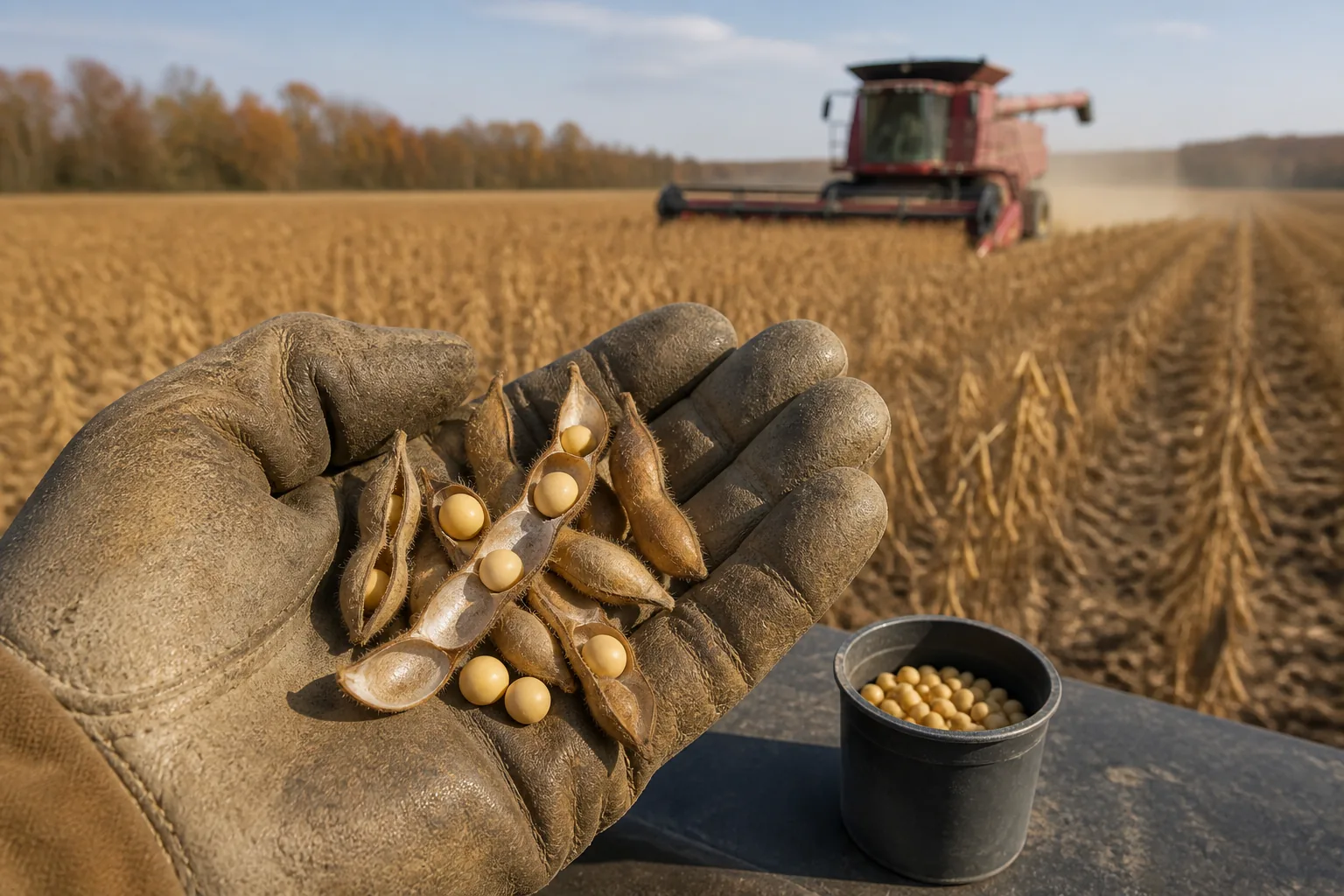
For commodity soybeans, 13% seed moisture is the best general harvest target because it preserves marketable weight while limiting shatter and mechanical damage. If you have dependable aeration or gentle drying capacity, it is often practical to start at 14%–15% so later acres are not harvested below 11%. For direct delivery without a wet-soybean plan, aim closer to 12%–13% and confirm the buyer's exact moisture basis before combining.
The correct decision is therefore not simply “wait until every field is 13%.” Soybean moisture can move several points during a dry, windy day or after overnight dew. A field that is 13% in the morning may be brittle by afternoon, while another field may still contain green pods and wet material. Use seed moisture, harvest loss, weather risk, and postharvest capacity together.
Practical Soybean Harvest Moisture Targets
| Situation | Working moisture target | Practical response |
|---|---|---|
| Direct delivery with no drying plan | About 12%–13% | Verify buyer basis, rounding, discounts, and maximum receiving moisture |
| On-farm aeration or gentle drying available | Start around 14%–15% | Dry promptly to the marketing or storage target |
| Seed moisture below 11% | Harvest during higher humidity when possible | Recheck header loss, pod shatter, splits, and ground speed |
| Uneven field with dry seed and green stems | Decide from seed and pod condition | Slow down if stems limit feeding; do not wait on stem color alone |
| Repeated rain and drying cycles expected | Favor timely harvest | Pod splitting and shatter risk can outweigh waiting for exactly 13% |
| Long storage planned | Harvest target and storage target may differ | Condition grain for the actual storage duration after harvest |
These are management ranges, not universal contract terms. Specialty soybeans, identity-preserved grain, food-grade beans, and seed production may have tighter receiving or quality requirements.
Why 13% Is the Reference Point
Iowa State University Extension describes 12%–13% as the soybean harvest “sweet spot,” with optimum yield at 13%. North Dakota State University also identifies about 13% as optimal for reducing mechanical damage. The reasons are practical:
- Soybeans are commonly marketed on a 13% moisture basis.
- Seed coats and pods become more brittle as moisture falls.
- Overly dry beans weigh less and are more vulnerable to shatter, cracking, and splits.
- Beans above the buyer's basis may receive moisture shrink or a discount and may need drying.
Thirteen percent is a balance, not a biological safety switch. A load at 13.2% does not suddenly become poor grain, and a field at 12.8% is not automatically ideal if the header is leaving several bushels per acre on the ground. Evaluate the whole harvest result.
Start-Harvest Moisture Is Not the Same as Delivery Moisture
This distinction prevents one of the most expensive soybean harvest mistakes.
If the farm has an aerated bin and a proven method for removing a small amount of moisture, beginning at 14%–15% can protect later fields from becoming excessively dry. NDSU advises that beginning in this range may reduce the amount harvested below 11%. University of Nebraska guidance similarly supports earlier harvest when suitable drying capacity is available.
If the soybeans will go directly from the combine to an elevator, the buyer's schedule matters more. Some buyers begin moisture deductions above 13%, use different brackets, or restrict wet-soybean deliveries. Call before hauling and ask:
1. What is the soybean moisture basis? 2. How are readings rounded? 3. Is the deduction a price discount, shrink, drying fee, or combination? 4. What is the current maximum receiving moisture? 5. Are loads settled individually or averaged?
Do not harvest 15% soybeans with no receiving, drying, or storage plan. Wet beans left in a truck, wagon, or unaerated holding bin are not protected simply because the field decision was agronomically reasonable.
Use Crop Maturity to Start Scouting, Not to Predict Exact Moisture
Soybean stage R8, or full maturity, occurs when 95% of pods have reached their mature color. University of Minnesota notes that soybeans commonly need another five to 10 days of drying weather after R8 to reach a desired harvest moisture below 15%.
That interval is only a scouting guide. Temperature, relative humidity, wind, rainfall, canopy condition, field variability, and variety change the rate. A visual maturity check cannot replace a seed-moisture measurement.
Use this sequence:
1. Identify fields at or near R8. 2. Walk representative high, low, edge, and interior areas. 3. Inspect whether pods are mature and releasing seed cleanly. 4. Measure seed moisture from multiple areas. 5. Check the forecast and harvest-loss risk. 6. Assign harvest order by condition, not planting date alone.
The first field planted is not always the first field that should be harvested. Earlier maturity, drought stress, disease, hail, lodging, pod integrity, and rapid drydown can move another field ahead in the queue.
Why Soybeans Below 11% Become High-Risk
NDSU reports that field loss, splits, and cracked seed coats increase as soybean moisture decreases, with shatter loss increasing significantly below 11% or after repeated wetting and drying cycles.
Several losses can occur at the same time:
Pod shatter before the combine arrives
Mature pods can split and release beans because of wind, rain-dry cycles, or mechanical contact. These beans are already lost before the header reaches them.
Header shatter and dropped pods
Brittle pods can open when struck by the reel, cutterbar, or other crop material. Soybean header loss can dominate total machine loss, so the loss monitor in the cab does not tell the whole story.
Cracked seed coats and splits
Dry soybeans are less tolerant of impact. Aggressive threshing or repeated transfers can create splits and damage that affect grade, handling, and storability.
Lost marketable weight
Dry beans contain less water than the 13% market basis. The dry matter may be present, but the scale weight is lower. This weight effect is separate from beans physically left in the field.
Use the formulas in How Much Shrink Am I Losing Because of Moisture? to convert a moisture difference into equivalent bushels. At a 13% target, each point of water-only adjustment equals approximately 1.149% of incoming weight per moisture point.
Why Starting at 14%–15% Can Be Rational
Starting slightly above the market basis creates a harvest window. The first loads may require aeration or drying, but the later loads are less likely to fall far below 13% before the crop is finished.
The tradeoff is measurable:
| Harvest condition | Main advantage | Main cost or risk |
|---|---|---|
| Start at 14%–15% | Less shatter and impact damage; protects later acres | Requires drying or moisture deduction; wetter stems can reduce capacity |
| Harvest around 12%–13% | Near common market basis; little conditioning needed | Window can be short during hot, dry, windy weather |
| Wait until below 11% | No drying requirement | Lower sale weight plus higher shatter, split, and header-loss risk |
Water-only shrink from 14% to 13% is approximately 1.15% of incoming weight. From 15% to 13%, it is about 2.30%. Those adjustments are not free, but they may be smaller than the combined value of excess field loss, physical damage, and delayed harvest.
Do not decide from moisture alone. Compare the buyer's actual schedule, on-farm drying cost, harvest-loss counts, upcoming weather, and acres remaining.
Soybean Moisture Can Change Within the Same Day
Soybean seed exchanges moisture with the surrounding air. NDSU notes that moisture may increase several points with overnight dew and decrease several points during a low-humidity, windy day.
This creates a practical daily pattern:
- Early morning may offer tougher pods and less shatter, but external moisture or wet crop residue can reduce feeding capacity.
- Late morning can provide a productive balance as surface moisture leaves while seed remains less brittle.
- Dry afternoon conditions may maximize combine capacity but increase shatter and splits in already dry fields.
- Evening humidity can sometimes restore a workable harvest window, although wet stems and leaves may again limit throughput.
Do not use the clock as the rule. Measure seed moisture and inspect losses. A dew can help brittle pods without making a severely dry seed lot truly equivalent to 13%, and field conditions must still support safe equipment travel.
When beans are below 11%, NDSU recommends considering harvest during higher humidity, such as early morning, late evening, or damp conditions, to reduce shatter and mechanical damage. Stop if loss rises faster than the added acres justify.
Green Stems Do Not Necessarily Mean Wet Seed
Soybeans can have mature, dry seed while stems remain green. Iowa State notes that green stems often limit header and combine capacity rather than yield directly.
Judge three things separately:
| Observation | What it may mean | Response |
|---|---|---|
| Dry, mature pods with green stems | Seed may be ready; stems are slowing crop flow | Measure seed moisture and reduce ground speed if necessary |
| Green pods or green leaves entering the tank | Foreign material and uneven moisture risk | Adjust harvest and cleaning; avoid concentrating wet material in storage |
| Green, soft, immature seed | Crop area is not fully ready | Separate or delay that area if practical |
| Dry pods that snap easily | Shatter risk is increasing | Check ground loss immediately and adjust the header |
Waiting for every stem to turn brown can push mature seed below the ideal moisture range. On the other hand, forcing large amounts of green plant material through the combine can increase fuel use, plugging, foreign material, and uneven bin conditions. The seed sample and clean-grain tank provide better evidence than stem color alone.
Take a Representative Moisture Sample
A single handful from a field edge can create a false harvest decision. Moisture can vary with soil type, topography, maturity, variety, drainage, disease, canopy, and time of day.
Before opening the field:
1. Sample several widely separated locations, including visibly different zones. 2. Shell seed from mature pods without intentionally selecting only the driest or cleanest plants. 3. Keep distinct problem areas separate rather than hiding them in one average. 4. Mix the representative seed and divide out the test portion. 5. Record the average and observed range.
After combining begins, collect increments from the clean-grain stream or tank at intervals rather than relying on the first small amount harvested. Recheck after moving to a new soil zone, variety, field, or time-of-day condition.
A portable grain moisture meter is useful for routine field decisions, harvest sequencing, and identifying loads near a buyer's threshold. It is not an official or legal-for-trade settlement instrument. The buyer's stated sampling and testing procedure controls the sale.
Measure Harvest Loss Instead of Guessing
Moisture is only useful if it leads to a better harvest result. Count beans on the ground before and after the combine.
University of Nebraska–Lincoln gives a useful conversion at 13% moisture:
| Soybean seed size | Beans per square foot equal about 1 bu/acre |
|---|---|
| Small | 5 |
| Medium | 4 |
| Large | 3 |
Because seed size varies, “four beans per square foot” is a rule of thumb, not an exact constant. Repeat counts across the full header width and in several representative areas.
Step 1: Establish preharvest loss
Before the combine enters, count loose beans and beans in opened or dropped pods. This is the baseline caused by the field and weather.
Step 2: Isolate header loss
Harvest a short distance, stop, and back up before residue covers the cut area. Compare beans and pods on the ground with the preharvest baseline. Iowa State reports that header loss can account for as much as 90% of total soybean machine loss.
Step 3: Check separation and threshing loss
Inspect residue behind the combine for loose beans and unthreshed pods. Look in the clean-grain tank for splits, cracked seed coats, and excessive foreign material.
Step 4: Repeat when conditions change
Recheck after a significant moisture change, new field, new variety, major ground-speed change, or adjustment. A setting that worked at 14% in the morning may be too aggressive at 10.5% in the afternoon.
Adjust the Combine to the Crop in Front of It
There is no single correct soybean setting for every combine and field. Begin with the operator's manual, then change one variable at a time and verify the result on the ground and in the tank.
Practical priorities include:
- Keep the cutterbar low enough to capture low pods without operating unsafely against the soil surface.
- Match reel position and speed to crop height and ground speed; avoid beating brittle pods.
- Reduce ground speed when green stems feed unevenly or the cutterbar cannot maintain a clean cut.
- Use the lowest rotor or cylinder speed that still threshes pods acceptably.
- Open or close the concave only as needed to complete threshing without unnecessary impact.
- Balance fan and sieve settings to remove light material without carrying soybeans out the rear.
- Inspect the tank and ground after each meaningful change.
The goal is not maximum acres per hour at any cost. It is maximum harvested value per hour after shatter, missed pods, splits, foreign material, and downtime are considered.
What to Do at Different Moisture Readings
15% or higher
Harvest only if you have confirmed drying, aerated storage, or buyer acceptance. Check for green material and uneven maturity. Do not allow wet beans to wait unaerated.
13%–15%
This can be an effective starting window when conditioning capacity is available. Monitor drying needs and buyer deductions load by load.
12%–13%
This is the preferred direct-harvest range for many commodity soybean situations. Keep checking losses because pods can become brittle even when the average sample remains acceptable.
11%–12%
Continue harvesting, but increase loss checks. Prioritize the driest, most shatter-prone fields and consider shifting working hours toward higher humidity.
Below 11%
Treat the field as high-risk. Measure preharvest and header loss, reduce unnecessary impact, and use morning or evening humidity when practical. Do not assume waiting for rain will restore all lost weight or reverse pod damage.
Storage Moisture Is a Separate Decision
The moisture that minimizes harvest loss is not automatically safe for the intended storage period. NDSU states that soybeans harvested at 11%–13% can be placed into ordinary bins with aeration, while beans carried into warm spring and summer conditions may need to be near 11% to limit deterioration.
The exact storage target depends on duration, grain temperature, quality, aeration, and climate. Beans harvested at 14%–15% need prompt conditioning; beans harvested at 9% do not become economically ideal merely because they are dry enough to store.
Keep these decisions separate:
1. Harvest moisture: protects yield and physical seed quality. 2. Delivery moisture: follows the buyer's contract and discount schedule. 3. Storage moisture: manages biological risk for a defined time and temperature.
Common Soybean Harvest Moisture Mistakes
Waiting until the entire field averages 13%
Dry areas may already be below 11% while low areas remain wet. Harvest or segregate by zones when practical.
Judging readiness from stem color alone
Green stems can coexist with dry, mature seed. Test seed moisture and inspect pods.
Starting at 15% without a postharvest plan
Early harvest only works if the farm or buyer can safely receive and condition the beans.
Harvesting through the driest afternoon without checking loss
Fast feeding can hide rising shatter and header loss. Stop and count.
Treating the field average as the whole story
Record the moisture range. A 12.5% average can contain zones well below 11% and zones above the buyer's basis.
Using one combine setting all day
Seed and stem moisture change. Verify losses and grain quality as conditions move.
Confusing dry beans with loss-free beans
Low moisture avoids a wet-grain deduction but reduces saleable weight and can increase physical loss and damage.
A Preharvest Soybean Checklist
- Confirm each field's maturity, pod integrity, lodging, and weather exposure.
- Measure seed moisture across representative field zones.
- Identify whether the load will be delivered, dried, or stored.
- Obtain the buyer's current soybean moisture schedule.
- Begin earlier when drying capacity exists and later acres are likely to become too dry.
- Establish a preharvest ground-loss baseline.
- Check header, separation, and tank quality after opening the field.
- Recheck moisture and loss as humidity, wind, ground speed, or crop condition changes.
- Keep wetter, greener, or specialty lots separate when their management requirements differ.
Bottom Line
Use 13% soybean moisture as the central harvest target, not as a reason to wait until every acre reaches exactly 13%. With dependable aeration or gentle drying, starting at 14%–15% can reduce the risk of harvesting later acres below 11%. Without that capacity, target approximately 12%–13% for direct delivery and verify the buyer's terms.
The best decision comes from representative seed-moisture readings plus actual harvest-loss counts. When beans become dry, shift harvest timing, slow or adjust the combine, and prioritize vulnerable fields. Protecting beans from shatter, splits, and lost scale weight is more valuable than hitting a single moisture number perfectly.
Sources and Further Reading
1. Iowa State University Extension and Outreach, Soybean Harvest: When the Time Is Right. 2. North Dakota State University Extension, Enhancing Soybean Storage Starts with Harvest Moisture. 3. University of Nebraska–Lincoln CropWatch, Set Soybean Harvest Goal of 13% Moisture to Aid Profits. 4. University of Nebraska–Lincoln CropWatch, How to Estimate Harvest Losses in Soybean and Corn Fields. 5. Iowa State University Extension and Outreach, Verifying Combine Adjustments During Crop Harvest. 6. University of Minnesota Extension, Soybean Growth Stages and Full Maturity. 7. North Dakota State University Extension, North Dakota Soybean Production Field Guide.