
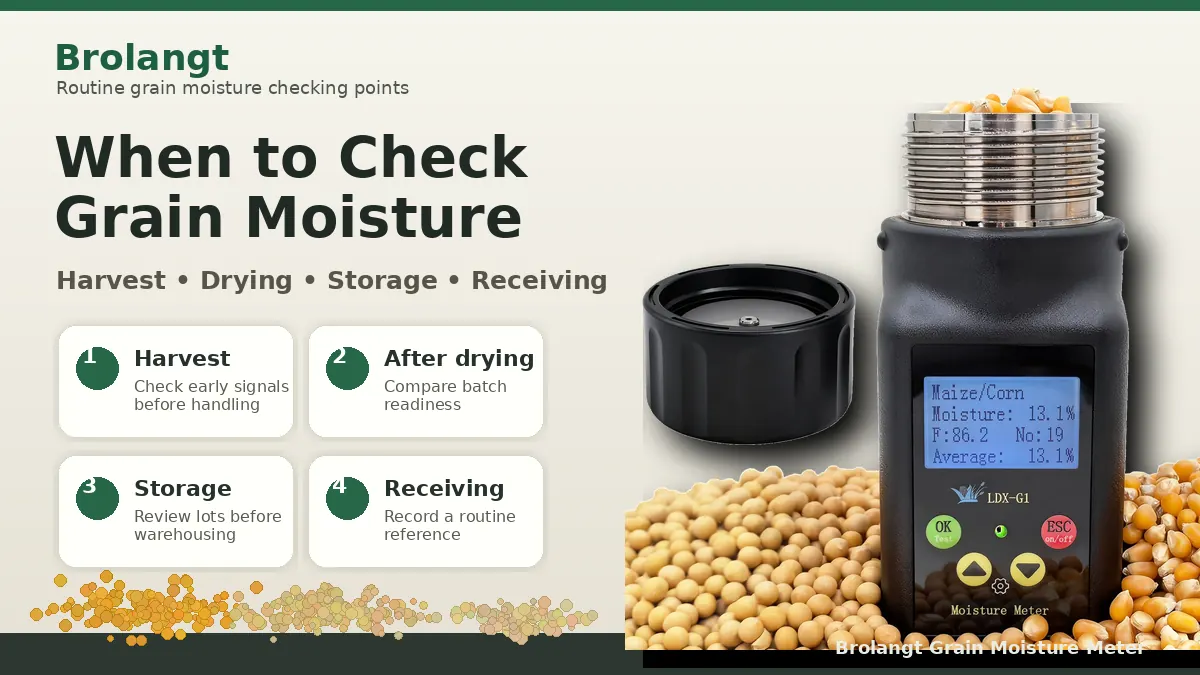
# When to Check Grain Moisture: Harvest, Drying, Storage and Buying Scenarios
Grain moisture should be checked at the points where a decision is about to be made: before harvest, after harvest, during drying, before storage, during storage review, before transport, and when grain is received or purchased. A portable grain moisture meter does not replace formal inspection where that is required, but it gives farmers, storage users, dryers and grain buyers a practical routine reference before they move, store or accept grain.
Moisture checking is not only a technical step. It is a management habit. Grain changes hands, moves between containers, goes through drying, waits in storage, and may be sampled again before loading. Each stage has a different purpose. Checking too late can leave the user reacting after the important decision has already been made. Checking at the right moment helps the user compare batches, decide whether more drying is needed, and keep basic records for daily operation.
This guide focuses on practical timing. It does not go into service adjustments or complicated technical procedures. The goal is to help users build a simple routine around harvest, drying, storage and receiving checks.
The Simple Rule: Check Before Each Handling Decision
The most useful way to think about grain moisture is this: check before the grain enters a new stage.
Before harvest, a moisture reference can help the user understand field condition. Before drying, it helps separate wetter and drier lots. After drying, it helps users decide whether the batch is ready for the next step. Before storage, it supports the decision to move grain into a bin, warehouse or bag. Before transport or receiving, it gives a basic reference for the lot being moved or accepted.
For a cup-type meter, the working process is usually straightforward. The user collects a small sample, places the grain into the sample cup or measuring chamber, selects the matching grain mode, and records the reading as a routine reference. For product-specific operation, users should follow the product manual.
If you are still comparing meter styles, see our guide to cup-type vs probe-type grain moisture meters. If you are choosing a device for several crops, our grain moisture meter buying guide for corn, wheat, rice and beans explains the main buying points.
Before Harvest: Understand the Field Condition
A moisture check before harvest is useful because the crop may not dry evenly across a field. Low areas, shaded sections, late-planted areas and different varieties can show different conditions. A farmer does not need to test every plant. The practical point is to understand whether the crop is approaching the desired handling stage and whether different field areas should be treated as separate lots.
For corn, wheat, rice and soybeans, pre-harvest checking can support harvest planning. It may help the user decide whether to inspect again later, prepare drying capacity, or separate earlier and later sections. This is especially useful when weather is changing quickly or when a drying facility must be scheduled.
The key is sample discipline. A single handful from the easiest location may not represent the field. Users should take small samples from several relevant points, keep the grain type consistent, and record the result with the date and location. This creates a more useful routine reference than one isolated reading.
After Harvest: Sort Batches Before the Next Step
After harvest, grain often moves fast. It may be loaded, transported, unloaded, dried or stored within a short period. This is one of the most important times to check moisture because different lots may look similar but behave differently in handling.
A routine moisture reference after harvest can help users decide whether grain should go directly to drying, temporary holding, storage preparation or further review. It also helps prevent all harvested grain from being treated as one uniform batch when field conditions were not uniform.
For small farms, this may be as simple as checking each trailer, bag group or lot before it is mixed with another batch. For grain buyers and receiving points, it may mean checking a collected sample from a delivery before the grain enters the main storage flow.
A portable cup-type grain moisture meter is practical in this situation because the user can work with a small collected sample instead of moving the whole batch. To understand this product format, read what a sample cup grain moisture tester is.
During Drying: Check the Process, Not Just the End Point
Drying is not a single moment. Grain condition changes during the process, and different parts of a batch may not respond in exactly the same way. A moisture reference during drying helps users observe the direction of change and avoid relying only on time or appearance.
For example, corn kernels may still appear similar while their moisture condition is changing. Wheat or rice may move through handling steps quickly, and a user may need to decide whether a batch is ready to move forward. In these cases, routine checking gives a practical reference for the drying process.
The best habit is to connect the reading to the process stage. Instead of writing only a number, record whether the grain was checked before drying, during drying, after cooling, before storage, or before loading. This context makes the record more useful later.
| Checking Point | Main Question | Practical Use |
|---|---|---|
| Before harvest | Is the crop ready for handling review? | Plan harvest and drying work |
| After harvest | Are lots similar or different? | Separate batches before mixing |
| During drying | Is the batch moving in the right direction? | Track drying progress |
| Before storage | Is the lot ready to be stored? | Support warehouse decisions |
| During storage | Has the lot changed since entry? | Review stored grain condition |
| Before receiving | What is the lot condition at arrival? | Create a routine receiving record |
Before Storage: Do Not Treat Storage as the First Check
Many moisture problems are easier to manage before grain enters storage than after it is already in place. A before-storage check gives the user a reference for the lot entering the warehouse, bin, sack or other storage method.
This does not mean a portable meter can promise safe storage conditions. Storage results depend on crop type, storage structure, ventilation, temperature, pest pressure, handling method, local practice and many other factors. The value of the moisture check is that it gives the user a practical reference before the grain is committed to storage.
This is also the point where batch records become more important. A simple record can include date, grain type, lot name, source field or supplier, whether the sample was before or after drying, and the routine moisture reading. When a later question comes up, these records help users compare the current lot with the entry record.
During Storage: Use Moisture Checks as Part of Routine Review
Stored grain should not be ignored after entry. Moisture can vary between lots, and storage conditions may change. A periodic check helps users keep a basic reference during storage review.
The purpose is not to create a complicated testing program. The purpose is to avoid relying only on memory. If grain was checked before storage and then checked again later, the user can compare routine references and decide whether the lot needs closer attention.
For storage users, it is better to check named lots than random grain with no record. A reading is more useful when it is connected to a location, batch, date and grain type. A cup-type meter can be helpful because the user can collect a small sample from a selected lot and test it without grinding whole grain samples, depending on the product instructions.
Before Transport, Buying or Receiving: Record the Lot Condition
Moisture checking is also useful when grain is moved or received. The receiving point may need a routine reference before unloading. A small trader may want a basic check before accepting a batch. A warehouse may want to compare the incoming lot with its own records.
The important point is to keep the wording realistic. A portable grain moisture meter supports routine reference checks. It should not be described as a legal settlement tool or a replacement for required inspection. For contractual, official or regulated requirements, users should follow the process required by the buyer, local authority or relevant organization.
In daily work, however, a portable meter can still be useful. It gives the operator a quick way to record the condition of a sample at arrival, compare different deliveries, and decide whether a batch needs further handling before it enters storage.
How Often Should Grain Moisture Be Checked?
There is no single schedule that fits every user. Frequency depends on the crop, climate, storage method, drying process, batch value and how often grain is moved. A small farm may check at fewer points. A receiving station or storage operator may check more often because more lots are moving through the site.
A practical routine may include these moments:
- Before harvest planning
- After harvest and before drying
- During or after drying
- Before storage entry
- During storage review
- Before loading, receiving or purchasing
The goal is not to create extra work. The goal is to check at the moments where the result can inform the next practical decision.
A Practical Tool for Routine Grain Moisture Checking
For users who handle corn, wheat, rice, soybeans and other common grains, a portable cup-type meter can be a useful daily reference tool. It is especially suitable when the user wants to collect a small sample, place it into a measuring chamber and read a result without grinding the grain.
The Brolangt Grain Moisture Meter is designed for routine moisture checking of common grains in farm, drying, storage and receiving scenarios. It is a practical option for users who want a portable sample-cup style meter for everyday reference checks.
FAQ
Should grain moisture be checked before or after harvest?
Both can be useful. A before-harvest check helps with planning, while an after-harvest check helps users sort lots and decide the next handling step.
Why check grain moisture before storage?
A before-storage check gives the user a reference for the lot entering storage. This helps with batch records and later comparison during storage review.
Is moisture checking useful during drying?
Yes. During drying, moisture checking helps users observe process direction instead of relying only on time or appearance.
Can a portable grain moisture meter be used for receiving checks?
Yes, it can support routine receiving reference checks. For official or contractual requirements, users should follow the required process for that transaction.
What kind of meter is practical for daily grain checks?
A portable cup-type grain moisture meter is practical when users want to test a small collected sample of whole grain for routine reference. For more details, see the Brolangt Grain Moisture Meter product page.