
# How to Choose a Grain Moisture Meter for Corn, Wheat, Rice and Beans
Choosing a grain moisture meter starts with one practical question: what grain will you check, and where will you check it? For corn, wheat, rice, soybeans and similar whole grains, a portable meter can be useful for routine moisture reference checks during harvest, drying, storage and receiving. The right choice depends less on a long feature list and more on whether the meter fits your grain type, sampling method and daily workflow.
This guide is written for farms, grain storage users, small receiving points and buyers who need a practical way to compare moisture meter styles before purchasing. It does not rank competing models or promise that one device can replace formal, third-party or contract-based testing. The goal is simpler: help you avoid buying the wrong type of tool for the job.
Start with the grains you actually need to check
A moisture meter is not useful just because it says “grain” on the label. The first step is to confirm that the grains you handle are supported by the meter. A user checking corn after harvest may not have the same needs as a user checking paddy rice before storage or soybeans before receiving.
For common agricultural use, buyers often look for support for corn, wheat, rice and beans. Some meters include grain modes that are selected before testing. This matters because grain shape, density and kernel structure are different. A device designed for whole grain samples is usually more suitable for routine checks when the user wants to test small samples without grinding.
Before buying, check these points:
- Does the meter list the grains you actually handle?
- Is the grain name shown clearly in the menu or manual?
- Does the workflow match whole grain samples, ground samples or inserted testing?
- Is the reading intended for routine reference rather than formal grading?
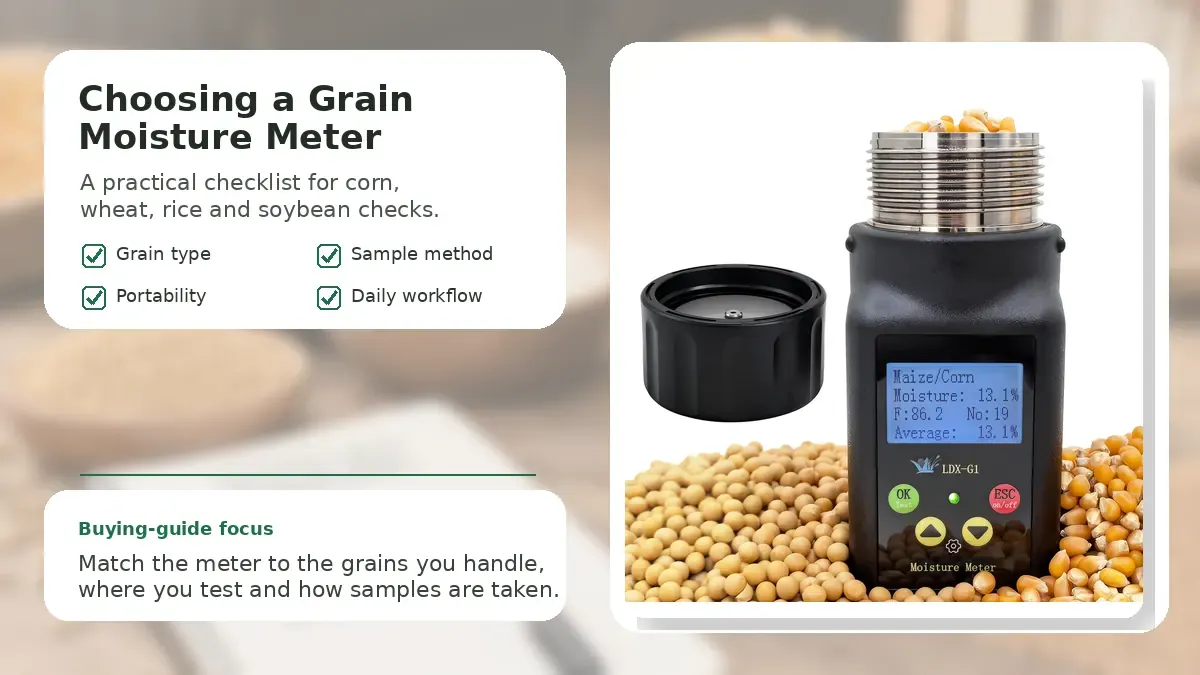
If your main grain is corn, wheat, rice or soybean, the Brolangt Grain Moisture Meter is positioned as a portable cup-type meter for routine moisture checking of common grains.
Choose the meter style that fits your workflow
Grain moisture meters are not all built around the same testing method. The three common styles a buyer may encounter are cup-type meters, probe-type meters and bench or sample-preparation systems.
A cup-type meter uses a small measuring chamber or sample cup. The user places a whole grain sample into the cup area, selects the grain mode and reads the moisture reference value. This style is useful when you want a controlled small sample rather than pushing a sensor into a bag or grain pile.
A probe-type meter is usually faster for checking bulk material in sacks, bins or piles. It can be convenient when speed is more important than careful sample handling. However, probe readings can be influenced by where the probe is inserted, how compact the grain is and how mixed the grain condition is across the pile.
A bench or sample-preparation system may be used in more controlled environments, but it is less convenient for field, storage or receiving checks. It may also require more time, space or preparation.
| Meter Style | Better Fit | Main Limitation |
|---|---|---|
| Cup-type meter | Small whole grain samples | Needs sample handling |
| Probe-type meter | Fast checks in bags or piles | Position affects reading |
| Bench-type tester | Controlled indoor testing | Less portable |
| Ground-sample method | Prepared sample workflows | More steps required |
If you are still comparing cup and probe designs, read Cup-Type vs Probe-Type Grain Moisture Meters first. That article explains the difference between the two shapes in more detail.
Decide whether portability matters in real use
Portability is not just about the device being small. A portable grain moisture meter should fit the way you move through your workday. A farm user may need to check grain near the field, near a dryer and later near storage. A receiving point may need to check different lots throughout the day. A small buyer may need a tool that can be carried to different pickup or delivery points.
When evaluating portability, look at the whole workflow, not only the size of the device:
- Can it be carried and used where grain is handled?
- Is the screen readable in normal working conditions?
- Are the buttons simple enough for repeated checks?
- Does the meter need a flat bench, or can it be used in a more flexible location?
- Can the user test a small sample without bringing grain to a separate room?
A portable meter is most useful when moisture checking is part of a daily routine. It gives users a practical reference before making drying, storage or receiving decisions. It should not be treated as a shortcut around required procedures where those procedures apply.
Look closely at sample handling
Many buyers focus on the display or the price first, but sample handling is often the difference between a tool that gets used and a tool that stays on a shelf. Ask how the grain is brought to the sensor.
For cup-type meters, the sample cup or measuring chamber creates a clear testing process: collect a small grain sample, place it into the chamber, select the grain type, run the reading and record the result if needed. This can be easier to repeat than pushing a probe into different places and trying to remember where each reading came from.
Good sample handling habits also matter. A single scoop from one corner of a sack may not represent the whole lot. For routine checks, users often take several small samples from different parts of a batch and compare the readings. If the results vary a lot, that may indicate the grain lot is not uniform and deserves closer attention.
For a simple explanation of this product shape, see What Is a Sample Cup Grain Moisture Tester?. It explains why the sample cup design is useful for whole grain reference checks.
Match the meter to the stage of grain handling
The same meter may be used at several points, but the reason for checking moisture changes by stage.
During harvest, users may want a quick view of whether grain is relatively dry or still needs attention. Around drying, the meter can help users compare moisture before and after the drying process. Before storage, it can support routine checks before grain is placed into a bin, warehouse or storage bag. During receiving, it can help staff create a reference record for incoming lots.
The buying decision should match the most frequent stage in your own workflow:
- Farm use: prioritize portability, simple operation and support for your crop.
- Drying use: prioritize repeatable sample handling before and after drying.
- Storage use: prioritize easy periodic checks and clear readings.
- Receiving use: prioritize fast small-sample checks and batch records.
- Trading use: prioritize a practical reference tool, while keeping formal requirements separate.
A meter that works well for one stage may still be inconvenient in another. For example, a bench-based tester may be acceptable in a fixed warehouse office but inconvenient during field movement. A probe may be fast in a bagged grain setting but less structured for comparing small collected samples. A cup-type meter is often easier to fit into sample-based checking routines.
Check usability before chasing technical claims
A moisture meter used in real agricultural work should be simple enough to use correctly again and again. Overly complex claims are less valuable than a clear workflow. If staff need to check grain several times a day, the display, buttons, grain selection and reading process should be easy to understand.
Useful buying questions include:
- Can the user select the grain type without confusion?
- Is the moisture reading easy to see?
- Does the manual explain the correct sample amount and operation steps?
- Does the device support the grains listed in your actual work?
- Is the device practical for field, drying, storage or receiving areas?
Be careful with exaggerated language. A portable grain moisture meter can support daily reference checks, but it should not be evaluated as if it were a formal inspection system. For purchase decisions, focus on whether the tool reduces uncertainty in routine work and whether the operation is clear enough for repeated use.
Common mistakes when buying a grain moisture meter
The first mistake is buying by keyword only. A product page may say “grain moisture meter,” but the actual testing method may not match your grains or workflow.
The second mistake is ignoring the sample type. Some users want to test whole grain kernels. Others may be comparing tools that require inserted probes or prepared samples. These are different workflows, and they should not be treated as identical.
The third mistake is expecting one reading to describe an entire batch. Grain lots can vary by position, drying condition and storage history. A practical routine often uses multiple small samples and records readings by lot or location.
The fourth mistake is using a portable meter for purposes it was not meant to handle. Where formal third-party or contract testing is required, follow the required method. A portable meter is best understood as a convenient daily reference tool.
Practical buying checklist
Before choosing a meter, write down your real use case in one sentence. For example: “I need to check corn and soybeans around harvest and storage,” or “I need a portable tool for receiving small grain lots.” This simple sentence can prevent you from buying a tool designed for a different job.
A good shortlist should answer these questions:
1. Which grains will I check most often? 2. Do I need field portability or only fixed-location use? 3. Do I prefer a cup-type sample workflow or a probe-style workflow? 4. Will the meter be used before storage, after drying or during receiving? 5. Can the operator follow the steps consistently? 6. Are the readings being used as routine reference information?
If your work involves common grains such as corn, wheat, rice and soybeans, and you prefer a portable cup-type workflow for small whole grain samples, review the Brolangt Grain Moisture Meter for product details.
FAQ
What is the best type of grain moisture meter for farm use?
There is no single best type for every farm. A portable cup-type meter is useful when you want to collect small whole grain samples and check them in a repeatable way. A probe-type meter may be more convenient for quick checks in sacks or piles.
Can one moisture meter check corn, wheat, rice and beans?
Some grain moisture meters support multiple grain modes. Always confirm the supported grain list before buying and follow the product manual for sample handling and operation.
Is a cup-type grain moisture meter suitable for storage checks?
A cup-type meter can be useful for routine reference checks before storage and during periodic monitoring. Users should take representative samples instead of relying on one scoop from one location.
Should I choose a portable grain moisture meter or a bench tester?
Choose a portable meter when checks happen in different locations such as farms, dryers, warehouses or receiving points. A bench tester may fit fixed indoor workflows better but is usually less convenient for mobile checking.
Can a portable grain moisture meter be used for formal testing?
A portable meter should be used as a routine reference tool. Where formal, third-party or contract testing is required, follow the required testing method.
Final recommendation
Choose a grain moisture meter by matching the device to your grain, sampling method and daily workflow. For many farm, drying, storage and receiving users, a portable cup-type meter offers a practical way to check small whole grain samples without grinding. If that is the workflow you need, start with the Brolangt Grain Moisture Meter and compare its supported use with your actual grain handling process.