
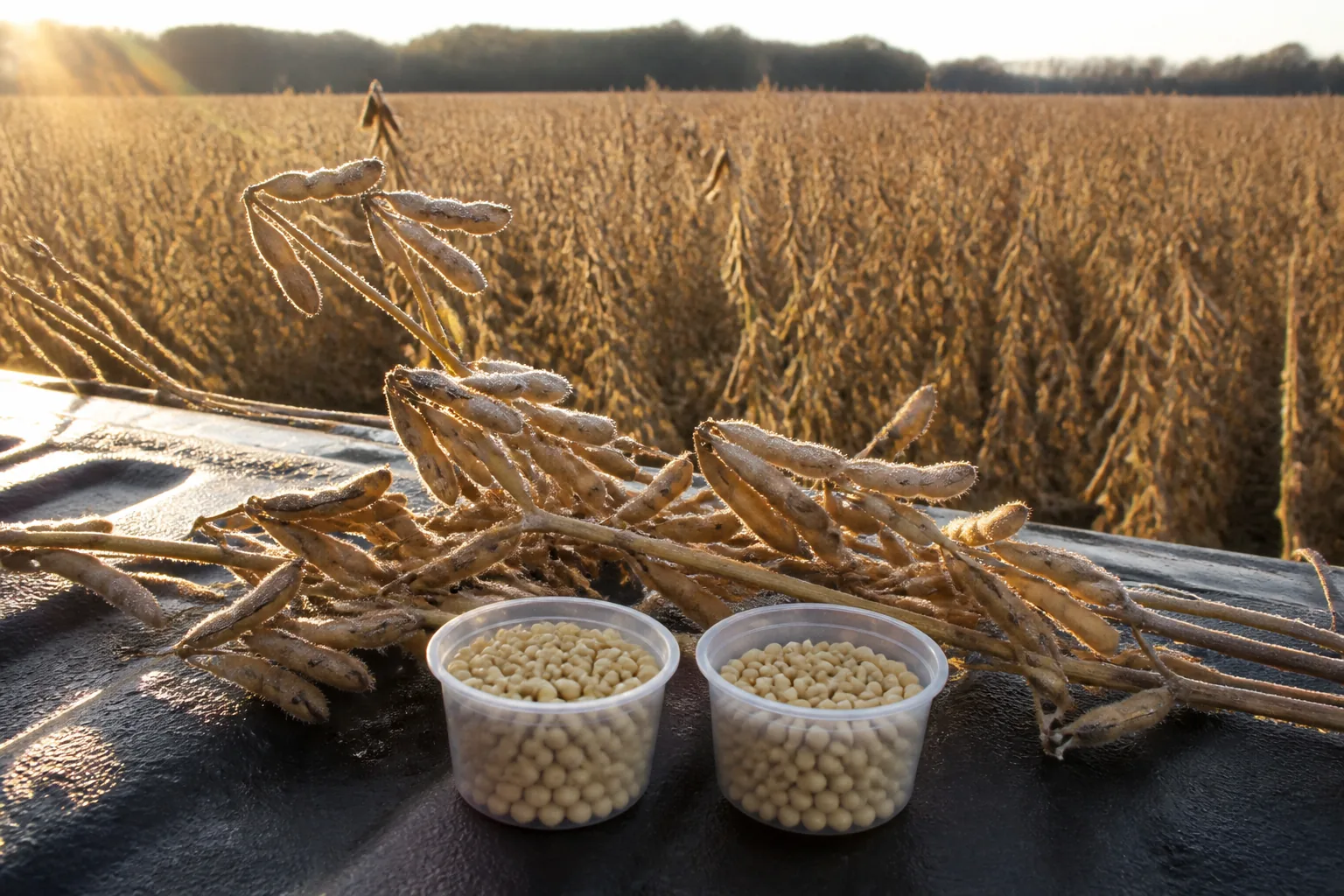
A drop from 13% to 10% soybean moisture can be real, especially when mature beans experience a warm, sunny, low-humidity, windy afternoon. Mature soybean seed exchanges moisture with the surrounding air much faster than corn. North Dakota State University reports that soybean moisture can decrease by several points during a day with low humidity and wind, then increase by several points with overnight dew.
Before changing the harvest plan, confirm that both readings represent the same field condition. A morning hand sample from a damp low area and an afternoon combine-tank sample from a dry ridge are not a true three-point time comparison. If representative, repeatable samples confirm 10%, treat the drop as real and respond immediately: prioritize that field, measure harvest loss, reduce unnecessary impact, and consider harvesting during a higher-humidity part of the day.
The Short Explanation
Four processes usually combine:
1. The seed is physiologically mature. Once dry matter accumulation ends, water can leave rapidly. 2. Warm air lowers relative humidity. As the day warms, the air often has a greater capacity to accept water from seed. 3. Wind removes humid air around pods. Moving air continually replaces the moist boundary layer with drier air. 4. The morning reading may include overnight moisture. Dew and high nighttime humidity can temporarily raise seed or surface moisture.
Soybeans are not losing three points at a fixed daily rate. The direction and speed can reverse when temperature, humidity, wind, cloud cover, or rain changes. The same field may read 12.8% in the morning, 10.2% in late afternoon, and somewhat higher again the next morning.
Why Mature Soybeans Dry So Fast
Iowa State University studied soybean drydown across four planting dates and four maturity groups over three years. During the first 12 days after maturity, the average moisture decline was about 3.2 moisture points per day—roughly five times the rate observed for corn in that comparison. The rate later slowed or stopped near 13% under average conditions.
That average does not mean every field loses 3.2 points every day. It describes the early post-maturity period, when seed begins much wetter than the market target. Iowa State found that planting date, maturity group, and year all affected the rate. The study also noted that warm air with low humidity—a high vapor-pressure deficit—can take mature soybean seed down to 9%–10%.
This explains an important distinction:
| Crop condition | What is happening | Likely moisture behavior |
|---|---|---|
| Seed still filling before maturity | Dry matter is still accumulating | Moisture remains high; harvest is not ready |
| Beginning maturity, mature pod color developing | Dry matter accumulation is complete | Moisture can fall rapidly from high levels |
| Near 13% in moderate weather | Seed approaches the surrounding air's balance point | Drydown may slow or fluctuate |
| Near 13% in warm, dry, windy weather | Air strongly favors evaporation | Seed can continue toward 9%–10% |
| Cold, humid, dewy, or rainy weather | Air favors moisture absorption or slows evaporation | Moisture may hold or rise temporarily |
Maturity stage tells you when to begin close monitoring. It does not predict an exact harvest date or afternoon moisture.
Relative Humidity Can Change Even Without a New Air Mass
Relative humidity is the percentage of the air's current water-vapor content compared with the maximum it can hold at that temperature. Warm air can hold more water vapor than cool air. Therefore, relative humidity usually falls as morning air warms, even if the actual amount of water vapor changes little.
That common daily cycle matters:
- Near sunrise, temperature is often low and relative humidity high.
- After sunrise, leaves and pods warm and surface dew evaporates.
- By afternoon, temperature may be high while relative humidity is at its daily low.
- After sunset, temperature falls and relative humidity rises again.
The difference between how much moisture the air contains and how much it could contain is often described as vapor-pressure deficit. A high deficit creates a strong drying environment. Iowa State specifically connects warm, low-humidity conditions with soybean moisture reaching 9%–10%.
Use forecast relative humidity together with temperature, wind, and dew point. A forecast that only says “sunny and 80°F” does not show the full drydown risk.
What Equilibrium Moisture Tells You—and What It Does Not
Grain tends to exchange water with surrounding air until it approaches an equilibrium moisture content. University of Minnesota Extension provides the following soybean equilibrium values at 60°F:
| Relative humidity at 60°F | Approximate soybean equilibrium moisture |
|---|---|
| 50% | 8.6% |
| 60% | 10.5% |
| 70% | 12.8% |
| 80% | 15.7% |
This table helps explain the direction of moisture movement. Air near 60% relative humidity favors a much drier soybean than air near 80%. It does not predict that a field will instantly reach the listed value. Field beans are inside pods, air conditions change continuously, seed temperature differs from reported air temperature, and the crop may not remain exposed long enough to reach equilibrium.
Use equilibrium values as a warning signal, not an hourly forecast. If beans are near 13% and several hours of warm air, 50%–60% relative humidity, sunshine, and wind are ahead, expect downward pressure and recheck frequently.
Wind Makes the Afternoon Drop Faster
Water leaving seed raises humidity immediately around the pod and seed coat. In still air, that humid boundary layer slows further moisture loss. Wind removes it and replaces it with drier air.
Wind also moves brittle plants and pods. The result can be two losses at once:
- moisture drops and saleable scale weight declines;
- pods split or beans shatter before and during harvest.
NDSU reports that shatter, splits, and cracked seed coats increase as soybean moisture decreases, with shatter increasing significantly below about 11% or after repeated wetting and drying cycles. A windy afternoon is therefore not only a moisture issue. It can be a field-loss issue even before the combine arrives.
When readings move below 11%, do not look only at the moisture number. Count loose beans and opened pods immediately.
Dew Can Raise the Morning Reading
High overnight humidity and dew can add several moisture points, according to NDSU. Some of that change is real moisture absorption by the seed; some samples may also contain surface moisture from wet pods or plant material.
This creates three common misunderstandings.
“The beans gained three points overnight, so the moisture is permanently back.”
Not necessarily. If dry air returns after sunrise, the absorbed or surface moisture can leave quickly. Rewetting may create a temporary harvest window rather than a permanent recovery.
“The first morning reading is the moisture for the whole day.”
It is only the moisture at that time and sampling location. On high-risk days, a reading more than one or two hours old may no longer support a harvest decision.
“Waiting for rain will restore the value safely.”
Rain may raise moisture, but mature pods that repeatedly wet and dry can become more prone to shatter. Waiting also adds wind, lodging, and field-access risk. A damp harvest window can be useful; deliberately exposing a ready field to several weather cycles is a different decision.
Field Variability Can Look Like Rapid Drydown
Not every apparent three-point change comes from time. Soybean moisture can vary within one field because of:
- maturity group or variety;
- planting date and emergence differences;
- high ground versus low ground;
- soil texture and drainage;
- drought stress, disease, or lodging;
- field edges versus a protected interior;
- thin canopy versus dense canopy;
- green or immature pockets mixed with mature beans.
Suppose the morning sample comes from a shaded low area and the afternoon sample comes from an exposed ridge. The readings may be accurate for each location, but the difference does not measure the field's hourly drydown.
Combine-tank samples can differ from hand-shelled pod samples as well. The tank blends a much larger harvested area and may contain beans from several zones. A small hand sample can overrepresent whichever plants were easiest to reach.
The solution is not to search for one “correct” handful. Build comparable samples from the same management unit.
Confirm Whether the Three-Point Drop Is Real
Use this check before blaming weather or the meter.
1. Match the sampling route
Return to the same representative areas sampled earlier. Include interior, edge, high, low, early, and late zones in both rounds. Do not compare different field zones and label the difference “drydown.”
2. Match the sample source
Compare hand-shelled samples with hand-shelled samples, or clean-grain samples with clean-grain samples. If the source changes, record it and interpret the result separately.
3. Collect multiple increments
Gather small increments across each zone, mix the increments intended to represent that zone, and divide out the test portion. Keep visibly immature or unusually wet areas separate so their range is not hidden in one average.
4. Repeat the test
Iowa State advises testing a sample at least three times and averaging the readings because all moisture testers show some repeatability variation. Use fresh test portions when the instrument procedure requires them.
5. Consider sample temperature
Grain temperature can affect electrical moisture readings. Do not compare a cold, dewy morning sample with a hot afternoon sample without recording temperature and allowing the test procedure's temperature compensation to work as intended. Avoid testing a sample that has just moved between very different environments and may be developing surface condensation.
6. Check the clean-grain stream
Once harvest begins, collect increments at intervals from the clean-grain stream or tank. This shows what is actually being harvested and allows comparison with buyer results.
7. Use the buyer's test for settlement
A portable grain moisture meter is useful for routine field checks, harvest sequencing, and detecting rapid changes. It is not an official or legal-for-trade settlement instrument. If a load is near a price threshold, the buyer's approved sample and test determine settlement.
If repeated, representative samples show approximately the same result, the drop is probably real enough to manage—even if another device would differ by a few tenths.
Build an Hour-by-Hour Moisture Record
When beans are near the target and dry weather is moving in, replace one daily check with a short time series.
| Time | Field and zone | Seed moisture average | Sample range | Air temperature | Relative humidity | Wind | Ground loss |
|---|---|---|---|---|---|---|---|
| 8:00 a.m. | Field A, representative route | ___% | ___–___% | ___°F | ___% | ___ mph | ___ bu/acre |
| 10:00 a.m. | Same route | ___% | ___–___% | ___°F | ___% | ___ mph | ___ bu/acre |
| Noon | Same route | ___% | ___–___% | ___°F | ___% | ___ mph | ___ bu/acre |
| 2:00 p.m. | Same route | ___% | ___–___% | ___°F | ___% | ___ mph | ___ bu/acre |
| 4:00 p.m. | Same route | ___% | ___–___% | ___°F | ___% | ___ mph | ___ bu/acre |
The exact interval depends on conditions. Recheck more often when:
- moisture is within one point of your lower action limit;
- temperature is rising rapidly;
- relative humidity is falling;
- sustained wind is increasing;
- the first loss count shows a clear upward trend;
- the combine moves to a different field, variety, or soil zone.
Record the range as well as the average. An average of 12% can hide a 9.5% ridge and a 14.5% low area. That variability affects harvest loss, load uniformity, and storage management.
Turn Moisture Readings into a Harvest Decision
The best response depends on both moisture and measured loss.
| Current condition | Immediate action |
|---|---|
| 13%–14% and falling quickly | Begin or continue harvest; confirm receiving or conditioning plan if above the buyer basis |
| 12%–13% with acceptable loss | Continue and recheck on a short interval |
| 11%–12% with rising shatter | Prioritize the field; adjust the header and consider higher-humidity hours |
| Below 11% | Measure preharvest and machine loss immediately; avoid the driest afternoon period when practical |
| Wide moisture range | Harvest or store zones separately when feasible; do not trust the average alone |
| Moisture rebounds after dew | Use the workable window, but keep testing as surface moisture leaves |
For the broader target decision, see What Moisture Should Soybeans Be Harvested At?.
Measure the Financial Consequence of the Drop
At the common 13% market basis, a drop to 10% reduces the weight of the same dry matter by approximately 3.33%. For a crop equivalent to 60 bushels per acre at 13%, that is about 2.00 fewer saleable bushels per acre before counting any beans on the ground.
Physical loss is separate. For medium-size soybean seed, roughly four beans per square foot equal one bushel per acre. Establish preharvest loss before the header arrives, then measure header and rear-machine loss separately.
Use Am I Losing Money Harvesting Soybeans Too Dry? for the full calculation and field-loss worksheet. The key point here is that a rapid three-point drop is not merely a number changing on the display. It can narrow the profitable harvest window within one afternoon.
Adjust Harvest Operations as Beans Dry
Do not leave combine settings unchanged while moisture changes by several points.
- Check preharvest shatter before entering the field.
- Keep the cutterbar low enough to capture low pods without operating unsafely against the ground.
- Match reel position and speed to crop height and travel speed; avoid striking brittle pods aggressively.
- Reduce ground speed if the cutterbar or feeder cannot maintain smooth crop flow.
- Use only enough rotor or cylinder speed to thresh pods acceptably.
- Inspect the tank for splits and cracked seed coats.
- Check behind the full header width rather than at one convenient spot.
- Repeat counts after a moisture change, setting change, field change, or time-of-day shift.
NDSU recommends considering early morning, late evening, or other higher-humidity harvest periods when soybeans are below 11%, because tougher pods may reduce shatter and mechanical damage. This is not a command to harvest through heavy dew or poor feeding conditions. The correct window is the period when measured field loss falls more than throughput or foreign-material problems rise.
Green Stems Do Not Prove the Seed Is Still Wet
Mature seed can be 10%–12% while stems remain green. Waiting for every stem to turn brown can push the seed farther below the target and increase shatter.
Judge these conditions separately:
- Seed moisture: determines market weight and contributes to brittleness.
- Pod condition: indicates shatter and threshing risk.
- Stem and leaf condition: affects feeding, capacity, and foreign material.
- Immature green seed: creates a separate quality and moisture-variability concern.
If seed is dry but green stems reduce capacity, slow the combine and adjust crop flow rather than assuming the field needs several more drying days.
Common Misreadings of a 13%-to-10% Change
“Soybeans cannot lose three points in one day.”
They can. NDSU explicitly notes several-point daily declines in low-humidity, windy conditions.
“The meter must be wrong.”
Possibly, but weather and sampling differences are more useful first checks. Repeat representative samples, match sample type, and record grain temperature before reaching that conclusion.
“The morning average represented every acre.”
It represented only the areas and plants included. Field-zone range matters as much as the average.
“Dew permanently fixes dry soybeans.”
Morning moisture can leave again as relative humidity falls. Dew may create a temporary lower-shatter window.
“I should always wait for the evening rebound.”
Not if wind, field shatter, incoming weather, or lost combine capacity costs more than the rebound protects. Measure loss and throughput rather than deciding by the clock.
“A three-point drop only affects storage.”
Below-market moisture also reduces saleable weight and can increase shatter, splits, and cracked seed coats.
Bottom Line
Mature soybeans can move from 13% to 10% surprisingly quickly because their moisture follows changing atmospheric conditions. Warm temperatures, falling relative humidity, sunshine, and wind create a strong drying environment; dew and nighttime humidity can temporarily reverse the direction. Iowa State field research shows that soybean drydown is especially rapid after maturity and can reach 9%–10% under warm, low-humidity conditions.
When you see a three-point drop:
1. repeat comparable, representative samples; 2. record moisture range, sample source, time, grain temperature, weather, and field zone; 3. shorten the interval between checks; 4. count preharvest, header, and rear-machine loss; 5. prioritize dry fields and adjust harvest hours and combine settings; 6. use the buyer's approved result for settlement.
The practical lesson is simple: 13% soybean moisture may be a short harvest window, not an all-day condition. Once mature beans enter warm, dry, windy weather, manage moisture by the hour rather than by yesterday's reading.
Sources
- Iowa State University Extension: How Fast Do Soybeans Dry Down in the Field?
- North Dakota State University: Enhancing Soybean Storage Starts with Harvest Moisture
- University of Minnesota Extension: Managing Stored Grain with Aeration
- Iowa State University Extension: Storing Soybean
- Iowa State University Extension: Crop Quality in 2019—Another Unusual Year