
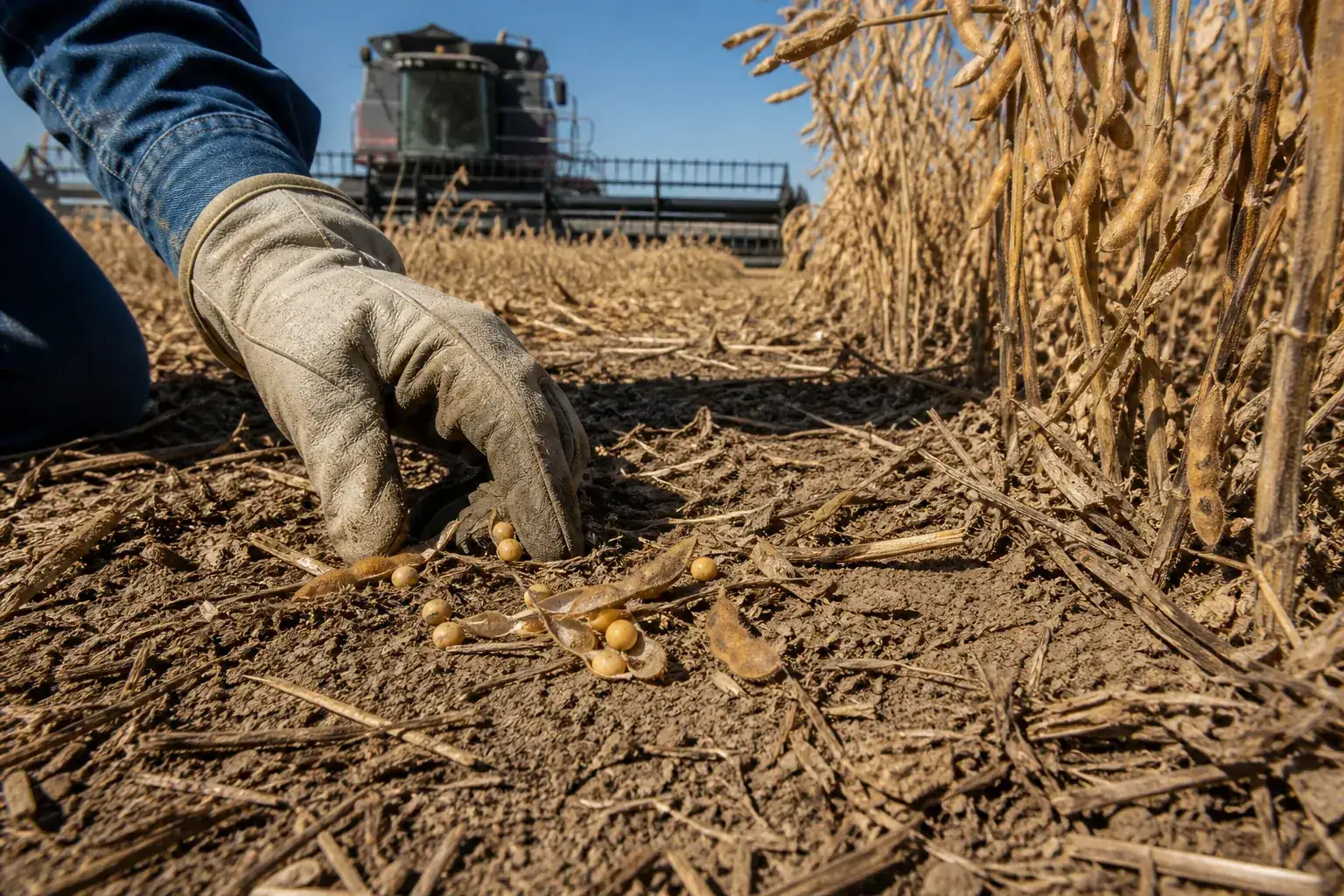
Yes—if commodity soybeans are sold below the common 13% moisture basis and the buyer still calculates bushels at 60 pounds, overly dry beans usually reduce saleable weight without earning a premium. At a 60-bushel-per-acre yield standardized to 13% moisture, harvesting at 12% represents about 0.68 bushel per acre of lost sale weight; at 10%, the difference is 2.00 bushels per acre; and at 9%, it is about 2.64 bushels per acre. Shatter, dropped pods, header loss, splits, and cracked seed coats can add a second layer of loss.
However, “below 13%” does not automatically mean every dollar was wasted. Lower moisture may be justified by long storage, a special contract, limited drying capacity, or field conditions that made earlier harvest unsafe. The useful question is:
> Did the value protected by waiting or drying below 13% exceed the sale weight, physical beans, and quality lost?
This guide shows how to calculate that answer with your own yield, price, field-loss counts, buyer schedule, and storage plan.
The Quick Cost of Selling Below 13%
The table below assumes a field would produce 60 bushels per acre when standardized to 13% moisture and uses a hypothetical soybean price of $10 per bushel. Replace both values with your own numbers.
| Actual soybean moisture | Sale-weight loss versus 13% | Bushels not sold per acre at 60 bu/acre | Value difference at $10/bu |
|---|---|---|---|
| 12% | 1.14% | 0.68 bu/acre | $6.82/acre |
| 11% | 2.25% | 1.35 bu/acre | $13.48/acre |
| 10% | 3.33% | 2.00 bu/acre | $20.00/acre |
| 9% | 4.40% | 2.64 bu/acre | $26.37/acre |
| 8% | 5.43% | 3.26 bu/acre | $32.61/acre |
These figures describe only the change in scale weight caused by moisture. They do not include soybeans already shattered onto the ground, pods missed by the header, beans discharged behind the combine, or quality discounts.
On 500 acres with the same 60-bushel yield and hypothetical $10 price, the water-weight difference alone is approximately $3,409 at 12%, $10,000 at 10%, and $13,187 at 9%. Small moisture differences become material when applied across an entire farm.
Why There Can Be a Loss Even When the Ticket Shows No Moisture Dock
A standard soybean bushel is commonly treated as 60 pounds at 13% moisture. That bushel contains:
- 52.2 pounds of dry matter
- 7.8 pounds of water
If the same 52.2 pounds of dry matter is reduced to 11% moisture, its total weight is only about 58.65 pounds. The soybeans did not lose dry matter merely because water evaporated, but they now contribute less scale weight. If the buyer still divides the delivered weight by 60 pounds to determine bushels, the missing 1.35 pounds is not restored on the settlement sheet.
That is why “the elevator did not dock me” is not proof that harvesting dry was free. A moisture discount usually applies to beans above the buyer's basis. Beans below the basis often receive neither a discount nor a credit for the water they could have carried at 13%.
The exact outcome depends on the contract. Specialty, seed, food-grade, identity-preserved, or dry-matter contracts may use different terms. Verify the buyer's moisture basis, rounding rules, shrink calculation, grade factors, and any premium before assigning a value.
Calculate Your Dry-Harvest Weight Loss
Use this formula when the reference moisture is 13%:
Sale-weight loss fraction = 1 − [0.87 ÷ (1 − actual moisture as a decimal)]
Then calculate:
Bushels not sold per acre = expected yield at 13% × sale-weight loss fraction
Value difference per acre = bushels not sold per acre × cash price
Worked example: 10% soybeans
Assume the crop would yield 60 bushels per acre at the 13% market basis:
1. Sale-weight loss fraction = 1 − [0.87 ÷ 0.90] = 0.03333. 2. Bushels not sold = 60 × 0.03333 = 2.00 bushels per acre. 3. At a hypothetical $10 per bushel, value difference = 2.00 × $10 = $20 per acre. 4. Across 500 acres, the difference is $10,000 before physical or quality losses.
This is a dry-matter-equivalent comparison, not a prediction of what a particular yield monitor will display. Use the same moisture basis on both sides of the comparison. Comparing raw wet bushels from one field with moisture-corrected bushels from another can produce a false result.
For other grains, target moistures, and loads above the target, use the general method in How Much Shrink Am I Losing Because of Moisture?.
Add Physical Harvest Loss Separately
Dry-weight loss and physical loss are different:
- Dry-weight loss means the same dry matter reaches the scale with less water.
- Physical loss means the soybean never reaches the scale.
Both can occur at the same time. North Dakota State University reports that shatter loss rises significantly below about 11% moisture and after repeated wetting and drying cycles. Dry seed is also more vulnerable to splits and cracked seed coats during threshing and handling.
University of Nebraska–Lincoln provides a practical soybean-loss conversion at 13% moisture:
| Approximate seed size | Beans per square foot equal about 1 bu/acre |
|---|---|
| Small | 5 |
| Medium | 4 |
| Large | 3 |
The familiar “four soybeans per square foot equals one bushel per acre” rule is therefore only an estimate. Confirm the approximate seed size and repeat counts in several representative places.
Separate loss into three locations
1. Preharvest loss: Count loose beans and beans in opened or dropped pods before the combine enters. This is the field-and-weather baseline. 2. Header loss: Harvest 20–30 feet, stop, and back up before residue covers the cut area. Count beans and missed pods between the cutterbar and the front of the combine, then subtract the preharvest baseline. 3. Threshing and separation loss: Count loose beans and unthreshed pods in residue behind the combine, again accounting for the baseline and header area.
Iowa State University notes that the header may account for as much as 90% of total soybean machine loss. Do not rely only on the loss monitor in the cab; it primarily helps show changes in what exits the rear of the machine and does not measure beans shattered ahead of the feederhouse.
Convert a field count into dollars
Suppose counts show six additional medium-size beans per square foot after harvest:
- 6 ÷ 4 = 1.5 bushels per acre of physical loss.
- At $10 per bushel, that is $15 per acre.
- On 500 acres, that is $7,500.
If the same field is harvested at 10% instead of 13%, the 2.00-bushel scale-weight difference adds another $20 per acre. The combined measurable exposure is therefore $35 per acre, or $17,500 across 500 acres, before any grade or handling effect.
Do not add a yield-monitor discrepancy again if it already represents the same ground loss. Identify what each number measures before totaling the loss.
Account for Splits, Cracks, and Handling Damage
Very dry soybeans are brittle. Impact from the reel, rotor or cylinder, augers, conveyors, and repeated transfers can split cotyledons or crack seed coats. The economic effect is not always visible immediately, but it can appear as:
- grade discounts if splits exceed the buyer's limit;
- more fines and foreign material;
- reduced seed quality in seed production;
- greater vulnerability during handling and storage;
- additional shrink as fragments are lost during cleaning or transfer.
Inspect the clean-grain tank after each meaningful moisture or setting change. Record the percentage of visibly split or cracked beans from a representative sample rather than judging one handful. Buyer grade limits and contracts control the actual monetary effect, so do not invent a flat “split penalty” for the calculation.
The best combine setting is not the setting that produces the most acres per hour. It is the setting that produces the highest harvested value per hour after missed pods, shatter, splits, foreign material, fuel, and downtime are considered.
Build a Harvest-Now Versus Wait Comparison
When beans are slightly wet, the decision is not “pay a drying charge or dry for free in the field.” Waiting can create dry-weight and physical losses. Harvesting now can create drying, shrink, handling, or capacity costs. Put both sides in dollars per acre.
Cost of harvesting now
Include only costs that change because you harvest now:
- buyer moisture shrink or price discount;
- on-farm aeration or drying cost;
- extra handling and labor;
- reduced combine capacity in green or damp plant material;
- quality risk if wet or uneven beans cannot be conditioned promptly.
Cost of waiting
Estimate:
- additional scale-weight loss if moisture falls below 13%;
- added preharvest shatter from wind and wet-dry cycles;
- added header and machine loss in brittle pods;
- splits, cracks, or grade risk;
- exposure to storms, lodging, and delayed harvest of other fields.
The practical break-even relationship is:
Maximum added cost worth paying to harvest earlier = avoided dry-weight loss + avoided physical loss + avoided quality loss + avoided weather loss − any other added harvest cost
For example, if waiting is expected to take a 60-bushel crop from 13% to 10%, the scale-weight exposure is 2.00 bushels per acre. If current and repeated ground counts show another 1.0 bushel per acre is likely to be lost, the total is 3.0 bushels per acre. At $10 per bushel, harvesting earlier protects up to $30 per acre before considering quality and weather. Compare that amount with the buyer's actual wet-bean schedule or the farm's true conditioning cost.
Do not assume all fees above 13% are automatically worse. A University of Nebraska worked example using one historical elevator schedule found that selling slightly wetter beans with a price deduction produced more gross income than selling at 9%, because the dry beans had already lost too much scale weight. That schedule and price are not universal; the lesson is to use current local terms instead of deciding from the word “dock.”
When Harvesting Drier May Be Economically Defensible
The 13% marketing basis is not always the final management target.
Long storage needs a safety margin
Soybeans intended for warm-weather or extended storage may need to be conditioned below 13% to control spoilage risk. NDSU guidance uses lower moisture targets for longer storage, including about 11% for summer storage under suitable management. In that situation, some sale-weight opportunity is exchanged for storage protection.
That can be rational if the lower moisture prevents heating, mold, deterioration, or forced sale. Compare the calculated dry-weight cost with the value of safe storage, expected seasonal basis improvement, aeration capability, grain temperature, and the real storage period.
Do not confuse harvest moisture with final storage moisture. Harvesting near 13% and then conditioning uniformly may preserve more beans than leaving a shatter-prone crop in the field until every area reaches the long-term storage target.
A contract may reward a different specification
Some specialty contracts emphasize protein, seed quality, processing performance, or a different receiving range. The contract—not a generic 13% rule—determines value.
Field access or harvest logistics may control the decision
Unsafe field conditions, unavailable transportation, full bins, equipment failure, or lack of an accepted wet-soybean destination can make earlier harvest impractical. These constraints still have a cost, but they change which alternative is feasible.
Dry beans may be safer than wet beans with no conditioning plan
Harvesting 14%–15% soybeans into an unaerated bin or leaving them in a truck is not a sound way to capture water weight. If wet beans cannot be cooled, aerated, dried, delivered, or monitored promptly, the spoilage risk can exceed the dry-harvest loss.
For a fuller target-moisture decision, see What Moisture Should Soybeans Be Harvested At?.
Measure Moisture So the Economic Calculation Is Real
A 0.5- to 1-point error matters when many acres are near the decision threshold. One reading from the field edge is not representative of a whole field or load.
Use this field procedure:
1. Sample multiple locations, including high ground, low ground, field edges, interior areas, different soils, and visibly early or late zones. 2. Collect seed from mature pods without selecting only the driest plants. 3. Keep unusually wet or dry zones separate long enough to see their range; an average can hide a problem area. 4. Combine and mix increments intended to represent the same management unit. 5. Test more than one portion and record the average, range, time, field, and weather condition. 6. After combining begins, collect increments from the clean-grain stream or tank throughout the run. 7. Recheck after a variety, soil zone, field, weather, or time-of-day change.
Soybean moisture can rise several points with overnight dew and fall several points during a dry, windy day. A morning number should not be used to price the entire afternoon's harvest.
A portable grain moisture meter can support routine field checks, harvest sequencing, and decisions about when to remeasure losses. It is not an official or legal-for-trade settlement instrument. The buyer's approved sampling, test method, and settlement reading control the sale.
Respond When Soybeans Are Already Too Dry
If representative readings are below 11%, focus on preventing the next loss rather than regretting the moisture already gone.
1. Prioritize the driest and most shatter-prone fields. Do not harvest only by planting date. 2. Use higher-humidity windows when practical. Early morning, evening, or damp conditions can make pods less brittle, although wet stems may reduce feeding capacity. 3. Recheck ground loss frequently. Conditions can change within hours. 4. Reduce unnecessary impact. Match reel speed and position to travel speed; Iowa State suggests reel speed approximately 25% faster than ground speed as a starting relationship, then verify in the field. 5. Slow down if the cutterbar or feeder cannot follow the crop. Dry seed can coexist with green stems; waiting for green stems to turn brown may make seed loss worse. 6. Use the lowest rotor or cylinder speed that threshes acceptably. Change one setting at a time and inspect both the tank and residue. 7. Avoid repeated unnecessary transfers. Each impact is another opportunity to split brittle beans.
Do not automatically wait for rain to “put weight back.” Dew or high humidity may reduce shatter temporarily, but repeated wetting and drying can weaken pods and increase preharvest loss. A surface-moist sample after rain may also hide variability within the lot.
Do Not Treat Reconditioning as an Easy Refund
Adding moisture back to overly dry soybeans is not as simple as adding a known quantity of water. Air temperature, relative humidity, airflow, seed temperature, bin depth, time, and equilibrium moisture all affect the result. Uneven moisture can create storage and handling problems.
NDSU warns that soybeans expand as they absorb moisture. Reconditioning more than a couple of percentage points can create substantial pressure on bin walls and may damage the structure if the system was not designed and managed for it. Directly adding water to grain may also violate applicable rules or contract requirements.
If reconditioning is being considered, obtain qualified engineering and grain-management guidance, confirm legal and contract requirements, and monitor the bin carefully. Prevention through timely harvest is usually easier to control than trying to restore several moisture points later.
A Five-Minute Field Worksheet
Use the following worksheet before deciding to continue, pause, or move fields.
| Input | Your value |
|---|---|
| Representative soybean moisture average | ___% |
| Moisture range across samples | ___% to ___% |
| Expected yield standardized to 13% | ___ bu/acre |
| Current cash or contract price | $___/bu |
| Dry-weight loss from the formula | ___ bu/acre |
| Preharvest loss | ___ bu/acre |
| Header loss above baseline | ___ bu/acre |
| Rear-machine loss above baseline | ___ bu/acre |
| Estimated quality or grade effect | $___/acre |
| Cost to harvest and condition now | $___/acre |
| Acres exposed before the next check | ___ acres |
Then compare:
Wait cost per acre = dry-weight loss + additional physical loss + quality risk + weather risk
Harvest-now cost per acre = moisture deduction or conditioning + added handling + capacity effect
Use ranges when weather or loss is uncertain. A conservative low, expected, and high estimate is more honest than a single precise number built from guesses.
Common Mistakes That Hide the Loss
“There is no dock below 13%, so I did not lose anything.”
The lost opportunity is in delivered scale weight. A missing charge on the ticket does not restore the water weight.
“Every point below 13% costs the same.”
It does not. Moisture adjustment is a dry-matter ratio, not a simple fixed subtraction. Use the formula rather than multiplying by an assumed constant.
“Four beans per square foot is exact everywhere.”
Seed size changes the conversion. Count multiple areas and use three, four, or five beans per square foot per bushel as appropriate for large, medium, or small seed.
“The yield monitor already includes every loss.”
It cannot measure beans left ahead of the header. Ground counts are required to identify preharvest and header loss.
“If I harvest at 13%, I avoid all loss.”
Moisture does not correct a poor cutterbar setting, excessive reel impact, improper threshing, lodged crop, or unmeasured field variability.
“Lower moisture is always bad.”
Lower moisture can be valuable for long storage or a specific contract. The mistake is allowing beans to become dry without calculating what that dryness buys.
Bottom Line
For commodity soybeans sold on a 13% basis, harvesting too dry can remove meaningful saleable weight even when no moisture penalty appears on the settlement sheet. At a 60-bushel yield, 10% soybeans represent about 2.00 fewer saleable bushels per acre than the same dry matter at 13%; 9% represents about 2.64 fewer bushels. Shatter, header loss, splits, and handling damage must then be added separately.
The most reliable decision is to:
1. measure representative moisture throughout the day; 2. calculate the scale-weight difference on a consistent 13% basis; 3. count preharvest, header, and rear-machine loss separately; 4. compare those dollars with the actual cost of harvesting and conditioning now; 5. account for storage duration, buyer terms, weather, and harvest capacity.
The objective is not simply to deliver the driest soybeans or avoid every visible dock. It is to deliver the greatest net value from the field.
Sources
- University of Nebraska–Lincoln CropWatch: Plan Harvest to Deliver Soybean at Optimum Moisture
- University of Nebraska–Lincoln CropWatch: Harvest Soybeans at 13% Moisture
- North Dakota State University: Enhancing Soybean Storage Starts with Harvest Moisture
- North Dakota State University: Considerations When Conditioning Too-Dry Soybeans
- University of Nebraska–Lincoln CropWatch: How to Estimate Harvest Losses in Soybean and Corn Fields
- Iowa State University Extension: Verifying Combine Adjustments During Crop Harvest
- North Dakota State University: Soybean Production Field Guide