
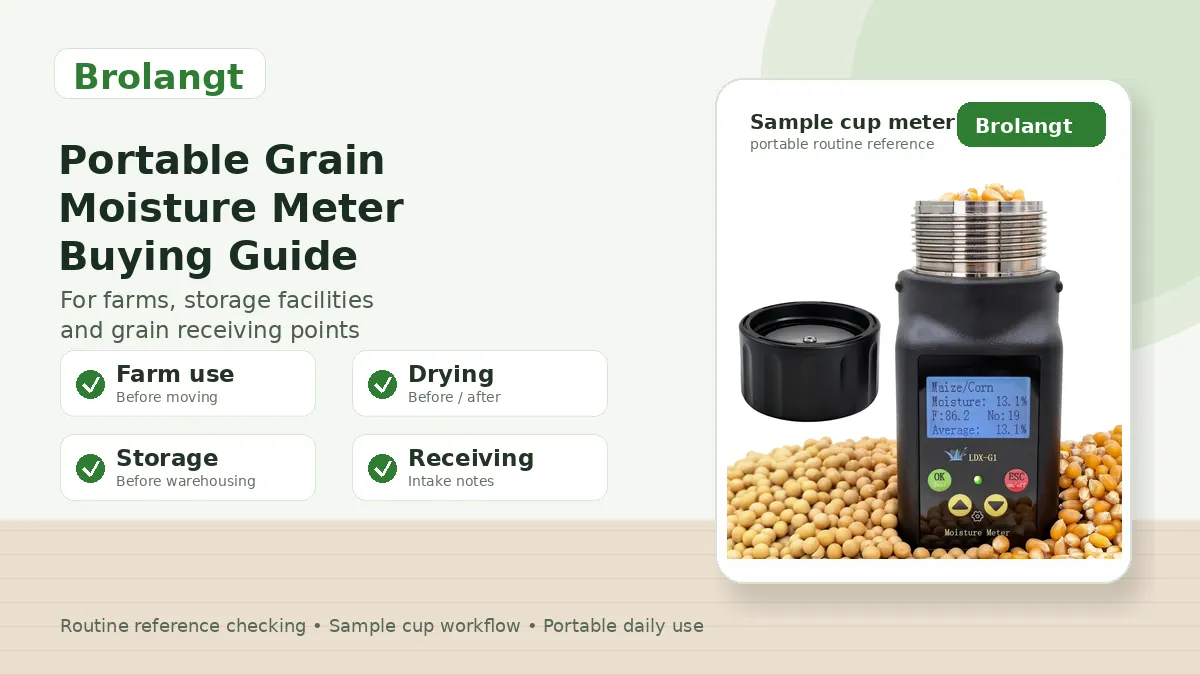
# Portable Grain Moisture Meter Buying Guide for Farms, Storage and Grain Buyers
A portable grain moisture meter is useful when moisture needs to be checked close to the grain, not only in an office or fixed testing area. For farms, drying areas, storage facilities and receiving points, the main buying question is not simply “which meter looks good?” It is whether the meter fits the way samples are collected, handled and reviewed during routine work.
A good portable meter should make daily checking easier: take a small sample, select the relevant grain mode, read the result clearly, and record it before the next decision is made. It should not create a complicated process that workers avoid. It should also match the grain types you actually handle, such as corn, wheat, rice or soybeans.
This guide explains what matters when choosing a portable grain moisture tester, especially for customers who need a practical routine reference for farm, storage and grain receiving work. For broader product selection logic, see our guide on how to choose a grain moisture meter for corn, wheat, rice and beans.
Start with the job, not the device
The most common buying mistake is starting with the instrument shape before defining the job. A portable meter used on a farm has different daily pressure than a meter used at a receiving desk. A storage user may care more about batch records. A drying operator may need to compare samples before and after drying.
Before choosing, define the main job:
- Do you need to check grain near harvest areas, drying areas, warehouse entrances or receiving points?
- Which grains are handled most often?
- Will one person use the meter, or will several workers share it?
- Is the result mainly used as a routine reference before moving, drying, storing or receiving grain?
- Does the workflow require quick repeated checks across different batches?
These questions are more useful than looking only at a product photo. A portable grain moisture meter should support the user’s actual routine, not force the routine to fit the instrument.
Who benefits most from a portable grain moisture tester?
Portable equipment is valuable when grain is moving. Farms, drying areas and storage points often do not have a single fixed testing location. Grain may be checked in the field, near a dryer, beside a storage bin, at a receiving table or before loading.
A portable grain moisture tester is especially useful for:
- Farmers who want a daily moisture reference around harvest and drying decisions.
- Storage users who compare batches before warehousing.
- Grain receiving staff who need a practical sample check before intake records are completed.
- Small grain traders who inspect grain before purchase, loading or delivery.
- Processing or warehouse teams that need a simple way to monitor incoming or stored grain.
Portable does not mean “less serious.” It means the device is designed to be used close to the work. For many users, that is the difference between checking moisture regularly and skipping the step because testing is inconvenient.
Cup-type workflow: why it suits routine sample checks
A cup-type portable meter uses a measuring chamber or sample cup. Instead of pushing probes into a bag or pile, the user places a small whole-grain sample into the top measuring area, selects the grain type, and reads the moisture reference value.
This style is useful when users prefer to work with a sample rather than the whole pile. It can fit farm, storage and receiving routines where workers already take small samples from a batch for inspection. It also keeps the process more consistent than randomly inserting a probe into different positions without a sampling habit.
If you are unfamiliar with this product shape, read what a sample cup grain moisture tester is and how it works. If you are comparing cup-type and probe-type devices, this overview of cup-type vs probe-type grain moisture meters explains the basic difference.
For a cup-type portable meter, the workflow should be simple enough for daily use:
1. Take a small grain sample from the batch. 2. Place the sample into the measuring chamber. 3. Select the relevant grain mode. 4. Read and record the moisture reference. 5. Repeat for another batch or sampling point when needed.
The value of this workflow is not just the reading. It is the habit of checking the right sample at the right moment.
What to check before buying
A portable meter should be judged by usability, supported grain types and field practicality. The following table keeps the main buying points clear.
| Buying point | Why it matters | What to look for |
|---|---|---|
| Supported grains | The meter must match your actual crops | Corn, wheat, rice, soybeans or other listed modes |
| Sample handling | Daily checks should be repeatable | A clear cup or measuring chamber workflow |
| Display readability | Workers need quick results | A screen that is easy to read in normal work areas |
| Operation steps | Complicated tools are often ignored | Simple buttons and clear grain selection |
| Portability | The meter may move between locations | Practical size for farm, storage or receiving use |
| Record habit | Results are more useful when recorded | Batch notes, date, grain type and sampling point |
This does not mean every buyer needs the same product. A farm user may value simple handling. A receiving point may value repeatable sampling. A storage user may care about batch records. The right portable meter is the one that supports the way you actually make decisions.
Farm, drying, storage and receiving use cases
A portable grain moisture meter can support several different stages. The same device may be used in different ways depending on where the grain is in the handling process.
Farm and harvest checks
Around harvest, moisture checking helps users avoid relying only on visual judgment. A routine reference can support decisions about whether grain is ready to move, whether more drying may be needed, or whether different parts of a field should be kept separate for later review.
This is especially useful for users handling corn, wheat, rice or soybeans where moisture conditions can vary by field, harvest time and weather.
Drying area checks
Drying is one of the clearest use cases for portable moisture checking. Users often need to compare grain before and after drying, or check whether different batches are behaving differently. A portable meter lets the user bring the tool near the drying workflow instead of moving every sample to a fixed location.
The point is not to overcomplicate the process. It is to create a practical comparison habit: before drying, after drying, and before storage or transfer.
Storage preparation
Before grain is stored, a moisture reference can help users separate batches and decide whether a batch needs more attention. It also helps create basic records before grain enters a bin, warehouse or bagging process.
For a deeper explanation of timing, see when to check grain moisture during harvest, drying, storage and buying.
Grain receiving and small trading
At a receiving point, moisture checking is often part of intake awareness. A portable meter can support sample-based review before grain is accepted, stored or moved onward. For small traders, it can also help compare lots before loading or purchase discussions.
Results should be treated as routine reference information unless a formal inspection process is required. That distinction keeps the tool in the right role and avoids turning a daily meter into something it is not intended to replace.
Grain type support matters more than generic claims
A portable grain moisture meter should be chosen around the grains you actually handle. A user who mainly checks corn has a different priority from someone who handles wheat, rice and soybeans every week.
Before buying, check the listed grain modes and confirm that the main crops in your work are covered. Common use cases include:
- Corn or maize checks around harvest, drying and storage.
- Wheat checks before storage or receiving.
- Rice or paddy-related sample checks where supported.
- Soybean or bean checks for farm and storage reference.
Avoid buying a meter only because the title says “grain.” In daily work, the useful question is more specific: does the meter support the grains you need to check, and can your workers use it consistently?
Practical details that affect daily use
The best portable meter is usually the one that workers can use correctly without hesitation. Several practical details matter.
First, the screen should be readable in ordinary working conditions. A number that is difficult to read will slow down intake, drying checks or storage work.
Second, the button layout should be simple. Grain selection and test operation should not feel like a technical task.
Third, the measuring chamber should be easy to fill and handle. If sample handling feels messy or uncertain, the device will be used less often.
Fourth, the meter should be easy to store near the work area. If it is not nearby when the decision is made, it may not be used at all.
Finally, the workflow should encourage basic records. Even a simple notebook entry with date, grain type, batch name and moisture reference can make the result more useful later.
A simple buying checklist
Before choosing a portable grain moisture tester, use this short checklist:
- The meter supports your main grains.
- The sample process matches your work routine.
- The screen is clear enough for daily use.
- The buttons and grain selection are easy to understand.
- The size is practical for farm, storage or receiving work.
- Your team can record results in a simple, consistent way.
- The product role is clear: routine moisture reference, not formal inspection replacement.
If these points fit your needs, a portable cup-type grain moisture meter can be a practical choice for daily checking.
FAQ
Is a portable grain moisture meter useful for farms?
Yes. It is useful when farmers need routine moisture reference checks around harvest, drying and storage decisions. The main benefit is convenience: the tool can be used close to the grain.
Is a cup-type portable meter different from a probe-type meter?
Yes. A cup-type meter checks a small sample placed into a measuring chamber, while a probe-type meter is inserted into grain bags or piles. Each style fits different workflows.
Can one portable meter be used for corn, wheat, rice and soybeans?
That depends on the grain modes listed for the meter. Buyers should confirm that their main grains are supported before purchasing.
Should results be recorded?
Yes. A simple record of date, batch, grain type and moisture reference makes routine checking more useful for farms, storage users and receiving points.
Does a portable meter replace formal grain inspection?
No. A portable grain moisture meter is best understood as a routine reference tool. If a formal inspection or official process is required, users should follow the appropriate procedure.
Final buying advice
Choose a portable grain moisture meter by matching it to your actual work: the grains you handle, the places you check them, the people who will use the device, and the decisions that follow the reading.
For users who need sample-based routine checks for corn, wheat, rice, soybeans and other grains, the Brolangt Grain Moisture Meter offers a cup-type workflow designed for practical farm, drying, storage and receiving use.