
# Cup-Type Grain Moisture Meter Buying Guide: What Features Matter Most?
If you are choosing a cup-type grain moisture meter, the most important question is not which product has the loudest marketing claim. A practical choice should support the grains you actually check, fit a simple sample-cup workflow, show values clearly, and be easy to carry between farm, drying, storage and receiving points. For routine moisture reference checks, those daily-use details often matter more than a long specification list.
A cup-type meter is especially useful when you want a portable tool for checking whole grain samples without grinding. It can help users compare moisture conditions across batches, monitor drying progress, and make better day-to-day storage decisions. ## What Makes a Grain Moisture Meter “Cup-Type”?
A cup-type grain moisture meter uses a measuring cup or measuring chamber on the top of the unit. Instead of inserting a long probe into a pile or bag, the user puts a prepared whole grain sample into the cup, selects the matching grain mode, and reads the moisture reference value on the screen.
This design is different from a probe-style meter. A probe is made for insertion into grain, feed, hay or similar bulk material depending on the model. A cup-type meter focuses on a smaller sample placed directly into the measuring chamber. If you want a deeper explanation of this format, see our guide to what a sample cup grain moisture tester is.
For many farm and storage users, the appeal is simple: the process is controlled enough for daily checking, but the tool is still portable. You do not need a complex setup. You put the whole grain sample into the cup, follow the product manual, and use the result as a routine reference.
Start With the Grains You Need to Check
Before comparing screens, buttons or body design, confirm that the meter supports the grains you work with. A cup type moisture meter for grains is only useful when its grain modes match your real work.
Common grain checks include corn, wheat, rice and soybeans. Some users may also handle similar whole grain samples, but the buying decision should start with the main crops you measure most often. For example, a farm drying corn after harvest has a different daily pattern from a warehouse checking mixed incoming grain lots.
Do not buy only because a listing says “grain meter” in general terms. Look for clear grain categories or modes. For broader selection points across several crops, you can also read our guide on how to choose a grain moisture meter for corn, wheat and rice.
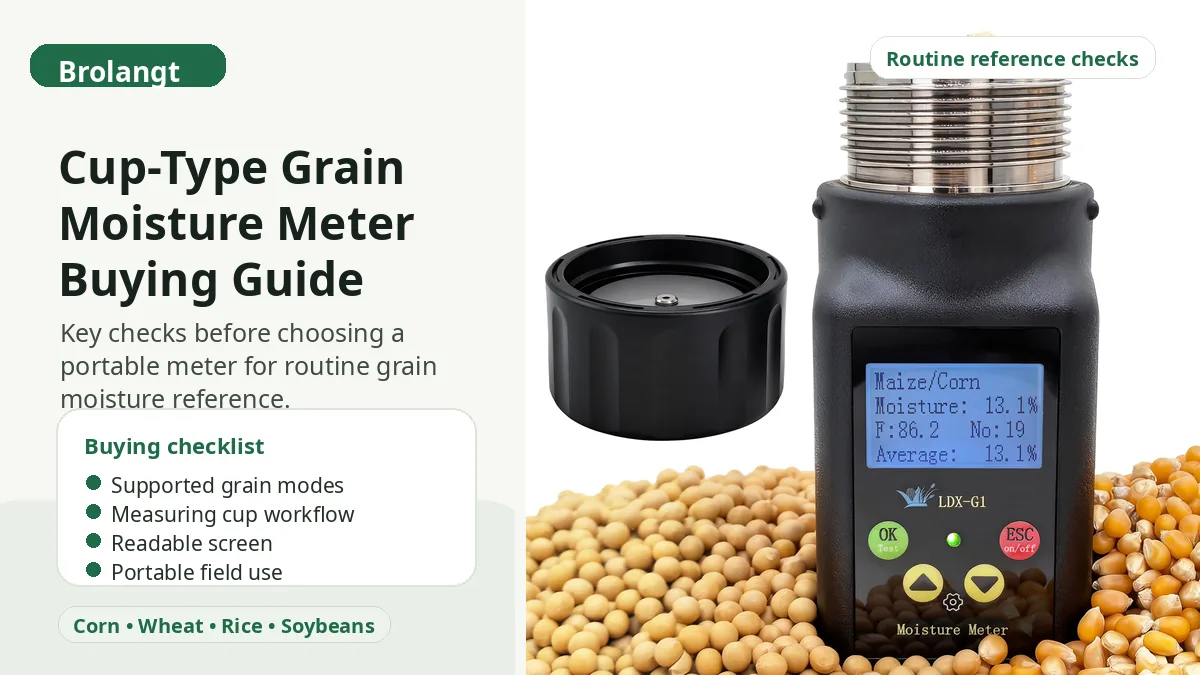
The Brolangt Grain Moisture Meter is designed for routine reference checks of whole grain samples such as corn, wheat, rice and soybeans.
Why the Measuring Chamber Matters
The measuring chamber is not just a container. It controls how the grain sample sits inside the meter during the check. A practical chamber should be easy to fill, easy to handle, and suitable for repeated daily use.
When reviewing a grain moisture tester with measuring cup, look at three practical points.
First, the cup should be straightforward to use. If the daily process feels slow or confusing, users may skip checks when they are busy. A simple cup workflow makes it easier to check moisture at multiple points during drying, storage or receiving.
Second, the chamber should match whole grain use. The product should be intended for grain kernels placed into the cup, not for ground material unless the manual specifically says so. For a portable cup-type grain moisture meter, whole grain sample handling is one of the main reasons users choose this style.
Third, the cup and cap should feel suitable for field handling. A meter may be used near a dryer, in a storage area, beside a truck, or at a receiving desk. The measuring cup should not make the tool difficult to carry or operate in those settings.
What a Practical Daily Workflow Should Look Like
For routine use, the best workflow is simple enough to repeat without hesitation. A cup-type meter should help the user move from sample to result in a clear sequence.
A typical process looks like this:
1. Take a representative whole grain sample from the batch. 2. Put the sample into the top measuring chamber according to the product manual. 3. Select the matching grain mode, such as corn, wheat, rice or soybean. 4. Start the check and read the moisture reference value on the display. 5. Record or compare the result as part of routine farm, drying, storage or receiving decisions.
This kind of workflow is useful because grain moisture is not checked only once. A user may check before drying, during drying, before storage, or when grain arrives at a receiving point. For more timing examples, see when to check grain moisture.
A feature that looks impressive in a product photo is less valuable if the actual process is slow, hard to read or difficult to repeat.
Features That Matter More Than Marketing Claims
A useful cup-type grain moisture meter should be judged by practical features. The table below is a quick checklist for comparing options without getting distracted by unclear claims.
| Feature to Check | Why It Matters | Practical Buying Question |
|---|---|---|
| Supported grains | Different grains need matching modes | Does it cover corn, wheat, rice or soybeans? |
| Measuring chamber | Holds the sample during routine checks | Is the cup easy to fill and handle? |
| Display | Affects daily usability | Can users read values clearly? |
| Portability | Useful across farm and storage areas | Can it be carried where checks happen? |
| Workflow | Reduces hesitation for routine use | Is the process simple enough for daily checks? |
Display readability deserves special attention. In real use, a meter may be checked under warehouse lighting, near equipment, or during a busy receiving process. A clear screen helps users read the grain mode and moisture value without slowing down the task.
Portability also matters. A fixed or bulky setup may be acceptable in one location, but many grain users need to move between fields, bins, dryers, trucks and storage areas. A handheld cup-type design is useful when moisture reference checks happen in more than one place.
Cup-Type vs Probe-Type: When This Style Makes Sense
A cup-type meter makes sense when you want to check a sample that you can place into a measuring chamber. It is a good fit for routine checks of common whole grains, especially when you want a portable tool and a consistent small-sample workflow.
A probe-type meter may make sense in other situations where insertion into bulk material is the intended method. If you are still comparing both styles, read our detailed article on cup-type vs probe-type grain moisture meters.
For users focused on corn, wheat, rice and soybeans, the cup-type format is often easier to understand. The grain sample goes into the cup. The user selects the matching mode. The display gives a moisture reference value. That direct workflow is one reason this style is popular for daily farm and storage checks.
Buying Checklist Before You Choose
Use this checklist before placing an order.
Confirm the grain modes first. If your main grain is corn, do not assume every meter supports it clearly. If you also check wheat, rice or soybeans, confirm those modes as well. For corn-specific use, our corn moisture meter guide explains the buying context in more detail.
Check that the product is truly cup-type. The product photo and description should show a top measuring cup or chamber. If you are looking for a grain moisture meter with measuring chamber, do not choose a probe-style product by mistake.
Review the sample handling process. The product should support whole grain samples and should not require grinding for the routine use case described here. The manual should explain how to place the sample and operate the meter.
Look at the screen and controls. Daily users need to select grain modes and read moisture values quickly. A clear display and simple buttons are more important than a complicated menu that few people will use.
Match the meter to your work location. Farm users may care most about portability. Storage users may care about repeated batch checks. Receiving points may care about fast operation during incoming grain handling. The right meter should fit the place where checks actually happen.
FAQ
Is a cup-type grain moisture meter suitable for corn?
Yes, if the meter supports corn or maize mode. Corn is one of the common grains checked with a cup-type moisture meter. Users should follow the product manual for sample placement and operation.
Can it be used for wheat, rice and soybeans?
It can be suitable when the meter includes matching modes for those grains. Always confirm the supported grain list before buying, because different products may cover different grain types.
Is a cup-type meter better than a probe-type meter?
It depends on the use case. A cup-type meter is useful when you want to place a whole grain sample into a measuring chamber for routine checks. A probe-type meter is a different style and may fit other sampling situations. Choose based on how and where you check grain.
Does a cup-type meter grind the grain?
No. The type discussed in this guide is used with whole grain samples placed into the measuring cup or chamber. Users should follow the product manual for the correct sample method.
Is it suitable for official grain inspection?
No. A cup-type grain moisture meter is for routine reference checks. Where official testing is needed, users should follow applicable local requirements and required procedures.
Final Recommendation
Choose a cup-type grain moisture meter for the work you actually do every day. The most important features are supported grain modes, a practical measuring chamber, simple whole grain sample handling, a readable display, and portability for farm, drying, storage and receiving checks.
If your main need is routine moisture reference checking for corn, wheat, rice, soybeans and similar whole grain samples, the Brolangt Grain Moisture Meter is a practical product to review. It follows the cup-type format, uses a top sample cup, and is designed for daily grain moisture reference checks without unnecessary complexity.