
# Why Grain Moisture Matters Before Storage
Checking grain moisture before storage helps users understand the condition of each batch before it enters a bin, warehouse, or storage area. A portable grain moisture meter does not replace official testing, but it can support routine reference checks for farm, receiving, drying, and storage decisions.
The point is not to chase a single perfect number. The practical value is to compare batches, spot changes after handling, and decide which stored lots deserve closer observation. Storage expectations vary by grain type, storage time, climate, ventilation, handling method, and local practice.
Storage Starts Before the Grain Enters the Bin
Grain storage work often begins too late. Many condition changes are noticed only after grain has already been placed in a bin or warehouse stack. By then, lots may already be mixed, the source of the issue may be unclear, and the user may have fewer options for separating or handling different batches.
A moisture check before storage gives users a reference point before the grain disappears into a larger storage system. It helps answer practical questions: Is this lot similar to yesterday’s lot? Is one field different from another? Did the latest truck arrive in the same condition as the earlier truck?
This is why many farms, warehouses, and receiving points build moisture checking into the intake process: take a representative whole grain sample, select the grain mode, load the measuring chamber, and record the value with lot information. For a broader timing view, see when to check grain moisture.
Why Different Batches Should Not Be Treated as Identical
Stored grain is rarely as uniform as it looks from a distance. Two loads may look similar but come from different fields, harvest times, drying stages, or transport conditions. Even within the same crop, grain can vary because of weather exposure, handling delay, or time spent in temporary holding.
This matters because storage decisions are usually made by lot, not by appearance alone. If several incoming loads are mixed without any reference check, the user loses visibility. Later condition changes may be harder to trace.
Routine checks help users separate “same-looking” grain into practical management groups. A warehouse may record each truckload, while a farm may record each field or drying batch. The principle is the same: do not assume that all grain entering the same storage area has the same condition.
This logic applies to corn, wheat, rice, soybeans, and other common whole grains. For crop-specific examples, see the articles on corn moisture meter use and wheat and rice moisture checks.
Moisture and Grain Condition: A Practical Relationship
Moisture is not the only factor in grain condition, but it is one of the most practical signals to observe before storage. Temperature, airflow, grain cleanliness, broken kernels, storage time, pest pressure, and local climate can all affect storage outcomes. A moisture reference does not predict the future by itself, and no portable meter can guarantee storage results.
What a routine moisture check can do is help users notice when a batch may deserve more attention. A lot that differs from the normal range for that operation may be handled differently from a lot that matches recent records. A warehouse may also use recorded checks to decide which lots should be watched more closely early in storage.
This is a practical risk-awareness tool, not a promise. Users still need proper storage practice, good sampling habits, and local judgment. Moisture readings should be viewed together with the condition of the grain, the storage environment, and the user’s operating requirements.
Why Batch Sampling Matters
The value of a moisture check depends heavily on the sample. A single handful from the top of a bag or truck may not represent the full lot. Grain can separate during loading, sit unevenly during transport, or vary between the top, middle, and bottom of a container. For storage decisions, users should think in terms of batch sampling, not one-point checking.
A practical routine is to take small portions from different parts of the lot, combine them into a working sample, and test a clean whole grain sample from that mix. The purpose is to make the tested sample closer to the real condition of the batch.
Batch sampling also supports record keeping. Users can record the grain type, lot, source, drying stage, date, and storage location, which helps later when a lot is moved, sold, processed, or checked again. For intake situations, see grain moisture checking for buying and receiving.
Why Routine Checks During Storage Still Matter
A pre-storage check is important, but it should not be the only reference point. Grain condition can change during storage because the environment around the grain changes. Weather, ventilation, storage time, handling, and movement between locations may all affect the condition of a stored lot.
Routine storage checks give users additional reference points after grain has entered the storage system. A warehouse may check lots at planned intervals, before movement, or before preparing grain for sale or processing. A farm may check after changing weather or before loading grain out of a bin.
The purpose is observation. If a stored lot shows a noticeable change compared with earlier records, the user can decide whether to inspect the lot more closely, review the storage environment, or separate it from other grain before movement.
| Storage Stage | What Users Are Checking | Practical Value |
|---|---|---|
| Before storage | Incoming batch condition | Helps compare lots |
| After drying | Moisture reference after processing | Supports handling decisions |
| During storage | Changes over time | Supports observation |
| Before transport | Batch condition before movement | Adds a reference point |
| Before sale or use | Current sample condition | Helps users prepare records |
How a Cup-Type Meter Fits Storage Workflows
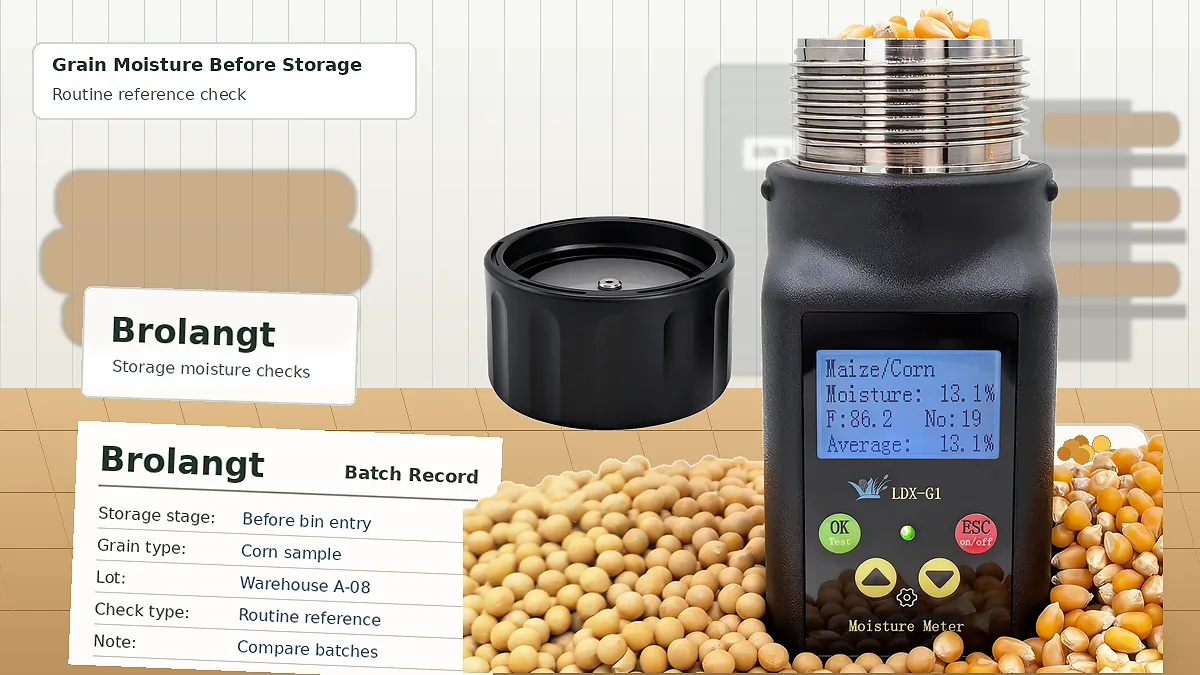
A portable cup-type grain moisture meter is useful when users need quick routine reference checks close to the work area. The Brolangt Grain Moisture Meter uses a top metal threaded sample cup, also called a measuring chamber. Users place a whole grain sample into the chamber, select the grain mode, and read a moisture reference value.
This format fits common storage workflows because the meter can be used near receiving points, drying areas, warehouse tables, small grain lots, and farm storage areas. That is helpful when grain is moving between locations.
The cup-type structure is also easy to understand for teams that need a consistent daily habit: prepare the sample, fill the chamber, run the test, and record the result with the lot information. For customers comparing meter types, the guide on portable grain moisture meter selection explains what to consider before buying.
A Simple Storage Moisture Check Routine
A useful routine should be simple enough that staff can repeat it without confusion. One practical workflow is:
1. Identify the batch before it is stored, moved, or mixed. 2. Take sample portions from more than one point when possible. 3. Mix the portions into a working sample. 4. Use clean whole grain in the measuring chamber. 5. Select the matching grain mode on the meter. 6. Record the value with the date, lot, grain type, source, and storage location. 7. Repeat checks when the lot is moved, reviewed, or prepared for later use.
The record does not need to be complex. A notebook, printed form, spreadsheet, or warehouse receiving sheet can work. The key is consistency. A moisture value without a lot name or date is much less useful.
What to Consider Before Choosing a Storage Moisture Meter
For storage use, buyers should look for a meter that fits their real workflow rather than only comparing product claims. The first question is grain type. A meter should support the grains the user actually handles, such as corn, wheat, rice, soybeans, or other common whole grain samples.
The second question is portability. If checking happens at the bin, receiving area, drying area, or warehouse table, a portable meter may be more practical. The third question is operation: staff should understand the sample cup, grain mode selection, screen reading, and record process.
Storage teams usually need repeatable daily habits: compare lots, record incoming condition, observe stored grain, and add a reference point before movement. For these needs, a portable cup-type meter can be a practical tool. To review the Brolangt model, visit the Brolangt Grain Moisture Meter product page.
FAQ
Why should grain moisture be checked before storage?
Grain moisture should be checked before storage because it gives users a reference point for each incoming batch before the grain is placed into a bin, warehouse, or storage area. This helps users compare lots, record condition, and decide which batches may need closer observation.
Does a portable meter guarantee safe storage?
No. A portable meter does not guarantee safe storage. Storage results depend on grain type, storage time, local climate, airflow, handling, grain condition, and storage practice. A portable meter supports routine reference checks, but it cannot promise storage outcomes.
Should different batches be checked separately?
Yes. Different fields, lots, drying stages, suppliers, and transport conditions can create different grain conditions. Checking batches separately helps users avoid treating all incoming grain as identical and creates better records for later storage observation.
Can a cup-type meter be used in a warehouse?
Yes. A cup-type meter can be used for routine reference checks in a warehouse, receiving area, drying area, or farm storage setting. Users should test suitable whole grain samples and record results together with batch information.
Is this a replacement for official testing?
No. It is for routine reference only. A portable grain moisture meter should not be presented as a replacement for official testing, laboratory testing, legal inspection, or trade settlement requirements.
Final Recommendation
Grain moisture before storage is worth checking because it helps users build a clearer picture of each batch before it enters the storage system. The most useful habit is not a single check in isolation. It is a simple routine: sample by batch, record the result, compare lots, and repeat checks when the grain is stored, moved, or prepared for later use.
A portable cup-type meter fits this work because it can be used close to the real storage process. For farms, warehouses, receiving points, and small grain handling operations, the Brolangt Grain Moisture Meter can support routine moisture reference checks for common whole grain samples such as corn, wheat, rice, and soybeans.