
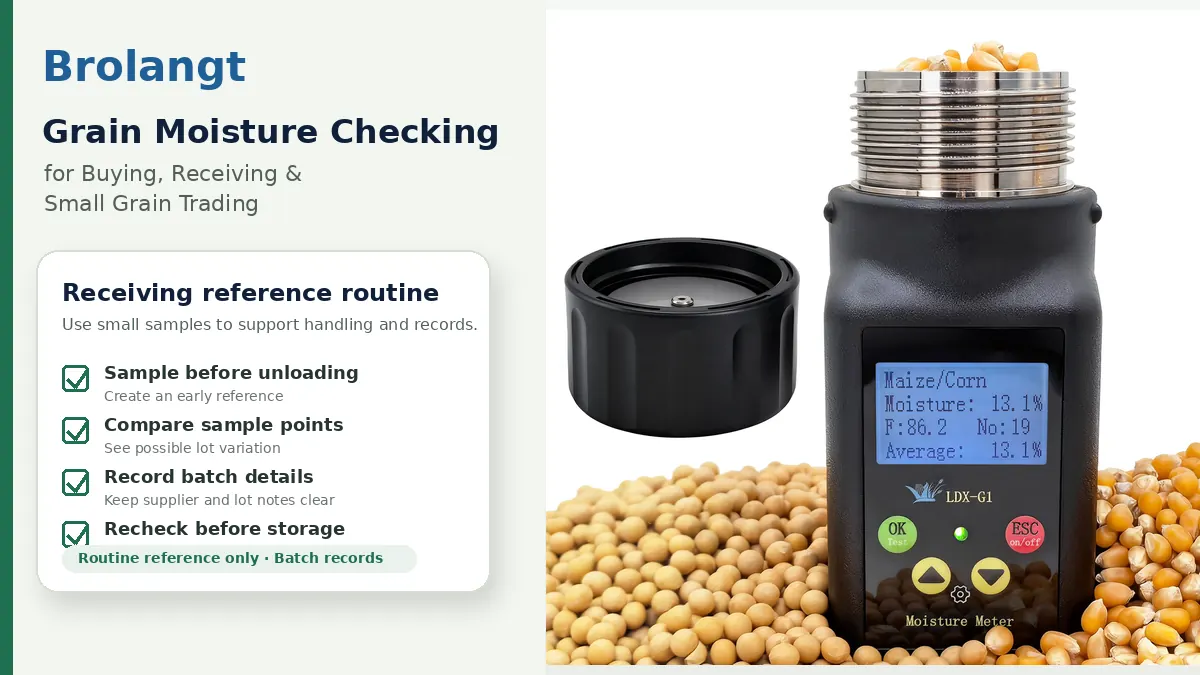
# Grain Moisture Checking for Buying, Receiving and Small Grain Trading
For grain buyers and receiving teams, moisture checking is useful because incoming lots can vary. A portable grain moisture meter gives a routine reference point for small samples before handling, storage or further review, but it should not be treated as a legal settlement tool.
In buying and receiving work, grain often moves quickly from truck, bag or container into storage or another handling step. Grain moisture testing for grain buying should not rely on one rushed look at the grain surface. A better routine is simple: identify the lot, take a reasonable sample, check it consistently, record the value, and use that reference before deciding the next handling or documentation step.
This guide is for grain buying points, warehouse receiving staff, small traders, farm buyers and small processing or storage users working with whole grain samples such as corn, wheat, rice and soybeans.
Why Moisture Reference Matters at Receiving
Moisture affects how incoming grain should be handled after arrival. Grain that looks normal may still need attention before storage, especially if it has been exposed to humid air, uneven drying, rain, transport time or temporary outdoor holding. A routine grain receiving moisture check gives the receiving team a practical reference before the lot is unloaded, mixed or moved.
It helps in three ways. First, it creates an early record while the lot is still identifiable. Second, it improves communication because a note with grain type, supplier, sample point and reference value is clearer than “looks dry.” Third, it supports handling decisions such as normal holding, separation, drying, faster movement or further review.
For broader timing guidance, see when to check grain moisture.
Incoming Grain Is Not Always Uniform
A common receiving mistake is treating one handful as the whole lot. Incoming grain may come from several field areas, farmers, drying periods or storage conditions. The top of a truck can differ from the deeper grain. One bag in a stack may not match another bag. Corn, wheat, rice and soybeans can also respond differently to harvest timing and temporary holding.
This does not mean every small purchase needs a complicated process. It means the receiving team should avoid blind sampling. If the lot is large, mixed, visually uneven or important for storage, checking more than one sample point gives a more useful routine reference than checking only the easiest sample.
A Practical Sampling Mindset for Small Buyers
The quality of a moisture reference depends heavily on the sample. The key question is not only “What value appears on the meter?” It is also “Did the sample reasonably represent the incoming lot?”
For bagged grain, do not always take only from the top bag. Compare samples from different bags or different sections of the stack when practical. For loose grain, take small samples from accessible points such as top, side and middle areas where safe. If the lot looks uneven, keep sample points separate first instead of mixing everything immediately.
A simple small-buyer routine can include:
- Identify the lot by supplier, vehicle, bag group, container or batch number.
- Take samples from more than one point when the lot size or condition justifies it.
- Check each point or a representative mixed sample, depending on the situation.
- Record where the sample came from, not only the moisture reference value.
- Repeat the same method across suppliers and receiving days.
This habit is useful for small traders who collect grain from several sources. It helps show whether lots are similar enough to handle together or whether one group should remain separate.
Small Sample Checks Before Unloading or Handling
One useful moment for grain moisture before purchase or receiving is before unloading begins. At that point, the supplier, vehicle, bag stack or delivery note can still be linked to the sample record.
A pre-unloading check should be fast and simple. Take a small whole grain sample, run a routine reference check, and write down the result with the lot details. If the value is clearly different from expectations, the team can compare another sample point, keep the lot separate or request further review before it is mixed with other grain.
This is not about turning one portable meter reading into a final buying decision. It is about avoiding unclear receiving work and creating a basic record before the lot changes location.
How a Cup-Type Meter Fits Receiving Work
A cup-type grain moisture meter fits receiving work because the operator places a small whole grain sample into the measuring cup. This makes the workflow practical at a buying desk, farm office, warehouse table or mobile receiving point.
For daily receiving, the process is direct: take the sample, place it into the cup, run the check, record the routine reference value, and compare it with other sample points or earlier batches. The equipment can stay close to the receiving area, so staff do not need to stop routine checks for a more complex process.
The Brolangt Grain Moisture Meter is designed for routine reference checking of whole grain samples, including common crops such as corn, wheat, rice and soybeans. If you are comparing meter formats, the guide on sample cup grain moisture testers explains why cup-type checking is convenient for small samples.
What to Record During Routine Checks
The record is as important as the number. A moisture reference value without context is easy to misunderstand later. A good receiving note can be simple, but it should be consistent.
Useful fields include date and time, supplier, grain type, lot or vehicle reference, sample point, moisture reference value and the next handling note. The record can be kept on a clipboard, spreadsheet or receiving log. The main point is to keep the habit repeatable.
| Receiving Step | What to Check | Why It Helps |
|---|---|---|
| Before unloading | Sample from the incoming lot | Creates an early reference |
| During receiving | Compare different sample points | Shows lot variation |
| Batch record | Note grain type and reference value | Helps organize records |
| Before storage | Check a representative sample | Supports handling decisions |
| Before resale or use | Recheck current condition | Adds a current reference |
Common Buying and Receiving Scenarios
For a local buying point, several small suppliers may arrive during the same period. Keep each supplier or delivery group separate in the record, even if the grain type is the same.
For a warehouse receiving team, grain may move quickly from unloading to temporary storage. A routine reference check before movement helps connect the incoming lot with the later storage location. For storage-focused handling, read why grain moisture matters before storage.
For a small trader, grain may be bought from one source and later resold, processed or moved again. A receiving record creates a basic history of the lot. If the grain is held for several days or exposed to changing conditions, a later recheck gives a current reference before resale or use.
For corn buyers, moisture can vary by harvest timing, drying condition and temporary holding. A dedicated corn moisture meter guide can help with corn-specific checking scenarios.
What to Look for in a Portable Meter for Buyers
A portable grain moisture meter for buyers should fit the actual receiving workflow. Useful features include a portable body, cup-style checking for small whole grain samples, support for the grain types used in your business, a readable display, and a process that staff can repeat without slowing receiving work.
The best choice is not only about specifications. It is about whether your team can use the meter consistently during busy receiving days. For a broader selection framework, see the portable grain moisture meter buying guide and the guide on how to choose a grain moisture meter for corn, wheat and rice.
How to Build a Simple Receiving Check Routine
A good receiving routine should be short enough that staff will actually follow it:
1. Label the lot before checking. 2. Take a reasonable whole grain sample. 3. Compare more than one sample point when the lot is mixed, large or uneven. 4. Run the check with the same basic method each time. 5. Record the result immediately. 6. Connect the reference value with the next handling step.
The result may support normal handling, separation, drying, faster movement or further review. The meter provides a routine reference point before users make further handling or documentation decisions.
FAQ
Why check grain moisture before buying?
Checking grain moisture before buying gives buyers and receiving teams an early routine reference for the incoming lot. It helps them understand whether the grain may need normal handling, separation, drying, storage attention or further review before it is mixed with other grain.
Can a portable meter decide the final buying price?
No. A portable grain moisture meter should not decide the final buying price on its own. It is best used as a routine reference point that supports receiving records, sample comparison and handling discussions.
Why take samples from more than one point?
Incoming grain is not always uniform. Different bags, truck areas, field sections or storage histories can create variation. Multi-point sampling helps the receiving team see whether the lot is consistent or whether one part deserves closer attention.
Is a cup-type meter suitable for receiving checks?
Yes. A cup-type meter is practical for small whole grain sample checks at a buying desk, warehouse table or farm receiving point. It fits routine checks for crops such as corn, wheat, rice and soybeans.
Can this replace third-party or official testing?
No. It should be treated as routine reference only. For requirements beyond daily receiving, users should follow the review process required by their buyer, customer, contract or local rules.
Final Recommendation
For buying, receiving and small grain trading, moisture checking works best as a simple, repeatable habit. Identify the lot, take a reasonable sample, compare points when needed, record the reference value, and connect the result with the next handling decision.
The Brolangt Grain Moisture Meter is a practical option for routine whole grain moisture reference checks in receiving and small batch work. It is especially useful for buyers who want a portable cup-type workflow for corn, wheat, rice, soybeans and similar whole grain samples.