
# Wheat and Rice Moisture Meter Guide for Farm and Storage Use
Wheat and rice moisture meters are useful for routine reference checks when users need to monitor grain condition during harvest, receiving, storage or processing preparation. A portable cup-type meter is especially practical when users want to test small whole-grain samples without grinding.
For farmers, grain buyers, warehouse operators and small processors, moisture checking is not only a technical task. It is a daily decision tool. Wheat, rice and paddy rice can look acceptable from the outside while still requiring closer attention before storage, transfer or processing. A portable grain moisture tester gives users a practical way to compare samples, organize lots and make better handling decisions.
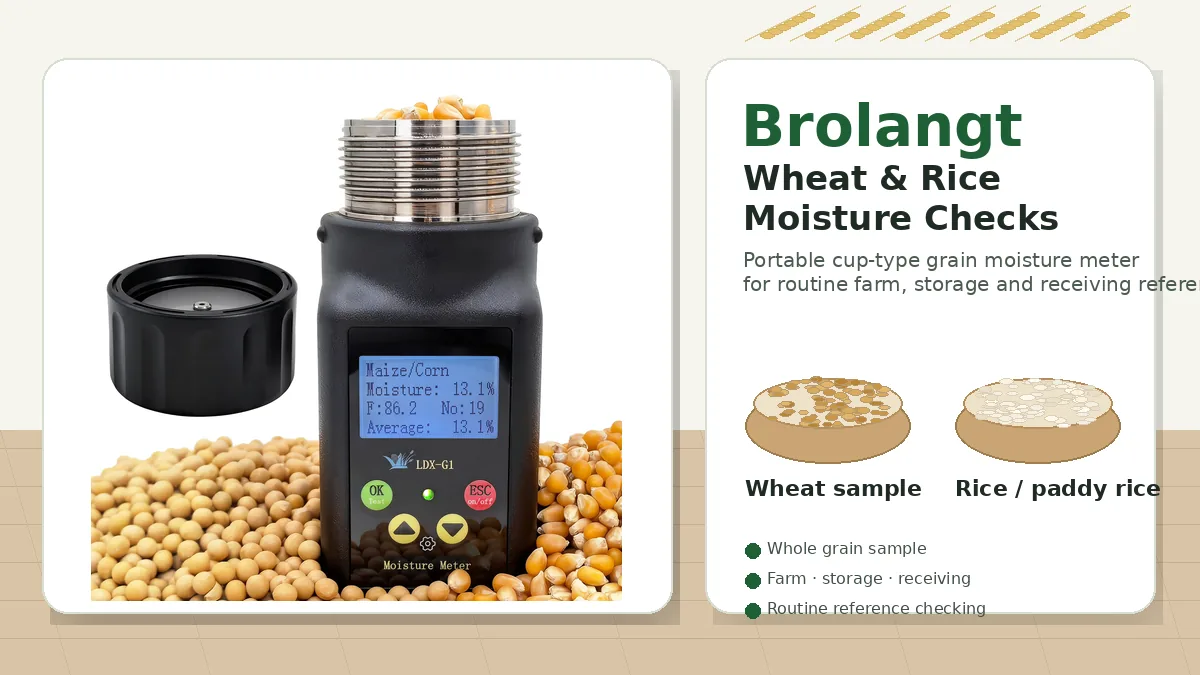
The Brolangt Grain Moisture Meter is a portable cup-type grain moisture meter for routine moisture checking of corn, wheat, rice, soybeans and other grains. This guide focuses on wheat and rice use because these crops are often checked at multiple points: after harvest, before storage, during receiving and before processing.
Why Wheat and Rice Moisture Checks Matter
Wheat and rice are handled in large volumes, but many important decisions start with small samples. A farmer may check several field areas before deciding whether to continue harvesting. A receiving point may screen incoming grain before unloading. A warehouse may compare stored samples from different areas. A small trader may record several lots before arranging delivery.
In these situations, the goal is usually not to produce an official laboratory report. The goal is to get a practical moisture reference quickly enough to support daily work. That is where a portable wheat moisture meter or rice moisture meter can be useful.
Moisture affects how grain behaves during handling. It can influence drying decisions, storage attention, lot separation and processing preparation. For wheat users, the concern is often whether different harvested batches are similar enough to group together. For rice and paddy rice users, the concern is often whether incoming or stored grain should be separated, dried further, moved, or prepared for the next process.
A routine meter helps users build a clearer picture instead of relying only on appearance, touch or experience.
Wheat Moisture Checks in Farm and Storage Work
Wheat moisture checking is common around harvest timing, field transfer, storage preparation and warehouse monitoring. A portable wheat moisture tester is useful because wheat lots are often sampled repeatedly across the same working day.
During harvest
At harvest, wheat conditions can change by field location, weather, time of day and batch handling. One side of a field may differ from another. Grain harvested in the morning may not match grain harvested later. A portable meter allows the user to take small whole-grain samples and compare them before making practical decisions.
The important point is consistency. Users should test similar sample sizes, select the wheat mode, and keep records in a simple way. Even a basic notebook or receiving sheet can help users see which lots are similar and which need separate attention.
For a broader timing view, see our guide on when to check grain moisture.
Before storage
Before wheat goes into storage, users usually want a better understanding of batch condition. This is especially useful when grain comes from different fields, different harvest times or different suppliers. A portable grain moisture meter can support this by giving a quick reference for each sample.
This does not replace storage management. Ventilation, grain temperature, bin condition, cleaning level and local practice still matter. But moisture reference data gives users another point of information before grain is placed into a bin, bag, warehouse section or temporary storage area.
You can also read our storage-focused article: why grain moisture matters before storage.
During storage checks
Stored wheat may be checked again over time, especially when grain is moved, inspected, sold or prepared for use. A handheld cup-type meter is convenient because the operator can collect a sample from the lot, fill the sample cup and get a reference reading without setting up large equipment.
For routine warehouse work, the value is repeatability of the process: sample from comparable points, avoid mixing unknown lots, record the result and compare with earlier records.
Rice and Paddy Rice Moisture Checks: What Users Usually Need
Rice moisture checking has a slightly different context because users may deal with paddy rice, brown rice, milled rice or other rice forms depending on the operation. For this article, the main focus is routine reference checking for rice and paddy rice in farm, receiving, storage and preparation scenarios.
Paddy rice receiving
Paddy rice is often checked when it arrives at a receiving point or storage location. The receiving user may need to screen multiple incoming samples quickly. A moisture meter for paddy rice helps create a reference for each delivery or lot before further handling decisions are made.
This is especially useful when grain comes from different farms or arrives at different times. A rice moisture tester can help the receiving team separate lots, organize records and decide which samples need closer attention.
For buying and receiving workflows, see grain moisture checking for buying and receiving.
Rice storage and preparation
Rice users may also check samples before storage, before movement, or before processing preparation. The point is not to make the meter responsible for the whole storage decision. The point is to add a practical sample reference that can be combined with visual inspection, handling experience and local process requirements.
Paddy rice and finished rice are not the same material in handling terms. The outer husk, processing stage and grain condition can affect how users organize their checks. A suitable grain moisture meter should support the grain type or mode the user needs. Before buying, users should check whether the meter includes the grain categories they work with.
Small processing users
Small processing users often need to decide whether a rice or wheat sample is ready for the next step in their workflow. A portable meter can help them compare incoming lots and prepare records. This is useful when the operation does not require a fixed testing station for every routine check.
The main advantage is speed and portability. The user can check representative whole-grain samples near the work area instead of sending every routine sample away.
Where Routine Checks Fit: Harvest, Receiving, Storage and Processing
A portable grain moisture tester for wheat and rice is most useful when the same user needs repeated reference checks in practical locations. The following table summarizes common use cases.
| Grain Scenario | Typical User Need | How a Portable Meter Helps |
|---|---|---|
| Wheat harvest | Check batch condition | Supports routine field reference |
| Wheat storage | Compare stored samples | Helps monitor condition |
| Paddy rice receiving | Screen incoming samples | Adds a receiving reference |
| Rice processing prep | Check sample condition | Supports preparation decisions |
| Small trading | Compare lots | Helps organize records |
For small trading, the meter can also help keep lot records more organized. A buyer or seller may test several bags, samples or deliveries and write down the date, grain type, sample source and reading. This is not a legal settlement method, but it can make communication clearer and reduce purely subjective discussions.
For storage users, routine checks should be part of a wider grain handling routine. Moisture reference is one point. Storage condition, airflow, temperature, cleanliness, pest control and regular inspection still need attention.
Why Cup-Type Testing Works for Small Samples
A cup-type grain moisture meter uses a sample cup or measuring chamber. The user pours a whole-grain sample into the top metal threaded cup, selects the corresponding grain mode and reads the moisture reference value. This type of design is practical for wheat, rice, paddy rice, corn, soybeans and other grain samples when the user wants a compact field or warehouse tool.
A cup-type meter is different from a probe-style tool. A probe is often inserted into bulk material, while a cup-type meter measures a prepared sample in the chamber. If you are comparing types, read our guide on cup-type vs probe-type grain moisture meters.
For wheat and rice users, cup-type testing has several practical advantages:
- It works with small whole-grain samples.
- It is easy to use near harvest, receiving or storage areas.
- It supports repeat checks from different lots.
- It helps users keep simple records.
- It is portable enough for farm and warehouse movement.
The user still needs to collect the sample carefully. A small sample should represent the lot as well as possible. If the sample only comes from one visible surface layer, it may not reflect the wider batch. Good sampling habits make the reading more useful.
For more detail on this testing style, see what is a sample cup grain moisture tester.
Choosing a Portable Meter for Wheat and Rice
When choosing a wheat moisture meter or rice moisture meter, do not look only at the product name. Look at how it fits your actual workflow.
Grain modes
The meter should support the grain types you need. If you work with wheat, rice and paddy rice, check whether the available modes match your routine samples. If your work also includes corn, soybean or other grains, a broader grain moisture meter may be more practical than a single-crop tool.
Our general selection guide, how to choose a grain moisture meter for corn, wheat and rice, covers this from a wider buying perspective.
Sample handling
A cup-type meter is usually suitable when you prefer to test small whole-grain samples. This is useful for receiving desks, farm checks, storage checks and small trading records. Before buying, consider whether your operator can collect, pour and repeat samples easily in the real work area.
Portability
For farm and warehouse work, portability matters. A meter that is easy to move can be used where the grain is handled, not only in one fixed place. This is helpful when checking several fields, storage sections or incoming deliveries.
Clear operation
The operator should be able to choose the grain mode, fill the cup and read the result without a complicated process. A clear workflow reduces mistakes in daily use and makes it easier for different workers to follow the same routine.
Record keeping
The device itself is only part of the routine. Users should also decide how they will record samples. A simple form may include date, grain type, supplier or field, lot number, sample note and meter reading. This helps make the moisture check useful beyond the moment of testing.
For a cup-type buying angle, see cup-type grain moisture meter buying guide.
How This Fits Into a Broader Grain Moisture Routine
A portable grain moisture tester is most useful when it becomes part of a consistent routine. For wheat and rice users, that routine may include checks at harvest, checks before storage, checks when grain arrives, and checks before movement or processing.
The routine does not need to be complex. In many cases, users can start with a few basic habits:
- Use the correct grain mode for the sample.
- Test whole-grain samples of a consistent size.
- Keep sample sources clearly identified.
- Compare lots under similar working conditions.
- Record readings with date and sample notes.
- Use the result as a routine reference, not as an official inspection result.
This type of routine helps users make better practical decisions. It also helps teams communicate. Instead of saying that a sample “feels dry” or “looks different,” the team can record a reference value and compare it with other samples from the same period.
The Brolangt cup-type meter is positioned for this kind of daily use: portable, direct and suitable for multiple grain types. It is not presented as a replacement for official inspection or laboratory testing. Its role is routine reference checking for users who need quick sample information in farm, storage and receiving environments.
FAQ
Can one meter be used for both wheat and rice?
Yes, if the meter supports both wheat and rice modes. Many users prefer a multi-grain meter because their work may include wheat, rice, paddy rice, corn, soybean or other grains. Always check the supported grain list before buying.
Is paddy rice the same as finished rice for moisture checking?
No. Paddy rice and finished rice are handled differently. Paddy rice still has the husk, while finished rice has been processed further. Users should choose the grain mode that matches their actual sample type.
Does a cup-type meter require grinding?
For the Brolangt portable cup-type grain moisture meter, the user pours a whole-grain sample into the top sample cup or measuring chamber. It is designed for routine whole-grain sample reference checks, not a grinding workflow.
Can this replace official grain testing?
No. It is for routine reference only. It should not be used as a replacement for official inspection, laboratory testing, legal trade settlement or any required standard testing process.
What should wheat and rice users check before buying?
Check the supported grain modes, sample cup design, portability, operation steps and whether the meter fits your real work scenario. A farmer, warehouse operator, receiving point and small trader may all use moisture reference data differently.
Final Recommendation
If you handle wheat, rice or paddy rice and need quick routine reference checks during harvest, storage, receiving or processing preparation, a portable cup-type grain moisture meter can be a practical tool. It is most useful when you need to test small whole-grain samples, compare lots and keep simple records.
Choose a meter based on your grain types and workflow, not only on the keyword in the product name. For users who need one device for several common crops, the Brolangt Grain Moisture Meter is designed as a portable cup-type option for routine moisture checking of corn, wheat, rice, soybeans and other grains.